盆栽
bonsaiThe Japanese art of cultivating miniature trees in shallow containers, shaped through pruning, wiring, and careful care to evoke the beauty of full-sized trees in nature.
Meaning
盆栽 (ぼんさい, bonsai) is the Japanese art of cultivating and shaping miniature trees in small containers. The word combines two kanji: 盆 (bon), meaning tray or shallow basin, and 栽 (sai), meaning planting or cultivation. Together they describe the essence of the art form — a living 木 (き, tree) grown in a 鉢 (はち, pot or bowl), shaped to reflect the majesty of nature at miniature scale.
A bonsai is not simply a small tree. It is a carefully composed living sculpture, refined over years or even centuries, intended to evoke the feeling of a gnarled ancient tree in a mountain forest, a wind-swept cliff, or a riverside bank — all within the space of a single shallow container.
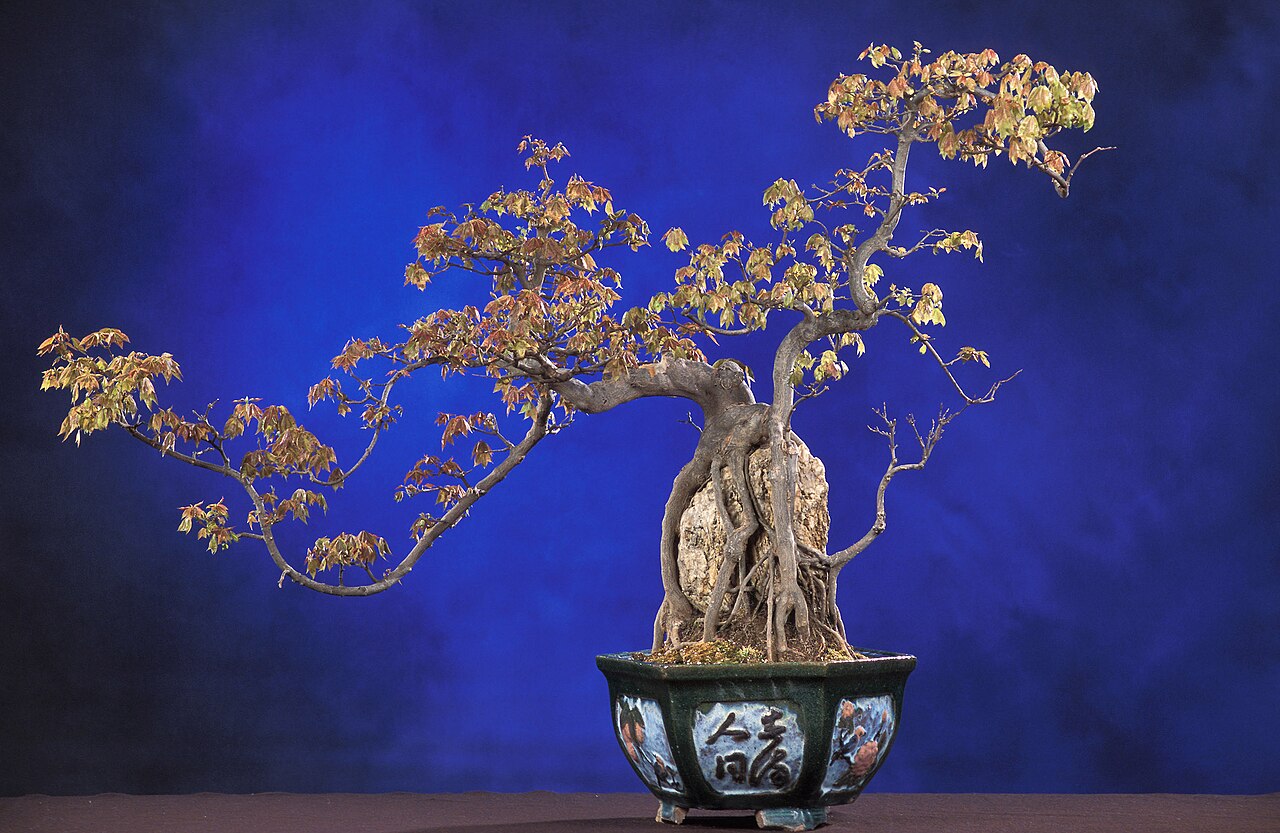
A Trident Maple (三叉楓) bonsai. Public domain, via Wikimedia Commons. Photo: Peggy Greb, USDA.
History
The origins of bonsai lie not in Japan but in China, where the art form was known as penjing (盆景, literally "tray scenery" or "tray landscape") or penzai. Chinese artists cultivated miniature landscapes in containers as far back as the Han dynasty (206 BCE – 220 CE), and by the Tang dynasty (618–907 CE) the practice was well established among the aristocracy and Buddhist monks.
Japanese Buddhist monks and imperial envoys traveling to China during the 6th century brought back the practice, along with many other elements of Chinese culture and religion. The art was initially the preserve of monks and the imperial court. Early Japanese depictions of container trees appear in 13th-century scrolls, showing that miniature potted trees were considered refined gifts and symbols of status.
By the Kamakura period (1185–1333), the practice had spread among the samurai class. The influence of 禅 (ぜん, Zen Buddhism) was transformative: Zen aesthetics stripped away the elaborate landscape elements found in Chinese penjing, favoring simplicity, asymmetry, and the suggestion of nature rather than its literal reproduction. This philosophical shift helped define bonsai as a distinctly Japanese art.
During the Edo period (1603–1868), bonsai moved beyond the aristocracy and became popular among townspeople and merchants. Markets in Edo (present-day Tokyo) sold bonsai openly, and growers began publishing illustrated manuals on techniques and styles. The Meiji period (1868–1912) brought an international audience: bonsai were exhibited at the 1900 Paris World Exhibition, sparking fascination in Europe and the Americas.
After World War II, American servicemen stationed in Japan brought bonsai trees home, and the art spread rapidly through the West. Today, bonsai clubs, exhibitions, and dedicated nurseries exist on every continent.
Styles
Bonsai artists classify trees according to their trunk angle and overall 形 (かたち, shape). The five fundamental styles — codified during the Edo period — are recognized worldwide:
| Japanese Name | Romaji | Meaning | Description |
|---|---|---|---|
| 直幹 | chokkan | Formal upright | Straight vertical trunk, tapered top, branches decreasing in length upward |
| 模様木 | moyogi | Informal upright | Gently S-curved trunk, most common style, reflects natural growth |
| 斜幹 | shakan | Slanting | Trunk leans to one side, as if shaped by prevailing winds |
| 半懸崖 | han-kengai | Semi-cascade | Trunk dips below the rim of the pot but not below the base |
| 懸崖 | kengai | Full cascade | Trunk falls dramatically below the base of the pot, evoking cliff-side trees |
Beyond these five, dozens of additional styles have been recognized, including 文人木 (bunjin, literati style — spare, tall, and irregular), 双幹 (sokan, twin trunk), 寄せ植え (yose-ue, forest grouping), and 石付き (ishizuki, tree growing over or into rock).
How It's Done
Creating and maintaining a bonsai is a lifelong practice requiring skill, patience, and intimate knowledge of the tree's needs.
剪定 (せんてい, Pruning) is the most fundamental technique. Artists cut back 枝 (えだ, branches) and foliage to control size, direct growth, and create the desired silhouette. Structural pruning (removing major branches to define the tree's framework) and maintenance pruning (pinching new growth to refine the foliage) are both essential.
Wiring (針金かけ, harigane-kake) involves wrapping copper or aluminum wire around branches and the trunk to bend and position them. The wire is left on for months until the wood sets in the new position, then carefully removed to avoid scarring the bark. This technique, which replaced older methods using rope and burlap, became widespread in the early 20th century.
Repotting is performed every one to several years (depending on the tree's age and species). The 根 (ね, roots) are pruned to keep the root mass compact and healthy, and fresh 土 (つち, soil) — typically a well-draining mix of akadama clay, pumice, and lava rock — is added. Repotting also prevents the tree from becoming root-bound.
Watering and feeding require daily attention. Bonsai dry out quickly in their shallow pots, and the specific watering schedule depends on species, season, pot size, and climate. Liquid fertilizer is applied regularly during the growing season to compensate for the limited soil volume.
Cultural Significance
Bonsai is far more than horticulture — it is a philosophical and aesthetic practice deeply intertwined with Japanese values.
The art embodies 侘び寂び (wabi-sabi) — the Japanese aesthetic of finding beauty in imperfection, impermanence, and incompleteness. A bonsai is never truly "finished"; it is always becoming, always changing with the seasons, and always subject to the gardener's ongoing care. This process mirrors Buddhist teachings on impermanence (無常, mujo).
忍耐 (にんたい, patience) is considered one of the highest virtues the art cultivates. A master bonsai artist may spend decades shaping a single tree, and some famous bonsai have been tended by multiple generations of the same family. The Sandai Shogun no Matsu, a Japanese white pine bonsai at the Tokyo Imperial Palace, is estimated to be over 500 years old.
Bonsai also reflects the Japanese concept of 間 (ma, negative space) — the meaningful emptiness between elements — and the ideal of 自然 (しぜん, nature) as teacher and inspiration. The goal is not to force a tree into an arbitrary shape, but to reveal and enhance the natural character already within it.
As one classical saying in the bonsai world goes:
盆栽は自然の縮図である。 Bonsai wa shizen no shukuzu de aru. "Bonsai is a miniature of nature."
Bonsai occupies the same cultural tier as 芸術 (げいじゅつ, fine arts) — alongside the tea ceremony (茶道), flower arranging (生け花), and calligraphy — as one of the traditional Japanese arts most closely linked to Zen philosophy and refined taste.
Modern Bonsai
Today, bonsai is a global phenomenon. International competitions, most notably the World Bonsai Convention (世界盆栽大会, held every four years), draw participants from dozens of countries. Japan's 国風盆栽展 (Kokufu Bonsai Ten), held annually at the Tokyo Metropolitan Art Museum, is the most prestigious exhibition in the bonsai world, with some entries having wait-lists years long simply to be judged.
Digital communities have amplified interest: enthusiasts share progression photos, techniques, and workshop footage across social media and platforms like YouTube. The phrase "bonsai progression" — documenting a tree's development over years — has become a beloved genre of online content.
Modern practitioners have expanded the canon of acceptable species. While traditional Japanese bonsai favored pines (松, matsu), junipers (真柏, shimpaku), and maples (楓, kaede), contemporary artists work with olive trees, figs, azaleas, tropical species, and even fruit trees. This openness reflects the art's living, evolving 文化 (ぶんか, culture).
In Japan, 植木 (うえき) markets and dedicated bonsai nurseries remain vibrant, and the government has recognized bonsai as an important part of national heritage. The city of Omiya (now part of Saitama) is home to the Omiya Bonsai Village (大宮盆栽村), established in the 1920s after the Great Kanto Earthquake displaced Tokyo's bonsai masters, and now houses five major nurseries and the Omiya Bonsai Art Museum — the world's first public museum devoted entirely to bonsai.
Related Dictionary Words
bonsai; miniature potted plant
tree; shrub; bush
bowl; pot; basin
garden; yard; courtyard
pruning; trimming
garden plant; garden tree
branch; bough; limb; twig; sprig; spray
root (of a plant)
earth; soil; dirt; clay; mud
form; shape; figure
nature
dhyana (profound meditation)
art; the arts
culture; civilization; civilisation
wabi-sabi; aesthetic sense in Japanese art centered on the acceptance of transience and imperfection
endurance; perseverance; patience