おにぎり
onigiriA hand-formed rice ball wrapped in nori seaweed, filled with savory ingredients — Japan's most beloved portable food eaten daily from packed lunches to convenience stores.
Meaning
おにぎり (onigiri), also known as 握り飯 (nigirimeshi), is a portion of cooked Japanese 米 (rice) shaped by hand — most often into a triangle, ball, or cylinder — and typically wrapped in a sheet of 海苔 (nori, dried seaweed). The name comes from the verb 握る, meaning "to grip" or "to squeeze," which describes the act of pressing the rice firmly into shape.
At its simplest, onigiri is seasoned rice shaped with lightly salted hands. Most versions contain a 具 (filling) tucked into the center — a burst of flavor at the heart of an otherwise plain, comforting food. The result is a portable, self-contained meal that has nourished Japan for over a thousand years.
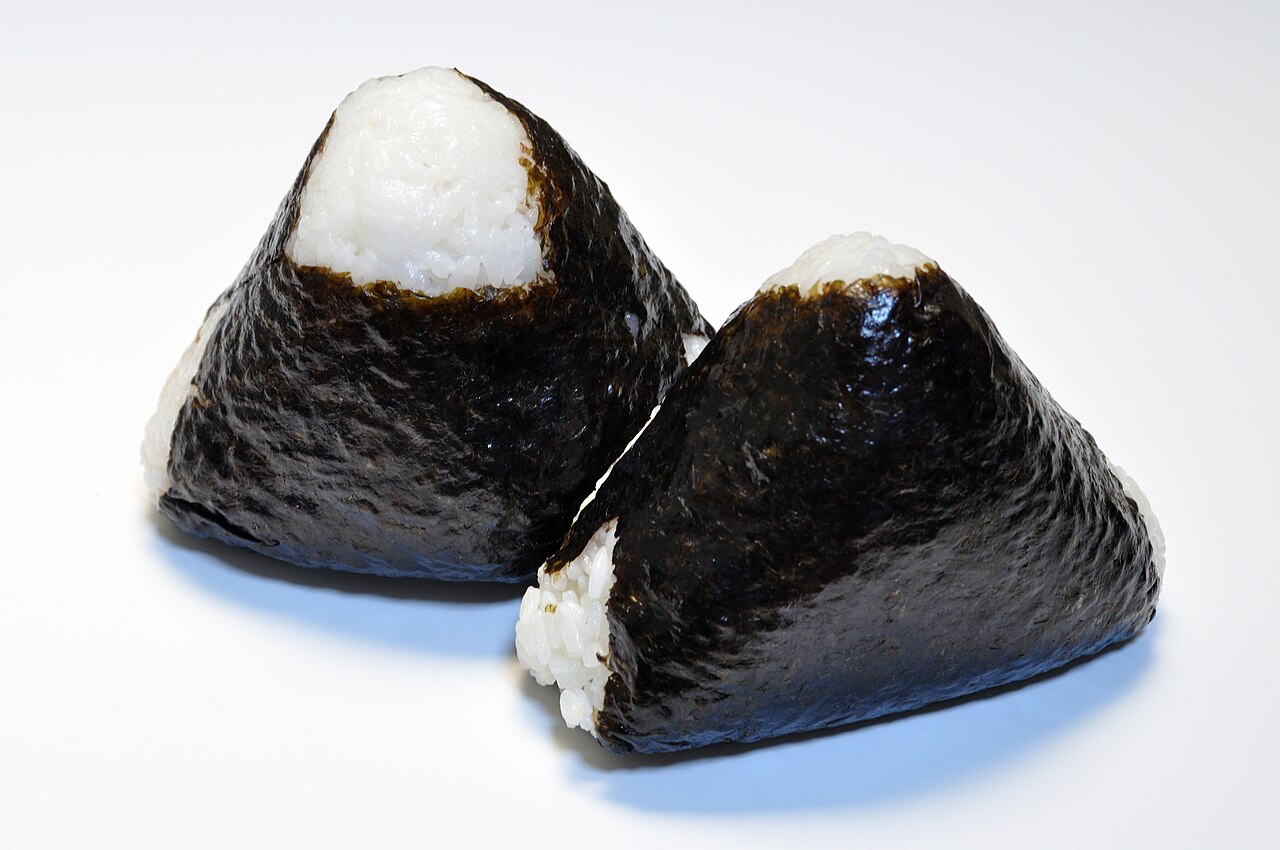
Freshly made onigiri with nori wrapping. Public domain, via Wikimedia Commons.
History and Origins
The history of onigiri stretches back to the Yayoi period (300 BCE – 300 CE), when rice cultivation first became widespread in Japan. Archaeological evidence — carbonized rice balls found at the Sugitani Chanobatake site in Ishikawa Prefecture — suggests rice was being hand-formed as early as the 1st century CE.
During the Heian period (794–1185), shaped rice called tonjiki was served at court banquets and to laborers. By the Sengoku era (1467–1615), onigiri had become essential battlefield rations for samurai: compact, portable, and packed with enough 伝統al sustenance to keep soldiers fighting. Warriors would carry them wrapped in bamboo leaves or tucked into their armor.
The Edo period (1603–1868) saw onigiri become mainstream street food, sold at roadside stalls and eaten by merchants, craftsmen, and travelers. By the Meiji era (1868–1912), they were firmly established as everyday food for all social classes. 日本's 文化 of efficient, practical eating made onigiri a natural fit — nutritious, filling, and eaten without utensils.
Shapes and Fillings
The classic onigiri is 三角 (triangular) — a shape said to derive from the sacred form of mountains, particularly the conical outline of Mount Fuji. Regional and personal preferences also produce round balls, oval cylinders (called tawara), and flat discs.
Traditional fillings:
| Filling | Japanese | Notes |
|---|---|---|
| Pickled plum | 梅干し | Intensely sour; natural preservative |
| Salmon | 鮭 | The most popular konbini filling |
| Kelp simmered in soy | 昆布 | Savory-sweet, dark green |
| Tuna mayonnaise | ツナマヨ | A modern classic, creamy and rich |
| Salt only | 塩 | Highlights the rice itself |
| Grilled salmon roe | いくら | Premium filling, often seasonal |
The simplest onigiri uses no filling at all — just salted rice and nori, letting the quality of the 炊く rice speak for itself. In some regions, 塩 (salt) is rubbed generously into the rice before shaping, acting as both flavoring and mild preservative.
Yaki-onigiri (焼きおにぎり) is a grilled variation brushed with soy sauce or miso until the exterior is crisp and caramelized — a popular izakaya snack.
Onigiri in Convenience Stores
No food better captures the spirit of the modern コンビニ (convenience store) than onigiri. Since the 1970s, Japanese convenience chains — FamilyMart, Lawson, and 7-Eleven — have sold them in a distinctive dual-wrap packaging that keeps the nori crisp and separate from the rice until the moment of eating.
The packaging itself is a small marvel of engineering: two plastic films and a perforated separator are pulled apart in a specific sequence (usually numbered 1-2-3) to unwrap the onigiri cleanly, releasing the dry nori sheet onto the moist rice just before it is eaten.
Convenience stores refresh their onigiri lineups seasonally and regionally, offering limited-edition fillings tied to local produce or cultural events. During the summer, cooling flavors like shiso and pickled cucumber appear; autumn brings mushroom varieties; winter sees salmon roe and rich ikameshi (squid) options. This seasonal rotation, combined with rock-bottom prices (typically ¥100–¥200 per piece), makes konbini onigiri a daily ritual for millions of students, office workers, and travelers.
Cultural Significance
Onigiri occupies a unique emotional space in Japanese 文化. Unlike elaborate 弁当 boxes that require skill and time, onigiri is democratic food — anyone can make one. A mother pressing rice for her child's 昼食 or 朝食, a grandmother shaping a rice ball for a long journey, a hiker unwrapping one at a mountain summit: these small moments carry powerful associations of care, home, and belonging.
In Japanese popular 文化, onigiri is a recurring symbol of everyday warmth. Characters in anime and manga are frequently shown eating onigiri — it signals normalcy, nourishment, and comfort. The Pokémon franchise's famous "jelly donuts" localization controversy, where onigiri were renamed for Western audiences, sparked debate about cultural authenticity and the recognition of Japanese food internationally.
The phrase "onigiri wa kokoro no tabemono" (おにぎりは心の食べ物 — onigiri is food for the heart) informally captures how deeply this humble food is tied to emotional nourishment, not just physical sustenance.
Okinawa has its own variation, pōku tamago onigiri, made with Spam and egg — a legacy of American military presence post-WWII, showing how onigiri adapts to local ingredients while retaining its essential form.
How to Make Onigiri
Making onigiri at home is one of the most accessible entry points into Japanese cooking. The process requires no special equipment, only properly cooked short-grain Japanese rice.
Basic method:
- Cook the rice — Use Japanese short-grain (uruchimai) rice. Rinse until the water runs clear, then 炊く (cook) using a rice cooker or stovetop. Allow to rest for 10 minutes.
- Prepare your hands — Wet both palms with cold water, then rub a generous pinch of 塩 across them. This prevents sticking and seasons the rice.
- Scoop the rice — Take roughly 100–120g of hot rice (about a large handful). Make a shallow indentation and place your chosen filling in the center.
- Shape — Cup the rice in your palms and press firmly but gently, rotating to form a triangle or round ball. The goal is cohesion, not compaction — the rice should hold together without becoming a dense lump.
- Wrap — Press a strip of 海苔 around the bottom edge, or 包む the entire rice ball for transport. If making ahead, keep nori separate and attach just before 食べる.
Tips:
- Use freshly cooked rice — cold rice crumbles and does not press together well.
- Do not overwork the rice; each squeeze should be deliberate.
- A mold (onigiri no kata) makes triangular shapes easier for beginners.
- Onigiri taste best at room temperature, not refrigerator cold.
Regional styles vary: Kyoto onigiri tend to be lightly seasoned and elegant; Osaka versions are often larger and heartier; Okinawan onigiri may be wrapped in plastic ラップ to hold non-traditional fillings.
From ancient battlefields to gleaming convenience store shelves, onigiri endures because it embodies a core principle of Japanese food 文化: that simplicity, quality, and care combine to make something greater than the sum of its parts.
Related Dictionary Words
onigiri; rice ball
onigiri; rice ball (often triangular, sometimes with a filling and wrapped in nori)
nori; laver; edible seaweed, usu. Porphyra yezoensis or P. tenera, usu. dried and pressed into sheets
umeboshi; pickled dried ume; pickled dried plum
salmon (Salmonidae spp.)
kombu (usu. Saccharina japonica); konbu; kelp; any edible species from the family Laminariaceae
bento; Japanese box lunch