納豆
nattōA traditional Japanese food of fermented soybeans known for its pungent smell, sticky texture, and powerful health benefits — loved in eastern Japan, famously divisive everywhere else.
Meaning
納豆 (nattō) is a traditional Japanese food made from 大豆 (soybeans) fermented with the bacterium Bacillus subtilis var. natto, known in Japanese as 納豆菌 (nattōkin). The fermentation process transforms ordinary soybeans into something entirely unlike any other food in the world: a sticky, stringy, pungent mass with a flavor that defies easy description — earthy, savory, faintly ammonia-tinged, with a 粘り (stickiness) that stretches into dramatic, thread-like strands when stirred.
The name 納豆 is written with the characters for "put away" (納) and "豆" (bean), thought to reference the practice of storing or packing soybeans in straw for fermentation. The food is typically sold in small polystyrene trays or traditional straw packaging (わらづと, warazuto), and most commercially available natto comes with small packets of 醤油 (soy sauce) and 辛子 (karashi hot mustard).
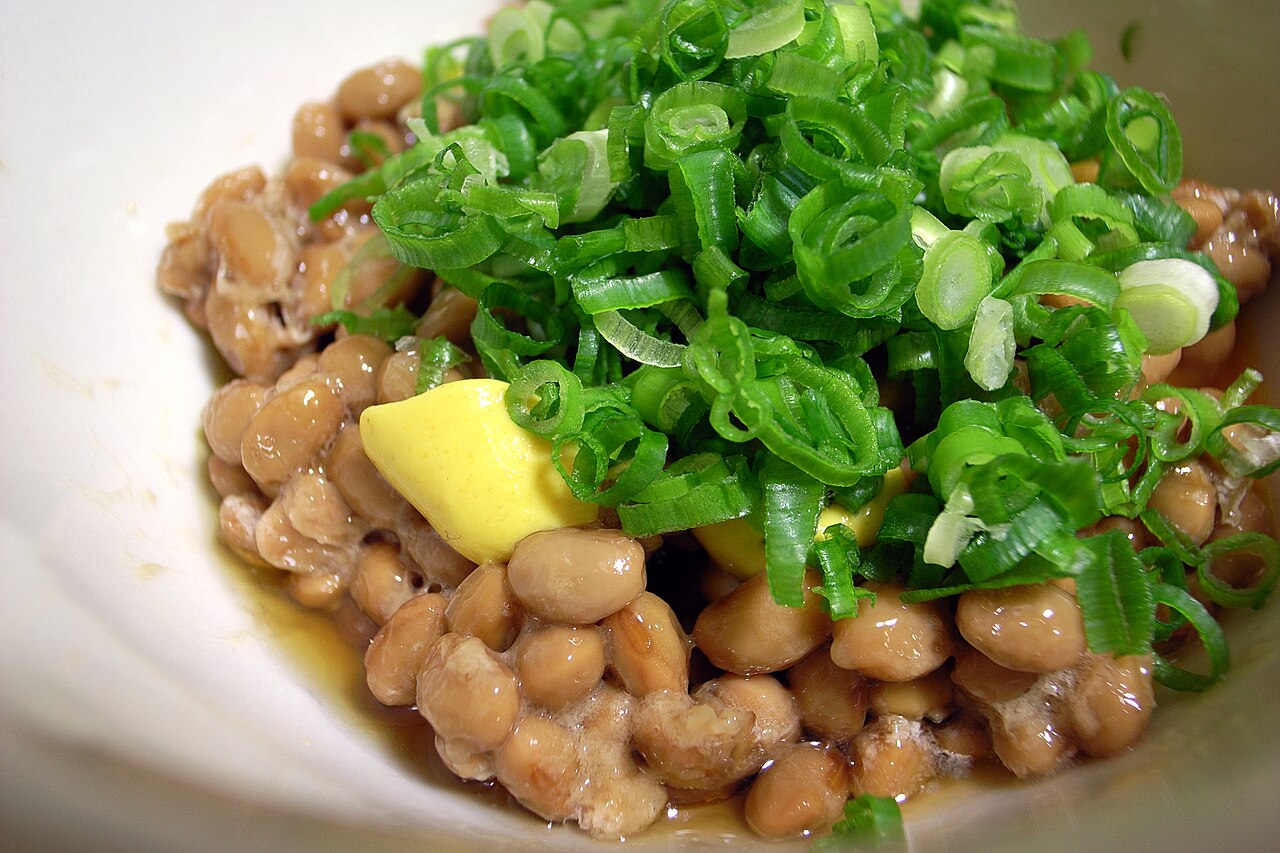
Freshly prepared natto served over ご飯 with green onion and karashi mustard. Photo: yoppy, CC BY 2.0, via Wikimedia Commons.
Usage
The classic way to eat natto — debated with near-religious intensity by enthusiasts — is to stir it vigorously before eating:
納豆はよく混ぜると美味しくなる。 Nattō wa yoku mazeru to oishiku naru. "Natto becomes tastier when you 混ぜる it well."
Most packages recommend 50–100 stirs to develop the creamy, aerated texture. The sauce packet and mustard are added after mixing. The natto is then eaten poured over hot ご飯, where the warmth softens the beans and melds the flavors.
Common additions include:
| Add-in | Japanese | Effect |
|---|---|---|
| Welsh onion (green onion) | ネギ | Freshness, cuts richness |
| Raw egg yolk | 卵黄 | Creaminess, richness |
| Karashi mustard | 辛子 | Heat, cuts the smell |
| Soy sauce | 醤油 | Umami depth |
| Kimchi | キムチ | Spice, fermented complexity |
| Grated daikon | 大根おろし | Freshness, digestive aid |
Natto is a staple of the traditional Japanese 朝食 alongside miso soup, rice, grilled fish, pickles, and tamagoyaki.
毎朝、納豆ご飯を食べています。 Maiasa, nattō gohan wo tabete imasu. "I eat natto over rice every morning."
Cultural Context
Origins and History
Natto's origins are the subject of considerable legend. The most popular story credits its discovery to 武士 (samurai) retainer Minamoto no Yoshiie during the Heian period (794–1185 CE). According to legend, during a military campaign, soldiers boiled soybeans as horse fodder and then stored the leftovers hastily in straw bags. Days later, the warm, humid conditions inside the straw had fermented the beans into natto — and hungry soldiers found the result surprisingly edible.
While the exact origins remain unclear, natto is documented as a food of the common people and 侍 (samurai) alike from at least the Heian period. The Ibaraki Prefecture city of Mito (水戸) in the 関東 (Kantō) region is most closely associated with natto — the Kanto Plain's colder climate and straw-rich agriculture made it an ideal natto-producing region. Mito natto (水戸納豆) became so synonymous with the food that Mito remains its spiritual home today.
The East-West Divide
Perhaps no food so perfectly divides Japan along geographic lines as natto. Eastern Japan — particularly Tōhoku, Kantō, Hokkaido, and the Chūbu region — embraces natto as an unquestioned daily staple. In 関西 (Kansai, western Japan), including Osaka, Kyoto, and Kobe, natto has historically been met with considerably less enthusiasm.
The reasons for this divide are both cultural and historical. Eastern Japan, centered on 東京, developed its culinary identity partly around fermented, strongly-flavored foods during colder months. Kansai cuisine (関西料理) favors lighter, more delicate flavors — the sharp 臭い (smell) and pungent taste of natto runs counter to these preferences.
Surveys consistently show that over 70% of people in eastern Japan eat natto regularly, while acceptance rates in Kansai hover much lower. This divide has become a source of friendly regional humor throughout Japan:
関東の人は毎日納豆を食べるけど、関西ではあまり食べないそうだ。 Kantō no hito wa mainichi nattō wo taberu kedo, Kansai dewa amari tabenai sō da. "They say people in Kantō eat natto every day, but in Kansai it's rarely eaten."
Health Benefits
納豆 has earned a formidable reputation as a 健康 (health) food, and modern nutritional science has largely validated this reputation.
Key health properties:
- Nattokinase (ナットウキナーゼ): An enzyme unique to natto that research suggests may help dissolve blood clots and support cardiovascular health. Discovered by Dr. Hiroyuki Sumi in 1980 at the University of Chicago.
- Vitamin K2 (ビタミンK2): Natto is one of the richest dietary sources of ビタミン K2 (menaquinone-7), which plays a crucial role in bone 健康 and cardiovascular function. A single 100g serving provides many times the recommended daily intake.
- Gut bacteria: The live Bacillus subtilis in natto acts as a probiotic, supporting 腸 (intestinal) health and 整腸 (gut regulation). This makes natto among Japan's most potent 発酵食品 (fermented foods).
- Protein: As a 大豆-based food, natto provides complete protein, iron, calcium, and dietary fiber.
- 栄養 density: 100g of natto contains approximately 200 calories, 17g protein, 11g fat, and significant amounts of manganese, copper, magnesium, and B vitamins.
Japanese longevity researchers have pointed to regular natto consumption as a potential contributing factor to Japan's exceptional life expectancy, particularly in natto-heavy eastern regions. This has driven significant international interest in natto as a superfood.
Varieties
Commercial natto in Japan comes in several varieties, most easily found packaged in sets of three small trays at convenience stores (コンビニ) and supermarkets:
| Type | Japanese | Description |
|---|---|---|
| Regular (itohiki) | 糸引き納豆 | Standard whole soybeans with classic stringy texture |
| Hikiwari | ひきわり納豆 | Crushed/broken beans; milder flavor, less stringy, popular for beginners |
| Kotsubu | 小粒納豆 | Small beans; more delicate flavor, often preferred in finer cooking |
| Okara natto | おから納豆 | Made from tofu lees; rarer, regional variation |
| Large bean (ōtsubu) | 大粒納豆 | Large beans; stronger flavor, longer fermentation |
Hikiwari (literally "crushed and separated") is often recommended for natto newcomers as the smaller pieces are easier to manage and the flavor is somewhat milder.
Modern Uses and Innovation
While 伝統 (traditional) natto-on-rice remains the dominant form, contemporary Japanese cuisine has expanded natto's repertoire considerably:
Natto in modern cooking:
- Natto toast (納豆トースト): Natto spread on buttered toast, often with cheese — a fusion breakfast increasingly popular among younger Japanese
- Natto pasta (納豆パスタ): Natto tossed with spaghetti, often with soy sauce, butter, and shiso leaves — a well-established yoshoku (Western-influenced Japanese food) dish
- Natto sushi: Served as gunkan-maki (battleship roll) or inside maki rolls; common in kaiten-zushi (conveyor belt sushi) restaurants
- Natto okonomiyaki: Mixed into the savory pancake batter
- Natto soup: Added to miso soup or other broths
Convenience stores stock multiple natto varieties year-round, including flavored versions with mentaiko (spicy cod roe), kimchi, and various tare (sauce) combinations. Natto-flavored snacks — crackers, chips, and even natto-flavored ice cream — appear regularly as novelty products.
During the COVID-19 pandemic, natto briefly sold out across Japan as interest in immune-boosting fermented foods surged, echoing a 2011 shortage when the Tōhoku earthquake disrupted production from natto-producing regions.
The Natto Experience
For visitors to Japan, natto is often presented as a cultural gauntlet — a rite of passage that separates those who have truly engaged with Japanese food culture. The 匂い (smell) hits first: pungent, yeasty, faintly funky. The texture follows: viscous, sticky strands that cling to chopsticks and require technique to manage without making a mess.
Reactions among first-time tasters range from immediate love to profound rejection. Japanese people are often both amused and genuinely pleased when foreigners enjoy natto — it signals a serious engagement with Japanese culinary 伝統, not merely the internationally accessible foods like sushi and ramen.
For those who embrace it, natto offers something few foods can: a flavor utterly unlike anything else, rooted in centuries of Japanese food culture, and backed by genuine nutritional power. It is, in the most literal sense, an acquired taste — and acquiring it feels like unlocking a deeper layer of Japanese daily life.