手塚治虫
Tezuka OsamuOsamu Tezuka (1928-1989), revered as 'the God of Manga,' created Astro Boy, Black Jack, and Phoenix while inventing the visual grammar and TV-anime production model that shaped virtually all modern manga and anime.
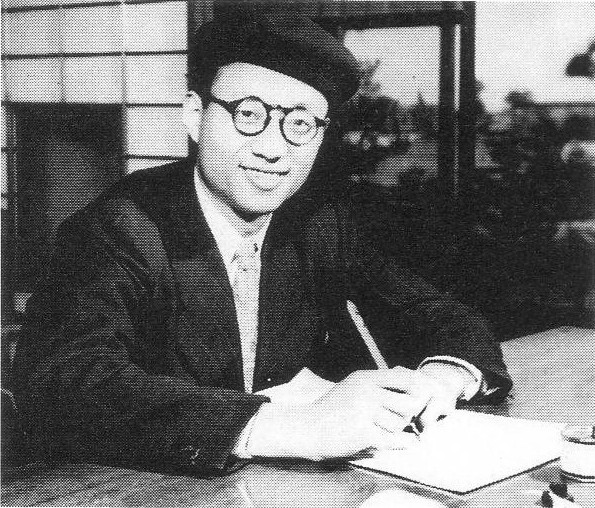
Osamu Tezuka photographed in 1951, early in his manga career. Public domain, via Wikimedia Commons (originally published in Showa Day by Day, vol. 9, Kodansha, 1989).
Meaning
Osamu Tezuka (手塚治虫, てづかおさむ, 1928-1989) is the manga artist and animator most often called 漫画の神様 — "the God of Manga." He is credited with almost single-handedly transforming manga from a minor children's amusement into a mature narrative art form, and with launching Japan's アニメ industry as a viable TV business. Over a nearly 40-year career he produced more than 700 manga series spanning roughly 170,000 pages, alongside dozens of animated films and TV series.
The honorific "神様" (kami-sama, god/deity) is not casual hyperbole in Japan — it reflects a broad consensus among later creators that Tezuka effectively invented the toolkit they all still use: cinematic panel composition, dramatic close-ups and camera-like framing, morally complex antihero protagonists, and stories that mixed adventure, science fiction, and serious philosophical or ethical themes into a medium previously seen as juvenile.
Major Works
| Title | Japanese | Years | Notes |
|---|---|---|---|
| Astro Boy | 鉄腕アトム (Tetsuwan Atomu) | 1952-1968 | A robot boy built to replace a scientist's dead son; became Japan's first weekly 30-minute animated TV series in 1963 |
| Kimba the White Lion | ジャングル大帝 (Jungle Taitei) | 1950-1954 | Early full-color manga; the 1965 anime was among the first Japanese color TV series exported abroad |
| Black Jack | ブラック・ジャック | 1973-1983 | An unlicensed genius surgeon; explores medical ethics, life, and death episode by episode |
| Phoenix | 火の鳥 (Hi no Tori) | 1954-1988 (unfinished) | Tezuka's personal magnum opus, an epic spanning ancient and far-future Japan built around reincarnation and the meaning of life; left incomplete at his death |
| Princess Knight | リボンの騎士 (Ribon no Kishi) | 1953-1956 | A foundational text of shōjo (girls') manga, starring a sword-wielding princess |
| Buddha | ブッダ | 1972-1983 | An eight-volume dramatized biography of Siddhartha Gautama |
Stylistic Innovations
Tezuka's most lasting contribution was less any single story than a set of formal techniques he popularized:
- Cinematic paneling: borrowing pacing, zooms, and multi-panel "tracking shots" from film (he was an avid fan of Disney and early Hollywood cinema), rather than the static, stage-play-like layouts common before him.
- Large, expressive eyes: influenced by Disney character design, Tezuka's rounded, oversized eyes became a defining visual convention of manga and anime character design that persists today.
- A "star system" of recurring characters: like a stock company of actors, the same designs (e.g., Hyōtantsugi, Rock Holmes) reappeared across unrelated titles in different roles.
- Genre-crossing seriousness: he treated science fiction, medical drama, and historical epic as vehicles for real ethical and philosophical inquiry, aimed at adult as well as child readers — paving the way for seinen manga and mature storytelling generally.
The Birth of TV Anime
In 1961 Tezuka founded the animation studio Mushi Production (虫プロダクション), and in 1963 adapted Astro Boy into what is widely considered Japan's first serialized weekly TV anime. To make a 30-minute production run on a fraction of Disney-level budgets, Tezuka pioneered limited animation techniques — reusing cels, holding static frames, and cutting frame rates — that became standard industry practice. This business model made ongoing TV anime commercially viable in Japan for the first time, effectively creating the industrial template the entire modern anime industry still follows. Critics have long debated the trade-off: it made a national anime industry possible, but also normalized the industry's notoriously low pay and grueling production schedules.
Cultural Context
Tezuka trained as a physician and held a medical degree (hence the recurring doctor-hero, as in Black Jack), but chose to draw manga full-time. Publishing through the postwar akahon ("red book") cheap-paperback market of Osaka, he broke out nationally in the late 1940s and by the 1950s and 60s was the central figure of the manga world centered in Tokiwasō, the shared apartment building where he and a generation of future star artists — including Fujiko Fujio (Doraemon) and Fujio Akatsuka — lived and worked in the 1950s.
Tezuka died of stomach cancer in 1989, reportedly still asking for a pencil on his deathbed. His death was treated as a national event; obituaries described the end of an era for Japanese popular culture. In 1997 the Japanese government's Agency for Cultural Affairs established the Tezuka Osamu Cultural Prize (手塚治虫文化賞), an annual award recognizing outstanding manga, explicitly named in his honor. The Osamu Tezuka Manga Museum opened in his hometown of Takarazuka in 1994.
His influence is difficult to overstate: nearly every major mangaka of the following generations — from Akira Toriyama to Naoki Urasawa — has cited him as foundational, and the visual conventions he popularized (large eyes, speed lines, cinematic panel-to-panel movement) remain the default vocabulary of manga and anime worldwide.
Related Terms
- 漫画 (manga) — the medium Tezuka is credited with modernizing
- アニメ (anime) — the TV industry he helped launch with Astro Boy
- 火の鳥 (Phoenix) — his lifelong, unfinished masterwork
- 少年漫画 (shōnen manga) — the boys'-manga category he helped define with Astro Boy
- 医師 (physician) — Tezuka's own medical training informed Black Jack and other works