七五三
shichigosanA traditional Japanese rite-of-passage festival held every November 15th to celebrate the growth and health of children aged three, five, and seven with shrine visits and formal dress.
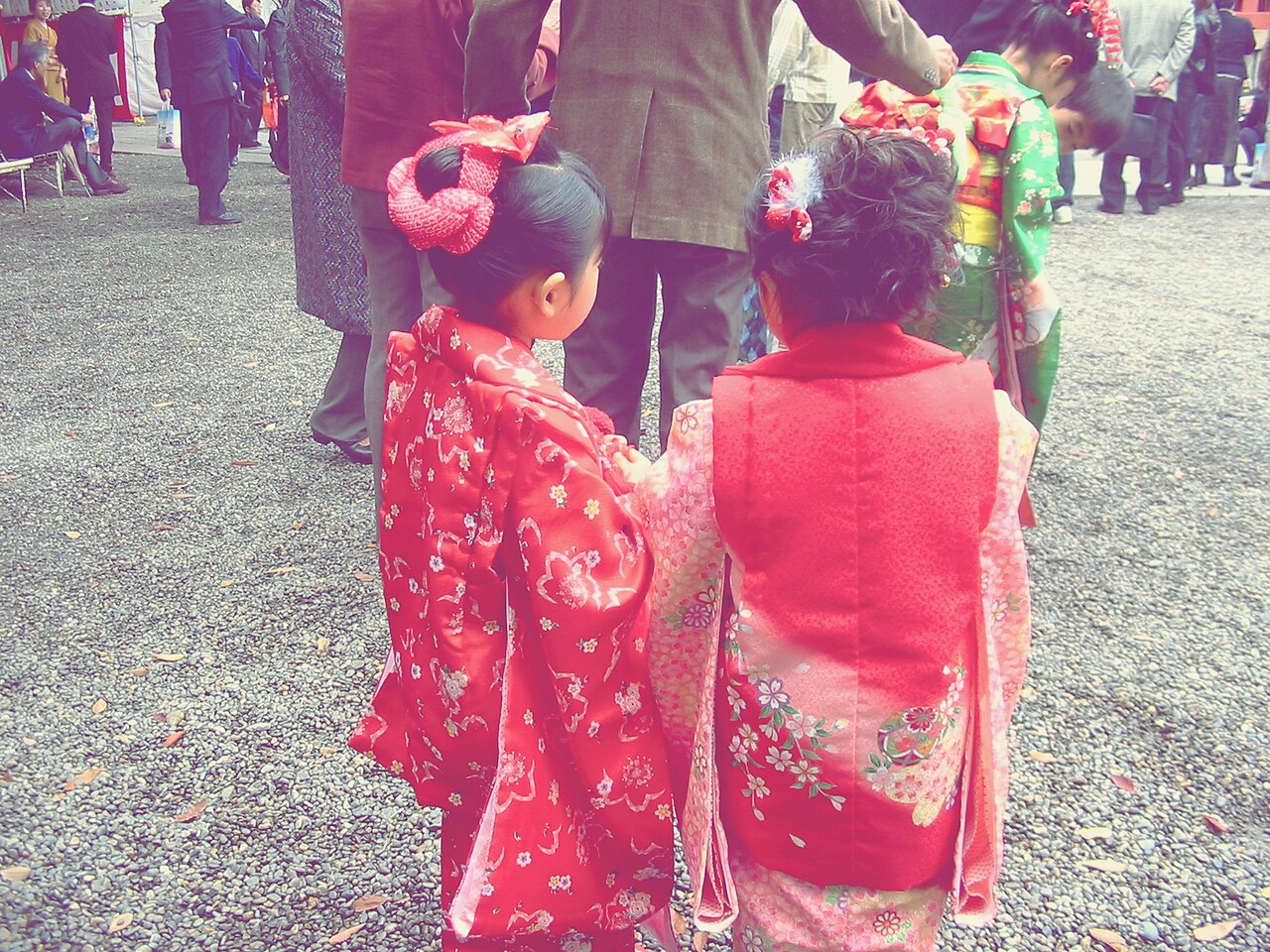
A family brings their children to a shrine for Shichi-Go-San blessings. Public domain, via Wikimedia Commons.
Meaning
七五三 (しちごさん, shichi-go-san) literally means "seven-five-three" — the three ages at which Japanese children are traditionally celebrated. Girls are honored at ages three and seven, and boys at ages three and five (age three is sometimes celebrated for boys only in some regions, and sometimes for both sexes). The festival marks each child's survival and growth to that milestone age and asks for continued health and good fortune.
Historically, ages were counted using 数え年 ("counting age"), an East Asian system in which a person is considered one year old at birth and gains a year at each New Year rather than on their birthday. Many families today use the child's actual age instead, so a "three-year-old" celebration may take place at what Westerners would call age two or three depending on the child's birth month.
The event falls each year on November 15th, though in practice families visit shrines on any convenient weekend in October or November, since the fixed date is now more of a cultural anchor than a strict requirement.
Usage
Shichi-Go-San is primarily discussed in the context of family milestones, shrine visits, and seasonal photography. Typical phrases include:
来月、娘の七五三のお参りに行きます。 Raigetsu, musume no shichi-go-san no omairi ni ikimasu. "Next month, we're going to the shrine for our daughter's Shichi-Go-San visit."
七五三の写真は写真館で撮りました。 Shichi-go-san no shashin wa shashinkan de torimashita. "We took the Shichi-Go-San photos at a photo studio."
The term also appears on shrine signage, seasonal store displays (kimono rental shops, photo studios), and calendars every autumn, much the way "Halloween" saturates October storefronts in English-speaking countries.
The Ritual
The core of Shichi-Go-San is a family visit to a 神社, often the local 氏神 (ujigami, tutelary shrine) or a larger, well-known shrine such as Tokyo's Meiji Jingu. Children are dressed in their finest traditional clothing — girls often in a bright 着物 with a decorative obi, and boys in 袴 (hakama) over a haori jacket — though Western-style formal wear has become an accepted alternative for many families.
At the shrine, a 神主 (Shinto priest) or miko (shrine maiden) performs a 御祈祷 — a purification and blessing ceremony — asking the local kami to watch over the child's continued health and growth. Families typically pay a small fee for this formal blessing, receive an amulet charm afterward, and often write wishes on an 絵馬 votive plaque before leaving.
Chitose-Ame: The Thousand-Year Candy
One of the festival's most recognizable traditions is 千歳飴 (chitose-ame, "thousand-year candy") — long, thin, hard candy sticks, traditionally red-and-white striped, sold in decorative bags printed with cranes, turtles, and pine (all symbols of longevity in Japanese culture). The candy's length and the wish embedded in its name ("a thousand years") symbolize a prayer for the child's long life and healthy growth. Children carry the candy bag home from the shrine as a treasured keepsake of the day, and the sugary treat itself is often more memorable to kids than the ceremony.
Kimono, Hakama, and the Modern Photo Studio
Formal dress has always been central to Shichi-Go-San, but its logistics have shifted dramatically in recent decades. Full children's kimono and hakama are expensive and require skilled dressing, so most families now rent outfits rather than buy them, and specialty 写真館 (photo studios) offer all-in-one packages: costume rental, hair and makeup, professional 家族写真 (family portrait) sessions, and sometimes even a separate "photo-only" appointment weeks before the actual shrine visit, since young children rarely sit still long enough for both a formal photo shoot and a real ceremony in one outing. It is now common for a family's Shichi-Go-San "photos" and their Shichi-Go-San "shrine visit" to happen on entirely different days.
Cultural Context and Origin
Shichi-Go-San traces back to Heian-period (794–1185) court customs marking early childhood milestones, when infant mortality was high and reaching these ages was far from guaranteed. Several distinct rituals eventually merged into the modern festival:
| Age | Rite (historical name) | Traditional meaning |
|---|---|---|
| 3 | 髪置き (kamioki, "hair-placing") | Children, whose heads were shaved in infancy, were allowed to grow out their hair for the first time |
| 5 | 袴着 (hakamagi, "hakama-wearing") | Boys wore hakama trousers for the first time, marking early entry into boyhood |
| 7 | 帯解き (obitoki, "cord/sash-untying") | Girls stopped wearing simple tied cords and began wearing a proper obi sash with kimono |
The festival was popularized among samurai and merchant families during the Edo period (1603–1868) and the November 15th date is traditionally said to derive from numerology and the lunar calendar: the 15th was considered an especially auspicious day (the "kishukujitsu," a day free of inauspicious influences in old almanacs), and 7+5+3 was seen as a lucky, odd-numbered combination in a culture that favors odd numbers for celebrations. Shogun Tokugawa Tsunayoshi is popularly credited with holding a hakamagi ceremony for his son on this date in the late 17th century, further cementing November 15th as the customary day.
By the 20th century, Shichi-Go-San had spread to all social classes and become a nationwide observance rather than a samurai or court tradition, sitting alongside other Shinto life-cycle events like hatsumode (the first shrine visit of the New Year) as one of the most widely practiced family rituals in Japan.
Modern Practice
Today's Shichi-Go-San blends old and new. Families still visit shrines and receive blessings, but rental kimono, studio photography, and social-media photo-sharing have become just as central to the experience as the religious rite itself. Grandparents frequently travel to join the shrine visit, and the day often ends with a family meal to mark the milestone. Despite Japan's declining birthrate shrinking the pool of eligible children each year, Shichi-Go-San remains one of the most visually iconic and commercially significant seasonal events in the Japanese calendar, recognizable even to those with no connection to 神道 as a religious practice — much like the sight of a red 鳥居 gate is recognizable worldwide as a symbol of Japan.
Related Dictionary Words
shichi-go-san; 7-5-3 day; festival day for children aged 7, 5 and 3 held on or around November 15
Shinto shrine
kimono; Japanese traditional clothing (esp. full-length)
hakama; pleated skirt or loose-legged trousers worn over a kimono mainly on ceremonial occasions
red and white candy stick sold at children's festivals
going and worshipping (at a shrine or temple); visit (to a shrine or temple to worship)
patron god; tutelar deity; guardian deity; local deity
rite of passage
ceremony fitting child with a hakama
ceremony of allowing the hair to grow at age three
East Asian age reckoning; traditional system of age reckoning whereby newborns are considered one year old and on New Year's Day one year is added to everyone's age
Shinto priest
miko; shrine maiden; young girl or woman (trad. an unmarried virgin) who assists priests at shrines
photo studio
family photo
growth; development; growing up; becoming an adult
health
thanks; gratitude; appreciation; thankfulness
turning point; critical juncture
to celebrate; to congratulate; to observe (a festival)
Shinto; Shintoism
torii (Shinto shrine archway)