千羽鶴
senbazuruThe tradition of folding one thousand origami paper cranes strung together as a wish for healing, peace, or good fortune, famously tied to Sadako Sasaki and Hiroshima's Children's Peace Monument.
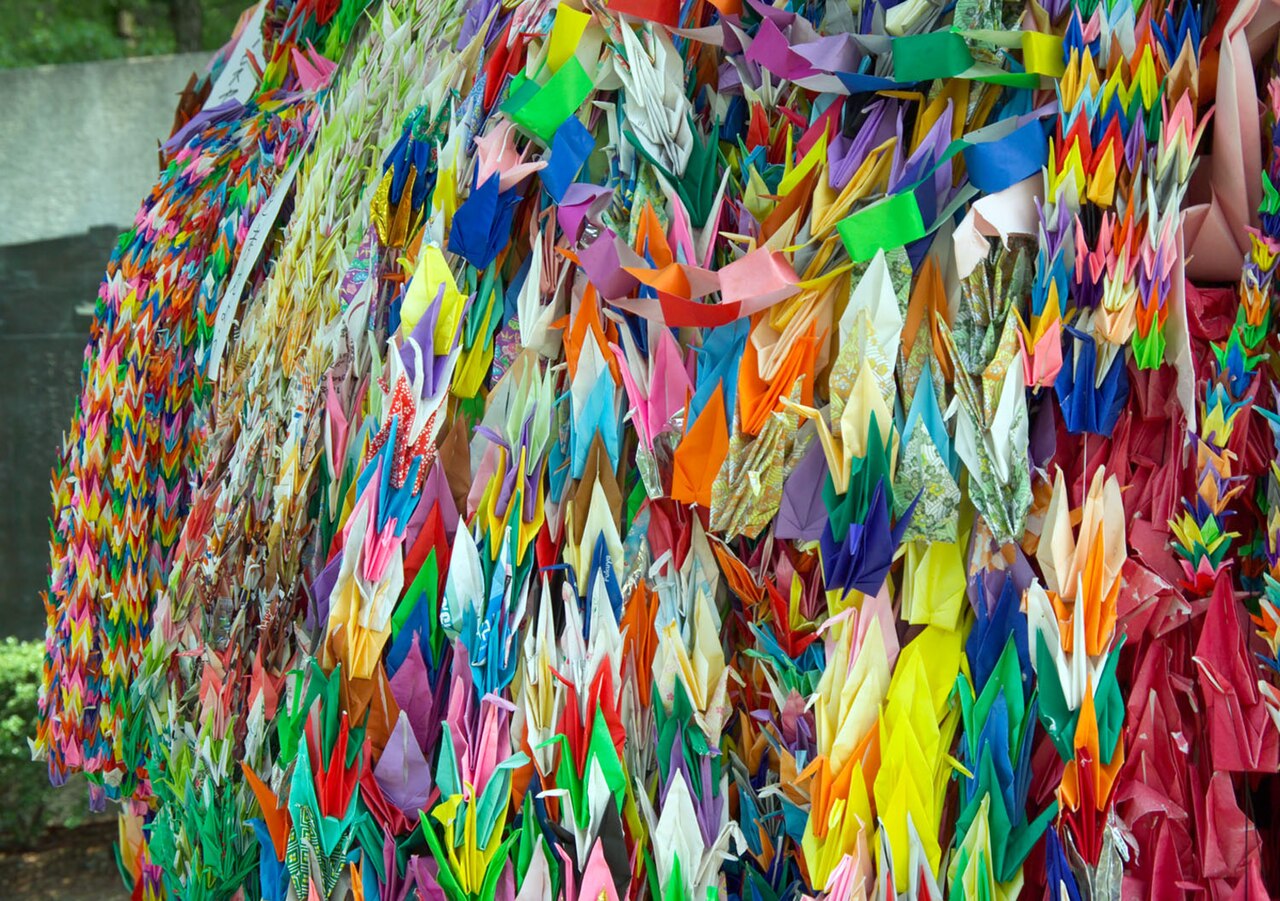
Origami crane strings (senbazuru) left as offerings in Hiroshima. Public domain, via Wikimedia Commons.
Meaning
千羽鶴 (senbazuru) literally means "a thousand cranes" — sen (千, thousand) plus ha/ba (羽, the counter for birds) and 鶴 (tsuru, crane). In practice the word refers not to a single bird but to a garland of one thousand 折り紙 (origami) cranes, individually folded and then strung together, traditionally in bundles of twenty-five cranes threaded on a string, with forty strings making up the full thousand.
The tradition rests on an old belief that the crane lives for a thousand years, making it a symbol of longevity in Japanese culture. From this grew a popular legend: anyone who folds a thousand paper cranes will be granted a single 願い (wish) — commonly for recovery from 病気 (illness), for a long life, or simply for lasting happiness and good fortune. The number itself is less a strict requirement than a poetic way of expressing an enormous, sincere effort.
Origin and History
Paper cranes have long been associated with Shinto and Buddhist practice in Japan, where folded cranes were offered at shrines and temples as tokens of prayer. Instructions for folding multiple linked cranes from a single sheet of paper appeared as early as 1797, in a woodblock-printed book titled Hiden Senbazuru Orikata (秘伝千羽鶴折形, "The Secret of Folding a Thousand Cranes") — one of the earliest known origami instruction manuals. It describes numerous ways to cut and fold a single sheet so that several cranes emerge still connected at the wingtips, a technique distinct from the modern practice of folding a thousand separate cranes and stringing them together.
The custom as it is practiced today — a thousand individually folded cranes strung in a garland — became widespread in the 20th century, closely tied to its use as a get-well gift. Friends, classmates, or coworkers fold the cranes collectively for someone facing surgery or serious illness, then present the finished garland at a hospital bedside or offer it at a shrine on the person's behalf.
Sadako Sasaki and the Children's Peace Monument
The tradition's modern symbolism owes much to Sadako Sasaki, a girl from Hiroshima who was two years old when the atomic bomb was dropped on the city in August 1945. Though seemingly unharmed at the time, she developed leukemia a decade later as a result of radiation exposure. While hospitalized, Sadako began folding paper cranes, inspired by the legend that a thousand cranes would grant her wish to recover and to see a world without nuclear weapons. She continued folding using any paper she could find, including medicine wrappers, but died in October 1955 before completing her goal.
Sadako's story spread across Japan and the world, and the paper crane became an international symbol of peace, healing, and opposition to nuclear war. Her former classmates raised funds for a memorial, and in 1958 the Children's Peace Monument was unveiled in Hiroshima Peace Memorial Park, topped with a bronze statue of a girl holding a folded crane aloft. The inscription reads: "This is our cry, this is our prayer: for building peace in the world."
To this day, an estimated ten million paper cranes arrive at the monument each year, sent by school groups, individuals, and visitors from around the globe, and displayed in glass cases surrounding the statue.
Usage
Senbazuru are given or displayed on several kinds of occasions:
- Get-well wishes: strung and brought to a hospital room for someone recovering from illness or surgery.
- Peace offerings: sent to the Children's Peace Monument in Hiroshima, or to the Nagasaki Peace Park, as a prayer for peace and against nuclear weapons.
- Weddings: given as a wedding gift, where the crane's association with longevity is reinterpreted as a wish for a thousand years of marital happiness.
- New Year and other celebrations: displayed as a general symbol of good fortune, health, and long life.
早く元気になりますように、千羽鶴を折りました。 (Hayaku genki ni narimasu you ni, senbazuru wo orimashita.) "I folded a thousand paper cranes so that you'll get better soon."
Cultural Context
The crane (鶴, tsuru) holds a broader place in Japanese symbolism as one of the traditional emblems of 長寿 (longevity), often paired with the tortoise in the expression "tsuru wa sennen, kame wa mannen" ("the crane lives a thousand years, the tortoise ten thousand"). Cranes appear on kimono patterns, in New Year decorations, and as motifs at weddings for this reason.
Senbazuru sits alongside other everyday objects of prayer and wish-making in Japanese culture, such as ema wooden plaques and omamori amulets, though it is distinctive in being a collaborative, labor-intensive act — the effort of folding a thousand cranes is itself understood as part of the wish's sincerity. Unlike general origami, which covers the whole craft of paper folding, senbazuru refers specifically to this one ritual object and the legend, hospital custom, and peace symbolism attached to it.
Related Terms
- 折り紙 (origami) — the general art of paper folding from which senbazuru is made.
- 鶴 (tsuru) — the crane itself, a standalone symbol of longevity.
- 平和 (heiwa) — peace, the wish most associated with senbazuru since Sadako Sasaki's story.
Related Dictionary Words
crane (any bird of the family Gruidae, esp. the red-crowned crane, Grus japonensis)
origami; art of paper folding
peace; harmony
desire; wish; hope
illness (usu. excluding minor ailments, e.g. common cold); disease; sickness
(string of) many (traditionally 1000) paper cranes
long life; longevity
marriage ceremony; wedding; nuptials