絵馬
emaSmall wooden votive plaques sold at Shinto shrines and Buddhist temples where visitors write prayers, wishes, and expressions of gratitude for the gods to receive.
Meaning
絵馬 (ema) are small pentagonal wooden plaques on which worshippers write 願い (wishes, prayers) or expressions of gratitude, then hang them at a 神社 (Shinto shrine) or 寺 (Buddhist temple) as an offering to the 神様. The word itself is written with two kanji: 絵 (picture) and 馬 (horse) — literally, "picture horse" — a name that directly reflects the tradition's ancient origins.
Ema have a distinctive shape: typically a small wooden board about 15 cm wide with a peaked top, pre-printed on one side with an illustration (a horse, a shrine motif, the zodiac animal of the current year, or a design specific to the shrine). Visitors write their wish on the plain back side, then hang the plaque on a wooden rack called an emagake (絵馬掛け), where the accumulated offerings form dense, layered walls of wooden plaques that are a familiar sight at any major shrine or temple.
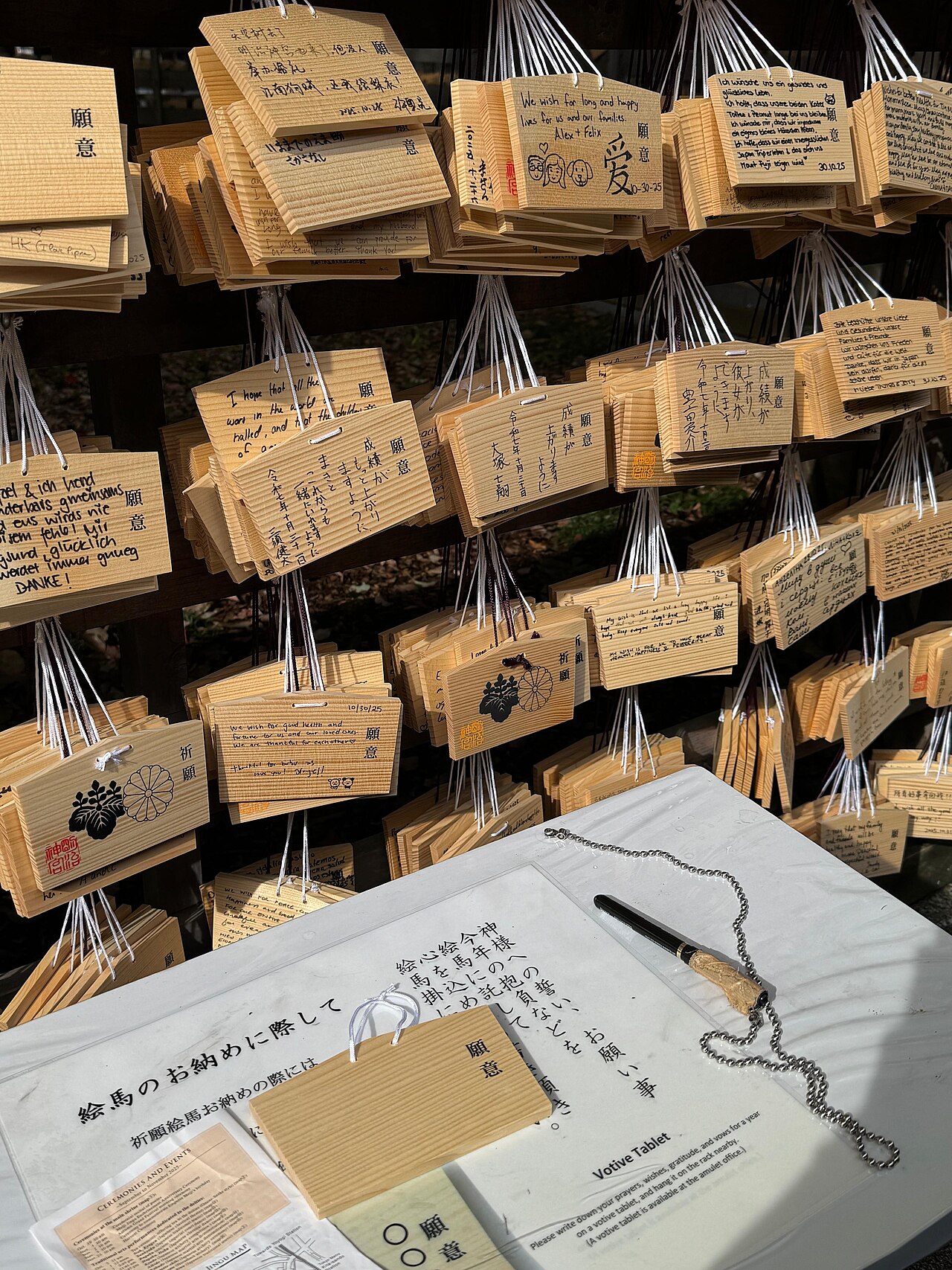
Ema hanging at Meiji Shrine, Tokyo. Photo: Joli Rumi, CC BY-SA 4.0, via Wikimedia Commons.
Cultural Context
The tradition of ema is one of the oldest continuous religious practices in Japan, with roots stretching back more than 1,300 years. In ancient times, horses were considered sacred animals — the divine vehicles on which the kami (gods) descended from heaven to earth. Offering a live horse to a shrine was considered the highest form of supplication, used to petition for rain during drought (black horses) or to stop flooding (white horses). Real horses were, however, enormously expensive, and over time wooden, clay, and paper horse effigies substituted for live animals. By the early Nara period (710–794 CE), flat wooden plaques bearing a painted image of a horse — the ema — had emerged as the standard form of votive offering.
During the Heian period (794–1185), the practice spread from aristocrats to the wider population. The Kamakura period (1185–1333) saw ema adopted into 仏教 (Buddhism) as well, and today the custom crosses sectarian lines — you'll find emagake at both 神道 shrines and Buddhist temples throughout Japan. The Edo period (1603–1868) brought a golden age for ema: specialist artisans emerged who painted elaborate scenes on larger "e-ma" commissioned by wealthy donors, and the tradition became deeply embedded in the everyday religious life of the common people.
Usage
Buying and writing an ema is a straightforward ritual anyone can participate in:
- Purify your hands at the temizuya (hand-washing basin) before approaching the shrine.
- Purchase an ema at the shamusho (shrine office) or omamori stall. Prices typically range from ¥500 to ¥1,000.
- Write your wish on the plain back of the plaque. Writing is done vertically or horizontally — neatness and sincerity matter more than format. An oil-based pen is recommended because it resists rain.
- Hang the ema on the emagake rack near the main hall.
Common wishes follow fixed four-character phrases (yojijukugo) that leave no ambiguity about the petitioner's desire:
| Phrase | Kana | Meaning |
|---|---|---|
| 合格祈願 | ごうかくきがん | Prayer to pass an exam |
| 恋愛成就 | れんあいじょうじゅ | Success in 恋愛 (romance) |
| 家内安全 | かないあんぜん | Safety for one's family |
| 商売繁盛 | しょうばいはんじょう | Prosperity in business |
| 健康祈願 | けんこうきがん | Prayer for good health |
Wishes can also be written freely in any language — foreign visitors are welcome to write in English, and shrines in tourist areas often post multilingual example phrases on signboards nearby.
If a wish is fulfilled, etiquette calls for a return visit (orei-mairi, お礼参り) within the year to express gratitude by bowing and making a coin offering at the main hall.
Shrine Specializations
Different shrines are associated with different types of blessings, and the illustrations on their ema reflect this. Shrines dedicated to 参拝-heavy seasons often sell ema branded with the new year's zodiac animal:
- Academic success — Tenmangū shrines (dedicated to the scholar-deity Sugawara no Michizane) nationwide, especially Yushima Tenmangū in Tokyo and Dazaifu Tenmangū in Fukuoka. During exam season (January–March), the emagake at these shrines are buried under thousands of plaques bearing 合格祈願.
- Love and marriage — Shrines dedicated to Ōkuninushi-no-Mikoto, such as Izumo Taisha in Shimane, are thronged with heart-shaped ema and ハート motifs.
- Childbirth and family safety — Water-deity shrines and shrines with an en musubi (縁結び, binding of fate) association.
Some shrines even issue ema in a 五角形 (pentagonal) shape as a visual pun: gokaku (五角) shares its sound with gōkaku (合格, "passing an exam").
Ema in Contemporary Life
Ema remain deeply relevant in modern Japan. During お正月 (New Year), millions of visitors to shrines for hatsumōde (the first shrine visit of the year) write ema alongside purchasing お守り (amulets). The practice has also entered internet culture: themed ema featuring anime characters, video game motifs, and pop-culture icons are now common at certain shrines, sold as licensed goods. Tourists and pilgrims alike post photographs of elaborate emagake boards to social media, and some shrines have begun accepting digital ema submitted through smartphone apps — though the physical plaque and its weathered wood retain an emotional resonance that digital substitutes rarely replicate.
The 奉納 (votive offering) function of ema also intersects with contemporary self-reflection: reading the anonymous wishes of strangers hanging on an emagake rack — exam anxiety, family illness, longing for love — offers an unexpectedly intimate window into the ordinary hopes and sorrows of Japanese life.
Related Dictionary Words
votive tablet; wooden tablet usu. filled out with a prayer and one's name and hung up at a shrine or temple; orig. picturing a horse, as a stand-in for a donation of a live horse
Shinto shrine
desire; wish; hope
prayer; supplication
dedication; offering; presentation; oblation
going and worshipping (at a shrine or temple); visit (to a shrine or temple to worship)
charm; amulet; talisman
Shinto; Shintoism
Buddhism