注連縄
shimenawaThe twisted straw or hemp rope that marks sacred Shinto space, hung across torii gates, sacred trees and rocks, sumo rings, and New Year doorways to separate the profane from the divine.
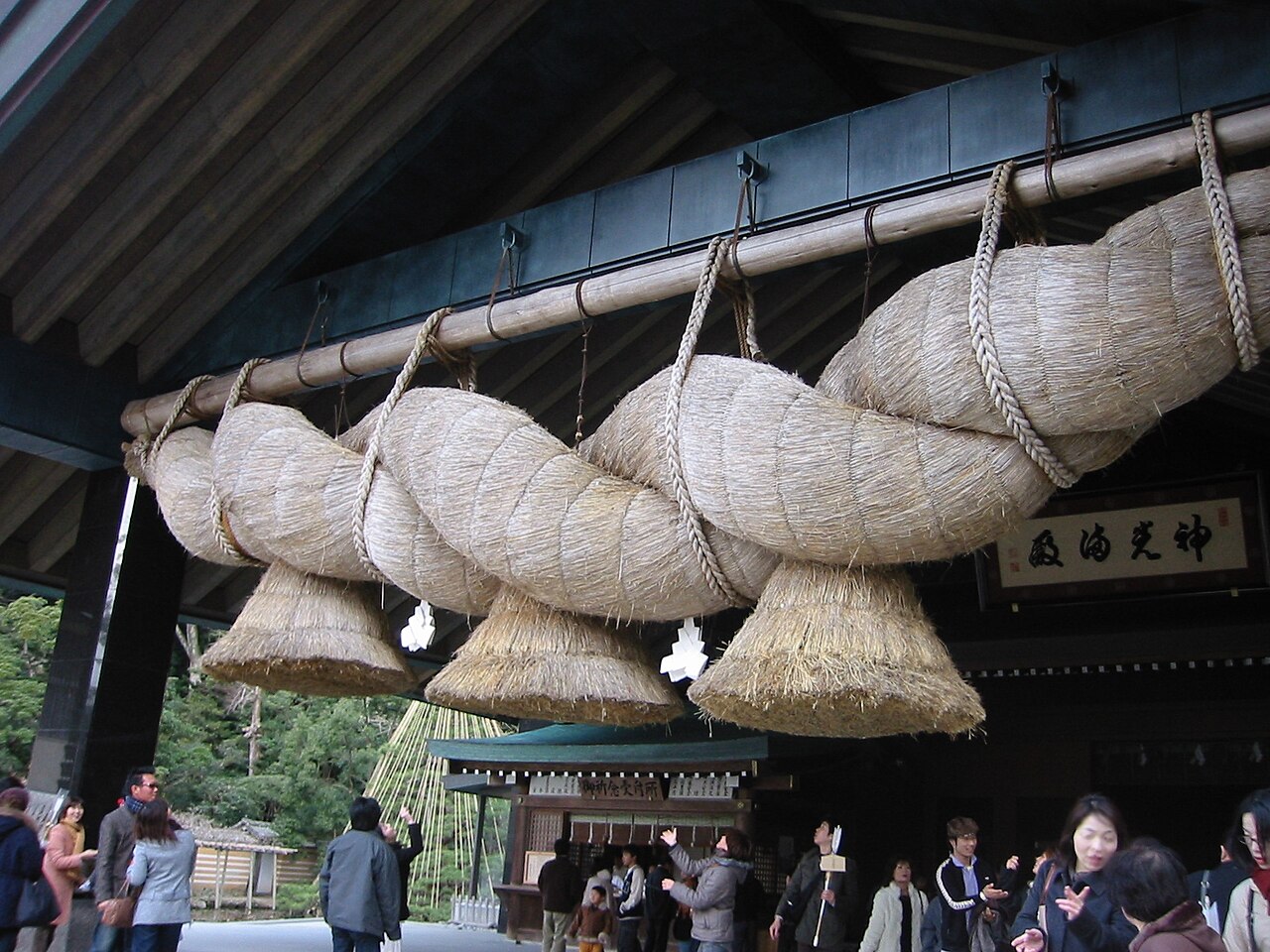
The giant shimenawa at the Kagura-den (kagura hall) of Izumo Taisha, one of Japan's oldest and most important shrines — among the largest shimenawa in the country, twisted from tons of rice straw. Photo: Jnn, CC BY 2.1 JP, via Wikimedia Commons.
Meaning
A 注連縄 is a thick rope, traditionally twisted from rice straw or hemp, that Japanese 神道 (Shinto) uses to mark the boundary of a sacred space. The rope itself is only half the picture — a shimenawa is almost always hung together with shide (紙垂), jagged zigzag strips of white paper (or sometimes cloth) that dangle from it at intervals. The rope marks the line; the shide announce that something sacred lies on the other side of it.
The core idea behind a shimenawa is separation: it draws a visible border between the ordinary, everyday world and a space that has been ritually purified for the kami (Shinto deities) — a concept close to what Shinto calls 結界 (kekkai), a consecrated boundary that ordinary impurity cannot cross. Anything wrapped in a shimenawa — a gate, a tree, a rock, a building — is being marked as this ground is different from the ground around it. It is less a decoration than a kind of signage for the sacred, readable at a glance by anyone raised in the culture.
Shimenawa are traditionally made from 藁 (rice straw), reflecting agricultural Japan's reverence for the rice harvest, though 麻 (hemp) has also long been used, particularly for the shide-like fibers and for the ritually purer varieties used in the Imperial Household and at major shrines. The rope is twisted left-handed (counter-clockwise) rather than the right-handed twist of ordinary utility rope — a small but deliberate detail that marks it as a ritual object rather than something for everyday use.
Where It's Used
Shimenawa appear anywhere Shinto marks a threshold or a sacred presence:
- Torii gates — A shimenawa is often strung across the crossbeam of a 鳥居, reinforcing the gate's own role as a boundary marker with an even more explicit "sacred ground beyond this point" signal.
- Shrine entrances and buildings — The main hall (honden) of a 神社 and its outer gate frequently carry a shimenawa, sometimes an enormous one; the giant rope at Izumo Taisha's Kagura-den, pictured above, is among the largest in Japan and is a popular pilgrimage sight in its own right.
- Sacred trees and rocks — A tree or boulder wrapped in a shimenawa is marked as goshinboku (a sacred tree believed to house a kami) or a sacred rock. The most famous example is Meoto Iwa (夫婦岩), the "Wedded Rocks" off the coast of Futami in Mie Prefecture — two 夫婦岩 joined by a massive shimenawa symbolizing marital union, replaced each year in a public ceremony.
- The sumo ring — A shimenawa is not tied around the 土俵 (dohyo) itself, but a yokozuna, 相撲's highest rank, wears an enormous ceremonial shimenawa around his waist during his ring-entering ritual (dohyo-iri), marking him as a living embodiment of purity and sacred strength in the ring.
- New Year decorations — A small shimenawa, often woven into a wreath called shimekazari, is hung on the front door of ordinary homes and shops around 正月 (New Year), alongside 門松 (kadomatsu) pine-and-bamboo displays. The shimekazari welcomes the New Year's kami (toshigami) into a home that has been marked as clean and worthy of a visit, and it is taken down and ritually burned soon after the holiday.
神社の鳥居に注連縄が張られている。 Jinja no torii ni shimenawa ga harerarete iru. "A shimenawa is strung across the shrine's torii gate."
Cultural and Mythological Origin
The origin story most often told for the shimenawa comes from the Kojiki (712 CE), Japan's oldest chronicle. In the myth, the sun goddess 天照大神 (Amaterasu), enraged and grieved by her brother Susanoo's violent behavior, withdraws into the Ama-no-Iwato (Heavenly Rock Cave), plunging the world into darkness. The other deities, desperate to lure her out, stage a raucous celebration outside the 洞窟 (cave) — culminating in the goddess Ame-no-Uzume's comic dance, which makes the assembled kami laugh so loudly that Amaterasu peeks out to see what she's missing. A god pulls her the rest of the way out, and immediately a rope is stretched across the cave's entrance behind her, so that she can never retreat into the darkness again.
That rope, according to the story, was the first shimenawa. Its purpose in the myth is exactly its purpose in shrines today: not to physically block anything, since a rope stops nothing, but to mark a line that should not be crossed back over — separating the world of light and order from the world of darkness and chaos. From that founding image, the shimenawa became Shinto's standard way of saying: purified space begins here, and by extension, of keeping 邪気 (evil spirits, malign energy) from re-entering ground that has been cleansed.
Making and Renewing a Shimenawa
Shimenawa are not permanent objects. Straw degrades, and a shimenawa is meant to represent freshly purified space, so shrines traditionally replace theirs at set intervals — most commonly at 正月 (New Year), and at some shrines annually or even more frequently for smaller ropes. Large shimenawa, like the famous one at Izumo Taisha (rewoven roughly once every six to eight years) or at Meoto Iwa (renewed several times a year in a public ceremony with local fishermen and priests), are substantial community undertakings requiring tons of straw and dozens of participants, and the ceremony of replacing one is itself treated as a form of worship.
Shimenawa come in a few recognized shapes, distinguished by how the straw is bundled:
| Style | Shape | Common setting |
|---|---|---|
| Gobo-jime (牛蒡締め) | Thick at one end, tapering like a burdock root | Standard style at most shrines |
| Daikoku-jime (大黒締め) | Symmetrical, thick in the middle, tapering at both ends | Named for its resemblance to the mallet of Daikoku, god of wealth |
| Shimekazari (しめ飾り) | Small decorative wreath with shide, pine, and citrus attached | Home and shop entrances at New Year |
Related Terms
- 紙垂 (shide) — the zigzag white paper streamers hung from a shimenawa, worn by Shinto priests, and attached to the gohei wands used in purification rites
- 御神木 (goshinboku) — a tree marked with a shimenawa as the dwelling place of a kami
- 神棚 (kamidana) — the household Shinto altar, which is sometimes fitted with a small shimenawa above the shelf
- 初詣 (hatsumode) — the first shrine visit of the New Year, when shimekazari and fresh shimenawa are most visible at shrines nationwide
- 注連の内 (shime no uchi) — the traditional term for "within the shimenawa," i.e. inside the sacred boundary it marks
Related Dictionary Words
Shinto shrine
Shinto; Shintoism
rope; cord
(fixing) boundaries for religious practices
straw
cannabis (Cannabis sativa); hemp (plant)
Amaterasu Ōmikami (sun goddess)
pair of rocks resembling a married couple (one larger representing the husband, one smaller the wife)
(wrestling) ring
New Year's pine decoration
New Year (esp. first three days)
malice; ill will