相撲
sumōJapan's ancient national sport and ritual martial art in which two rikishi (wrestlers) compete to force each other out of the circular ring or to the ground.
Meaning
相撲 (sumō) is Japan's national sport and one of its oldest martial arts, with a history spanning more than 1,500 years. Two 力士 (rikishi, wrestlers) compete inside a circular clay ring called the 土俵 (dohyō), each attempting to force the other out of the ring or cause any part of the opponent's body other than the soles of their feet to touch the ground. The contest typically lasts only a few seconds, yet within those moments lies a discipline demanding extraordinary strength, technique, balance, and psychological fortitude.
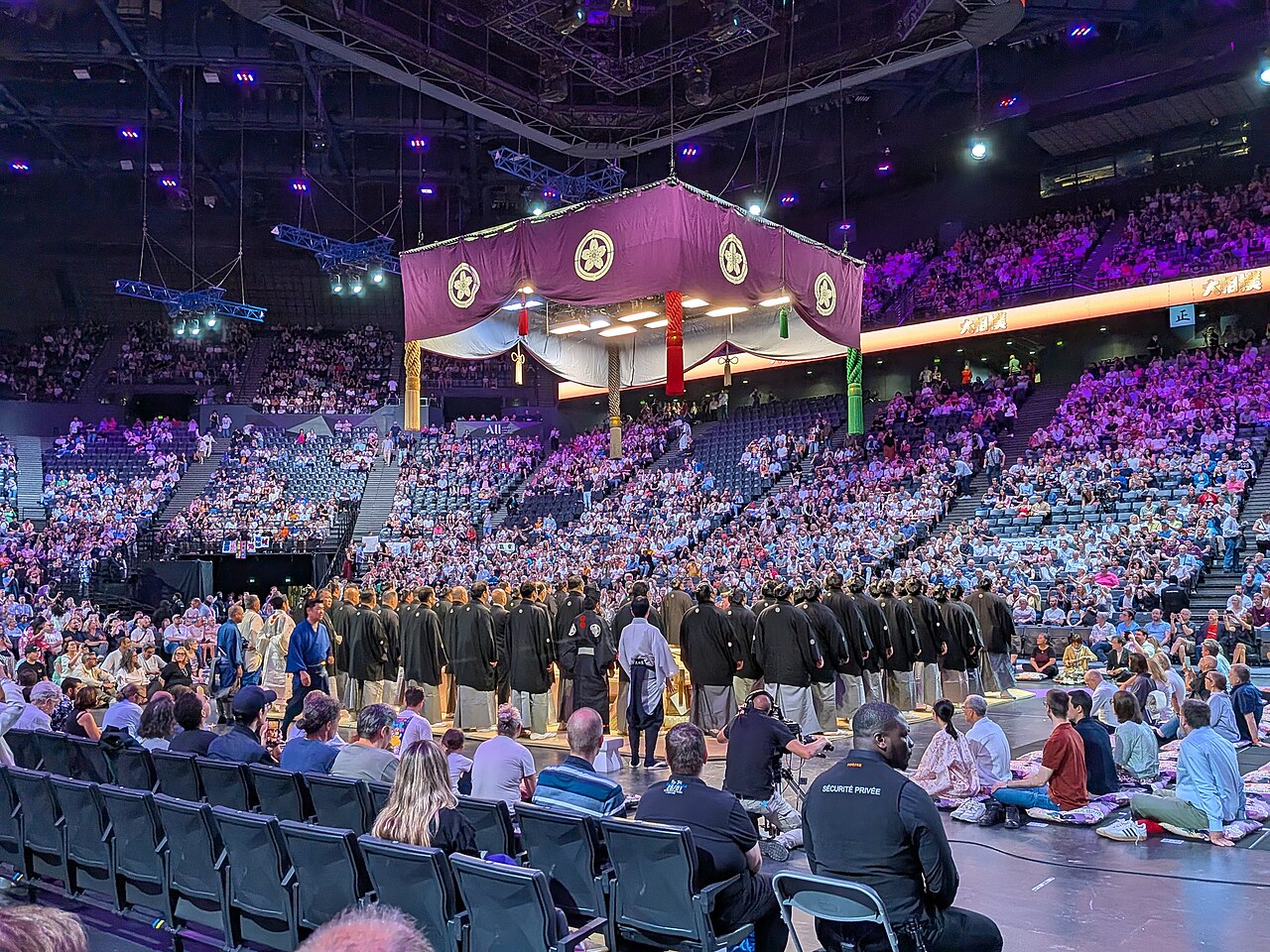
Rikishi competing at a sumo exhibition tournament. Public domain (CC0), via Wikimedia Commons.
The word 相撲 combines the characters 相 (mutual, together) and 撲 (to strike, to hit), reflecting the direct, physical contest between two opponents. Unlike many combat sports, sumo has no weight classes in professional competition — a smaller, technically skilled wrestler can and does defeat opponents many times their size.
Cultural Context
相撲 is inseparable from 神道 (Shinto), Japan's indigenous religion. According to the Kojiki (Record of Ancient Matters, compiled 712 CE), the very fate of the Japanese archipelago was determined by a sumo match between the gods Takemikazuchi and Takeminakata. This divine origin myth elevated sumo far beyond mere sport — it became a sacred ritual performed to please the gods and pray for bountiful harvests.
For centuries, sumo was performed exclusively at Shinto shrines (jinja). The 土俵 itself is considered sacred ground: before every tournament (本場所, 本場所), a 儀式 (ritual) called the dohyō-matsuri consecrates the ring with offerings of rice, dried squid, seaweed, salt, and chestnuts buried beneath the clay. The roof hanging above the professional dohyō — styled after a Shinto shrine roof — makes this spiritual connection architecturally visible.
During the Edo period (1603–1868), sumo developed into the professional spectator sport recognizable today, with stables, rankings, and regular tournaments drawing massive crowds in the cities of Edo (Tokyo), Osaka, and Nagoya.
Rituals and Traditions
Pre-bout rituals are as important as the match itself, and each carries deep meaning.
Salt purification (塩, 塩) Before stepping into the ring, wrestlers throw handfuls of 塩 (salt) to purify the sacred space and ward off evil spirits — an act rooted in Shinto purification rites. Top-ranked wrestlers may throw up to one kilogram of salt before a single bout.
Shiko (四股) Wrestlers perform shiko, the ritual stomping of each foot in turn, to drive evil spirits into the earth and demonstrate strength. The thunderous sound echoes through the arena.
Leg slapping and clapping The ritual leg-slapping and hand-clapping before a match signals readiness and invites the gods to witness.
Dohyō-iri (土俵入り) The ring-entering ceremony performed by the two highest divisions of wrestlers is one of sumo's most visually striking traditions. Yokozuna (横綱, 横綱) — the highest rank — perform their own elaborate version accompanied by two attendants, wearing the distinctive white rope tsuna around their waist. The yokozuna dohyō-iri ceremony is considered the pinnacle of sumo artistry.
The gyōji (行司, 行司) Referees wear elaborate court dress modeled on Heian-period (794–1185) aristocratic costume, and carry a decorative war fan called a gunbai used to signal the start of the match and indicate the winner. Senior gyōji carry a short sword at their belt — a reminder that in earlier times, a referee who made a wrong call was expected to commit ritual suicide.
The yobidashi (呼び出し, 呼び出し) Ring attendants in traditional dress announce each bout by calling the wrestlers' names in a distinctive chanting style and maintaining the ring between bouts.
Ranking System (番付)
The sumo ranking system (番付, banzuke) is a strict hierarchy published before each tournament on handwritten sheets using a traditional calligraphic style that has remained virtually unchanged for centuries.
| Rank | Japanese | Notes |
|---|---|---|
| 横綱 Yokozuna | 横綱 | Highest rank; cannot be demoted, must retire if performance declines |
| 大関 Ōzeki | 大関 | Second rank; most senior active rank that can be demoted |
| 関脇 Sekiwake | 関脇 | Third rank |
| 小結 Komusubi | 小結 | Fourth rank |
| 前頭 Maegashira | 前頭 | The bulk of the top division |
| 十両 Jūryō | 十両 | Second division; first paid professional rank |
| 幕下 Makushita | 幕下 | Third division and below (amateur stipend only) |
Wrestlers who reach the paid professional ranks (関取, sekitori) enjoy significantly elevated status and income. Promotion to Yokozuna is the highest achievable honor — the rank has been held by only 73 wrestlers in recorded history. A yokozuna is expected not just to win, but to win with dignity and grace; poor performance requires voluntary retirement rather than demotion.
The Stables (相撲部屋)
All professional wrestlers live and train in 相撲部屋 (sumo stables), communal training houses managed by a retired wrestler who has become an 親方 (stable master). Life in the stable is strictly hierarchical: junior wrestlers wake before dawn to prepare the training hall, cook meals, clean, and serve senior wrestlers — before undertaking their own hours of intensive 稽古 (training).
The stable system shapes every aspect of a wrestler's life. Wrestlers wear traditional dress (yukata or kimono) in public, maintain their hair in the chonmage topknot, and follow strict codes of conduct. The system is designed to produce not merely athletes but exemplars of discipline, perseverance, and respect for tradition.
The Six Grand Tournaments (本場所)
Professional sumo holds six official grand tournaments (本場所, honbasho) per year, each lasting 15 days:
| Tournament | Month | Location |
|---|---|---|
| Hatsu Basho (初場所) | January | Ryōgoku Kokugikan, Tokyo |
| Haru Basho (春場所) | March | Osaka Prefectural Gymnasium |
| Natsu Basho (夏場所) | May | Ryōgoku Kokugikan, Tokyo |
| Nagoya Basho (名古屋場所) | July | Dolphins Arena, Nagoya |
| Aki Basho (秋場所) | September | Ryōgoku Kokugikan, Tokyo |
| Kyushu Basho (九州場所) | November | Fukuoka Kokusai Center |
The wrestler with the most wins in a tournament earns the yūshō (優勝, tournament championship). Winning the yūshō is the ultimate goal of every basho, and a wrestler who wins the Emperor's Cup is presented to Japan's Emperor. Between tournaments, wrestlers undertake regional tours (巡業, jungyo) bringing sumo to cities without permanent venues.
Techniques (技, Waza)
Sumo recognizes 82 official winning techniques (kimarite). These fall into broad categories:
- Oshi-zumo (押し相撲): Thrusting and pushing — favored by heavier, powerful wrestlers who win through 突き押し (frontal thrust and push)
- Yotsu-zumo (四つ相撲): Belt-grappling — technique-focused wrestling gripping the opponent's [まわし] (mawashi, loincloth belt), using throws and trips
- Throwing techniques (投げ): Numerous arm throws, belt throws, and over-arm throws
- Leg trips and sweeps: Including the spectacular 蹴手繰り (heel hook sweep)
A match begins when both wrestlers simultaneously charge (tachi-ai, 立ち合い). The initial charge is critical — a well-timed tachi-ai can win the bout outright, throwing an opponent completely off balance in the first instant of contact.
Famous Rikishi Through History
Raiden Tameemon (雷電為右エ門, 1767–1825): Considered the greatest wrestler of the pre-modern era, Raiden amassed a career record of 254 wins and only 10 losses over 28 years of competition — yet was never promoted to yokozuna, possibly because his dominant technique (elbow strikes) was banned to prevent him winning every match effortlessly.
Tochigiyama Moriya (栃木山守也, 1892–1959): The last yokozuna of the Meiji-era style, Tochigiyama won 10 tournaments with a record of 202 wins against just 9 losses. He retired undefeated.
Chiyonofuji Mitsugu (千代の富士貢, 1955–2016): Known as "The Wolf," Chiyonofuji dominated 1980s sumo with extraordinary musculature and technique. He won 31 tournaments and 1,045 career bouts — a record at the time — earning him the People's Honor Award from the Japanese government.
Asashōryū Akinori (朝青龍明徳, born 1980): The Mongolian-born yokozuna became one of sumo's most dominant and controversial champions. He won 25 tournaments and in 2005 became the first wrestler to win all six tournaments in a single calendar year (an achievement called roku basho zensho).
Hakuhō Shō (白鵬翔, born 1985): Widely regarded as the greatest sumō wrestler of all time, Hakuhō holds the all-time records for career wins (1,187), tournament championships (45), and consecutive wins (63). The Mongolian-born yokozuna dominated sumo for nearly two decades before retiring in 2021.
Global Appeal and Modern Sumo
While sumo remains a deeply Japanese institution, the sport has undergone remarkable internationalization. Since the 1990s, wrestlers from Mongolia, Georgia, Eastern Europe, Egypt, and beyond have risen to the sport's highest ranks. Of the 73 yokozuna in history, 4 have been Mongolian, and Mongolian wrestlers dominated the sport for much of the 2000s and 2010s.
This globalization has prompted ongoing debate within Japan about preserving sumo's cultural character while embracing international talent. The Japan Sumo Association (日本相撲協会) maintains strict limits on the number of foreign-born wrestlers per stable (one per stable), attempting to balance openness with cultural continuity.
Sumo has also grown as a spectator sport internationally, with exhibition tournaments (jungyo) held in Paris, London, New York, and Las Vegas drawing large audiences. NHK World broadcasts tournaments with English commentary, and major bouts routinely trend on social media worldwide.
Despite — or perhaps because of — its ancient roots, sumo occupies a unique place in Japanese cultural life: a living ritual connecting modern Japan to its mythological origins, performed by giants in loincloths beneath a Shinto shrine roof, watched by millions.
相撲は日本の国技であり、神道の精神が息づく伝統芸能でもある。 Sumo is Japan's national sport and also a traditional performing art in which the spirit of Shinto lives.
Related Dictionary Words
sumo (wrestling)
sumo wrestler; rikishi
yokozuna (highest rank in sumo); grand champion
ōzeki (second highest rank in sumo)
(wrestling) ring
official sumo tournament (six per year); Grand Sumo Tournament; honbasho
ranked list (entertainers, sumo wrestlers, millionaires, etc.)
practice; practising; training; study
referee
stable