デコラ
dekoraA maximalist Harajuku street fashion style built on layering as many toys, hair clips, and neon accessories as possible for an overwhelming, joyfully childlike look.
Meaning
デコラ (dekora), often called decora-kei (デコラ系) or decora fashion in English, is a Japanese street style defined by piling on the maximum possible number of colorful accessories: dozens of plastic hair clips, stacked bracelets, chunky beaded necklaces, safety pins, stickers, and small toys layered over brightly colored, often mismatched clothing. The name comes from the English word "decoration" shortened and Japanized, and the aesthetic philosophy is essentially "more is more." Where most fashion subcultures aim for a cohesive silhouette, decora deliberately rejects restraint — a single outfit might include forty hair clips, five layered necklaces, leg warmers, and a backpack covered in charms, all at once.
The look is closely associated with 可愛い (kawaii, "cute") culture taken to its most extreme, saturated form: bright primary colors, cartoon character merchandise (Hello Kitty, Rilakkuma, Pokémon), fluorescent plastic jewelry, and a general refusal of adult minimalism. Practitioners are sometimes called デコラー (dekoraa) or デコラちゃん (dekora-chan).
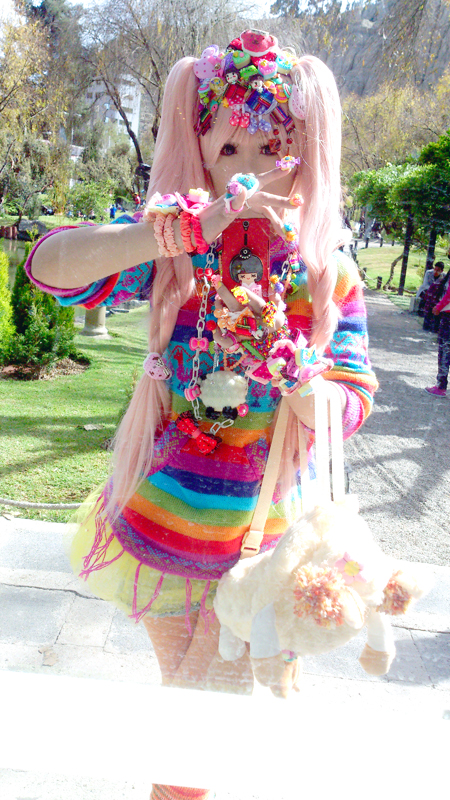
A rainbow-colored decora outfit showing the characteristic layering of hair clips, beads, and accessories. Photo: KazumiKawaii, CC BY-SA 4.0, via Wikimedia Commons.
Usage
Decora is used both as a noun for the style itself and as an adjective (decora-kei, デコラ系) to describe a person, outfit, or item.
今日はデコラ系のコーデにしてみた!ヘアクリップ全部つけたよ。 Kyō wa dekora-kei no kōde ni shite mita! Heakurippu zenbu tsuketa yo. "I tried a decora-style outfit today! I put on all my hair clips."
あの子、めっちゃデコラだね。アクセサリーどこで買ってるの? Ano ko, meccha dekora da ne. Akusesarii doko de katteru no? "That girl is so decora. Where does she buy her accessories?"
Within Harajuku fashion communities, decora is also treated as a specific sub-style distinct from its neighbors — a person might say they wear fairy kei (softer pastels) or pop kei (bold saturated colors, sometimes considered decora's close cousin) rather than pure decora, depending on the color palette and toy density of their outfit.
Cultural Context
Decora fashion emerged in the mid-to-late 1990s and peaked in the 2000s on 原宿's Takeshita Street (竹下通り), the narrow pedestrian shopping street that became the epicenter of Japan's most experimental youth fashion. It developed alongside and in dialogue with other Harajuku street styles documented in FRUiTS magazine, the influential street-snap publication (1997–2017) that gave international audiences their first look at decora, gyaru, and other Harajuku subcultures.
A key figure in decora's rise was designer and artist Sebastian Masuda, who opened the shop 6%DOKIDOKI on Takeshita Street in 1995. The shop sold the neon plastic jewelry, toys, and accessories that became decora's building blocks, and Masuda later served as art director for pop star Kyary Pamyu Pamyu, whose maximalist, toy-covered visual style in the early 2010s brought decora-adjacent aesthetics to a global pop audience and sparked a second wave of interest in the style.
Decora is often discussed as a rebellion against two different pressures at once: the restraint of conventional Japanese fashion norms, and the sexualized adult femininity found in styles like gyaru. Instead, decora deliberately embraces childishness — toys, cartoon characters, and primary colors associated with small children — as a way for teenagers and young adults to opt out of growing up on schedule. Scholars and fashion writers have connected this to a broader Harajuku-era impulse (shared with mori girl and lolita fashion) to build an entire alternate identity through clothing, one assembled from cheap, collectible objects rather than expensive designer pieces.
By the mid-2010s, foot traffic and rents on Takeshita Street shifted toward tourist-oriented shops, and the loose network of street-style subcultures that had defined 1990s–2000s Harajuku — decora included — became far less visible in daily life. FRUiTS magazine's founder announced in 2017 that he had stopped publishing new issues because he could no longer find enough interesting outfits to photograph on the street. Decora nonetheless remains one of the most internationally recognized Japanese fashion subcultures, referenced constantly in retrospectives on 2000s Harajuku, kept alive by devoted online communities, and revived in fragments by younger wearers mixing it with contemporary genderless kei and kawaii fashion trends.
Variations
| Style | Color palette | Key features |
|---|---|---|
| Decora (classic) | Neon, primary colors | Maximum accessory density, hair clips, plastic toys |
| Fairy kei | Pastel | Softer 1980s-inspired palette, fewer but larger accessories |
| Pop kei | Bold saturated colors | Similar density to decora, more emphasis on graphic prints |
| Yume kawaii ("dream kawaii") | Pastel with dark accents | Later 2010s evolution mixing cute and unsettling imagery |
Related Words
- 原宿系 (harajuku-kei) — "Harajuku style," the broader umbrella term for Takeshita Street subcultures
- 竹下通り (Takeshita-dōri) — the street most associated with decora shops and street snaps
- 個性的 (kosei-teki) — "individualistic," a word frequently used to praise a striking decora outfit
Related Dictionary Words
Decola (brand-name laminate similar to Formica, made of melamine resin)
cute; adorable; charming; lovely; pretty
individuality; personality; quirk; idiosyncrasy; character; individual characteristic
showy; loud; flashy; gaudy
ornament; decoration
hair ornament
accessory (fashion); jewelry
fluorescent color; fluorescent colour
young person; youngster; young people; (the) youth
peculiarity; uniqueness; characteristic
individual; distinctive; unique; characteristic; personal; idiosyncratic