ぼろ
boroThe Japanese tradition of patching and mending worn indigo cotton and hemp textiles with layered scraps and running stitches, born of rural poverty and now celebrated internationally as folk art and a model for sustainable, visible mending.
Meaning
ぼろ (boro) literally means "rags," "tatters," or "scraps" — a plain, unglamorous word for a plain, unglamorous origin. As a textile tradition, boro refers to Japanese garments and household 布 (cloth) items — work coats, 布団 covers, sleeping mats, aprons — that were built up over years or even generations by layering 古布 (old fabric) scraps on top of worn spots and stitching everything together to hold. Where a single hole might be patched once, a boro piece has often been patched, re-patched, and patched again, so that the original base cloth all but disappears beneath a quilt-like accumulation of 継ぎ (patches) in different weights, weaves, and shades of 藍 (indigo) blue.
Boro is not a stitching technique in itself — that is 刺し子 (sashiko), the running-stitch embroidery most often used to bind boro's layers together (see "Boro vs. Sashiko" below). Boro is the object: the finished, heavily mended garment or textile, and by extension the whole practice of textile reuse that produced it. A boro coat could contain fragments of a dozen older garments, each patch a small record of a specific repair made at a specific point in a family's history.
How Boro Was Made
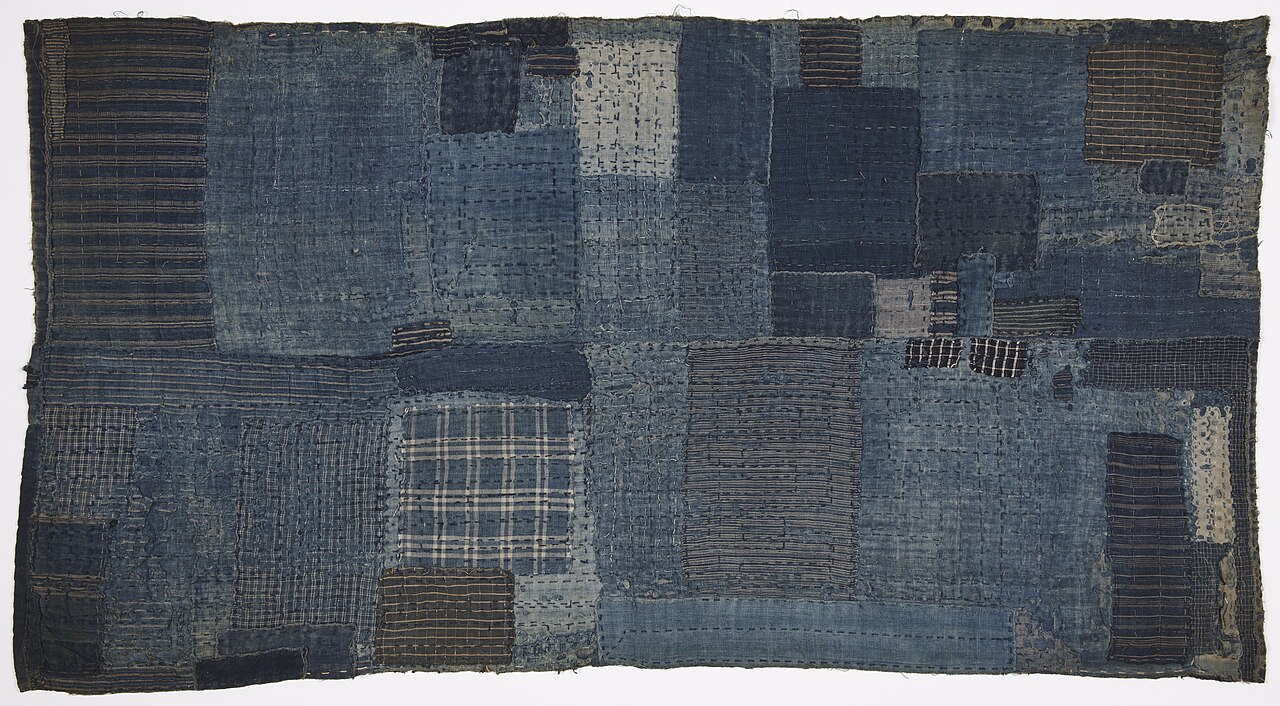
A child's sleeping mat (boro shikimono) composed of several layers of indigo-dyed cotton, patched and heavily stitched, late 19th century. Public domain, Cooper Hewitt, Smithsonian Design Museum, via Wikimedia Commons.
Boro developed as a direct response to material scarcity. In the cold, agrarian villages of 東北 (Tōhoku) and other rural regions, cotton could not be grown locally and had to be imported from warmer parts of Japan, making it expensive and hard to obtain. 木綿 (cotton cloth) and hemp were treated as far too valuable to throw away, so when a garment wore through, a household did not discard it — they patched it.
The process was cumulative and practical rather than decorative:
- Base garment: Usually a work coat in the noragi style, a 布団 cover, or sleeping mat, most often woven from hemp or 木綿 and dyed with 藍染め (indigo dyeing), which was cheap, colorfast, and believed to have insect-repellent and mildly antiseptic properties — practical virtues for clothing worn hard in the fields.
- Patching: When fabric wore thin or tore, a new 端切れ (scrap) of cloth — often salvaged from an even older, already-discarded garment — was layered over the weak spot.
- Reinforcement: The patch was fixed in place with running stitches, frequently in the 刺し子 style, which both anchored the patch and added structural strength and warmth by trapping air between the layers.
- Repetition: Over years, and sometimes across more than one generation, this process repeated dozens of times on the same piece, so that a single boro garment could be a literal patchwork of fabric spanning decades of a family's 修繕 (mending) history.
Because boro pieces were made by anonymous farm and fishing families rather than professional weavers or artisans, no two are alike — each is a one-off, dictated entirely by which scraps happened to be on hand when a hole needed covering. Unlike パッチワーク (Western-style quilting), which is typically planned with pattern and color in mind from the outset, boro was assembled reactively, patch by patch, purely in the interest of keeping cloth usable one more winter.
Boro vs. Sashiko
Boro and sashiko are frequently mentioned together — and this site has a separate sashiko article — but the two terms describe different things:
| Boro (ぼろ) | Sashiko (刺し子) | |
|---|---|---|
| What it is | The patched, layered textile object itself | A running-stitch embroidery technique |
| Purpose | Reuse and extend the life of worn cloth | Reinforce fabric and (later) create decorative geometric patterns |
| Focus | The accumulated patches and layers of fabric | The regularity and pattern of the stitches |
| Relationship | Boro garments are often held together using sashiko stitching | Sashiko can be used on new cloth, without any boro patching at all |
Put simply: sashiko is a stitch, boro is a garment. A boro coat is frequently sewn with sashiko stitches, but sashiko embroidery is used far more broadly — on brand-new indigo cloth, on modern quilts, on decorative panels — without any connection to the poverty-driven patchwork tradition that defines boro.
Cultural Context: From Shame to Folk Art
For most of its history, boro carried no positive associations at all. It was, quite simply, what poor people wore because they had no alternative. Through the Edo period (1603–1868) and into the early Shōwa era (1926–1989), boro textiles marked a household as unable to afford new cloth — a visible sign of 貧困 (poverty) rather than a craft to be admired.
That stigma outlived the hardship that produced it. As Japan rebuilt and prospered after the Second World War, boro came to represent a past that families actively wanted to forget. Old patched coats and bedding were burned or destroyed rather than kept, and entire households' worth of textiles vanished within a generation or two — historians and collectors estimate that the vast majority of boro pieces that once existed no longer survive.
What did survive was preserved almost by accident, largely through the efforts of a handful of collectors, most famously the folklorist Chūzaburō Tanaka (1933–2013), who spent decades gathering discarded boro textiles from rural Tōhoku before they disappeared entirely, ultimately amassing nearly 30,000 folk artifacts. From 2009 to 2019, roughly 1,500 pieces from his collection were on permanent display at the Amuse Museum in Tokyo's Asakusa district, one of the first institutions dedicated to boro as 民芸 (folk craft) rather than mere rag. Since the museum's closure, the Tanaka collection has continued to travel internationally as touring exhibitions.
By the late twentieth century, attitudes had reversed almost completely. Art dealers, textile 収集家 (collectors), and 美術館 (museums) began to treat boro not as evidence of want but as a distinct form of Japanese folk art — abstract, improvised compositions of indigo and patch that stand comparison with modern art. Fine art auction houses now sell striking boro pieces for significant sums, and museum exhibitions have presented them beside contemporary textile and fine art.
International Influence
Boro's rehabilitation has extended well beyond Japan. Since the 2000s and especially the 2010s, boro's aesthetic — irregular patches, visible mending, indigo-on-indigo layering — has become a recognizable reference point in international fashion and craft circles.
- High fashion: Japanese labels such as Kapital and Visvim have built signature looks around boro-inspired patchwork and indigo dyeing. Boro motifs have also reached major international runways — Louis Vuitton's 2013 Spring/Summer Paris menswear collection and Joseph Altuzarra's 2014 Spring/Summer New York collection both drew visibly on boro patchwork and indigo layering.
- Visible mending: The global "visible mending" movement — deliberately repairing clothing with contrasting, eye-catching stitches rather than hiding the repair — draws directly on boro's example of turning necessity into a distinguishing feature rather than something to disguise.
- Slow fashion and sustainability: As concern about textile waste and fast fashion has grown, boro is frequently cited as a historical precedent for 再利用 (reuse) — proof that a garment's working life can be extended indefinitely rather than treated as disposable.
Boro and Japanese Aesthetics
Boro's modern reappraisal is often framed through two closely related Japanese aesthetic ideas, both of which already have their own articles on this site:
- Wabi-sabi (侘び寂び) — the appreciation of imperfection, wear, and impermanence. A boro textile, with its faded patches and visible age, embodies wabi-sabi almost literally: beauty found not despite the wear but because of it.
- Kintsugi (金継ぎ) — the ceramic repair tradition that highlights a break with gold lacquer rather than hiding it. Boro follows the same underlying logic in cloth form: repair is displayed, not disguised, and the visible mend becomes the object's most expressive feature.
Where a Western instinct might be to patch invisibly, or replace a worn item outright, boro — like kintsugi — treats the marks of repair as worth keeping in plain sight.
Related Traditions
- Sashiko (刺し子) — the running-stitch technique most commonly used to construct and reinforce boro pieces
- Furoshiki (風呂敷) — another Japanese textile tradition built around reuse, in this case wrapping and carrying cloth used repeatedly instead of disposable packaging
- Kintsugi (金継ぎ) — gold-seam ceramic repair, the pottery counterpart to boro's philosophy of visible mending
- Wabi-sabi (侘び寂び) — the aesthetic framework most often used to explain boro's modern appeal
- もったいない (mottainai) — the Japanese ethic of not wasting, the practical mindset underlying boro's creation long before it had any aesthetic value attached to it
Related Dictionary Words
tremendous; huge; enormous; resounding
cloth; fabric; material; textile
patch; patching
dyer's knotweed (Persicaria tinctoria, used to produce indigo dye)
indigo dye
cotton (material)
recycled cloth
scrap of cloth; odds and ends
poverty; penury; need; destitution
repair; mending
reuse; recycling
folk craft; folk art
north-east
collector
art museum; art gallery