村上隆
Murakami TakashiContemporary Japanese artist who founded the Superflat movement, blending ukiyo-e and otaku aesthetics with global luxury and pop-culture collaborations.
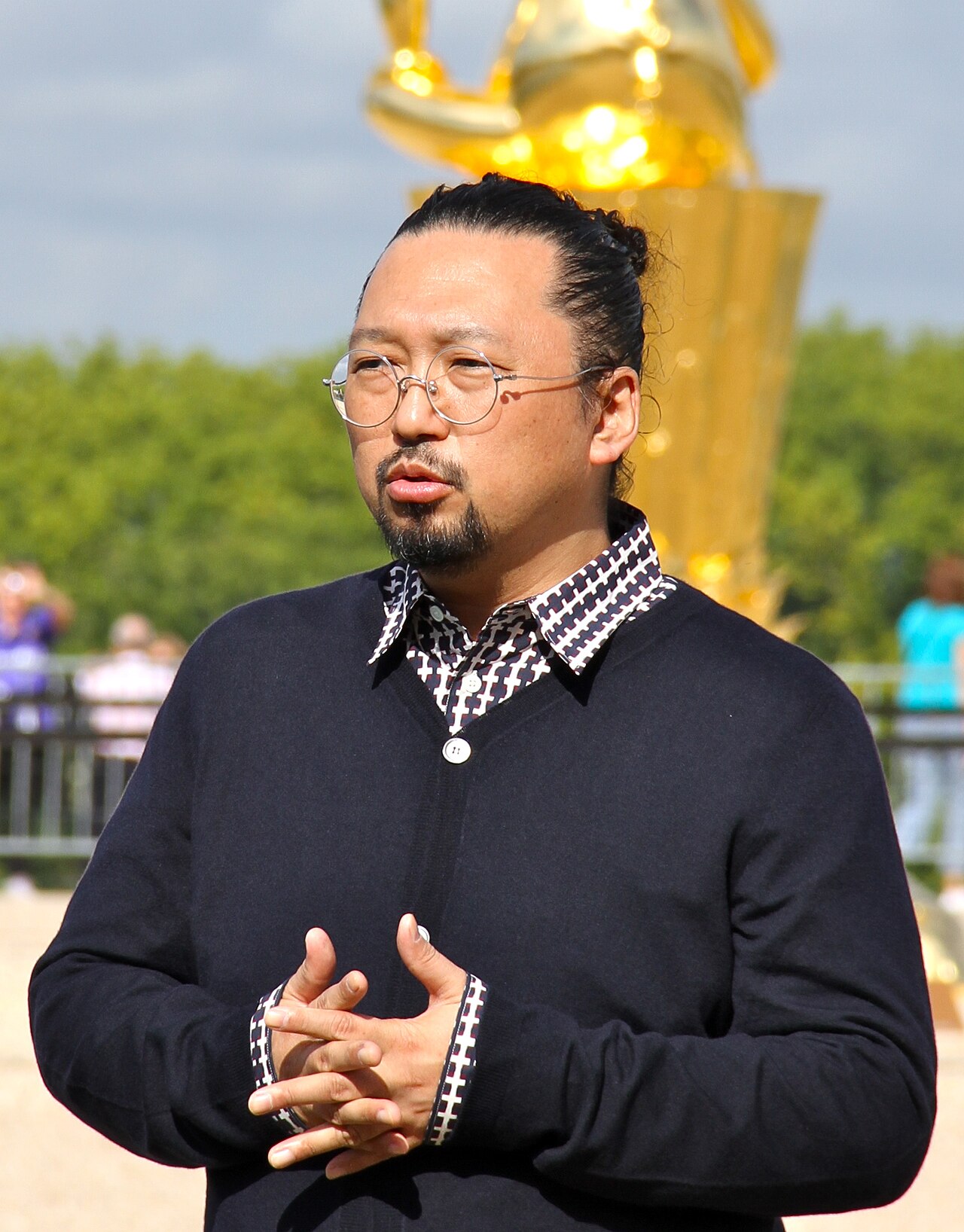
Takashi Murakami at the Palace of Versailles, September 2010, during his landmark exhibition there. Photo: Sodacan, public domain, via Wikimedia Commons.
Meaning
村上隆 (Murakami Takashi, born 1962) is arguably the most internationally famous living 芸術家 (geijutsuka, "artist") from Japan. He is best known as the creator of Superflat (スーパーフラット, sūpāfurato), a theory and art movement he formulated around 2000 that argues Japanese visual culture — from Edo-period 浮世絵 woodblock prints to postwar anime, manga, and otaku subculture — shares a common formal trait: a deliberate flattening of pictorial space, with no illusionistic depth, and a matching flattening of the boundary between "high art" and commercial pop imagery.
Murakami runs his own art-production studio and management company, Kaikai Kiki Co., Ltd. (カイカイキキ株式会社), which employs dozens of assistants in a workshop system modeled partly on Andy Warhol's Factory and partly on traditional 美術 ateliers, and which also manages younger Japanese artists' careers and organizes the GEISAI art fairs.
His signature motif is a grinning, multicolored flower (Murakami Flower), which recurs across paintings, sculptures, inflatables, phone cases, skateboards, and luxury handbags — an image as recognizable, in its own register, as Mickey Mouse or the Louis Vuitton monogram it has literally been printed alongside.
Superflat Theory
Murakami articulated Superflat in his 2000 exhibition and accompanying essay/book Superflat, arguing three interlocking claims:
- Formal flatness as a Japanese pictorial lineage. Ukiyo-e prints, 江戸-period screen painting, and later anime/manga cel art all favor flat, outlined, two-dimensional compositions over Western linear perspective. Murakami frames this as a continuous native visual grammar running from artists like Hokusai through to contemporary character design.
- Flattening of "high" and "low" culture. In postwar Japan, Murakami argues, the historical hierarchy separating fine art from commercial illustration, anime, and otaku fandom collapsed — partly as a side effect of Japan's demilitarized, consumer-driven postwar culture. Superflat art treats a Louis Vuitton bag print and a museum canvas as operating on the same plane of value.
- Flattening of surface and meaning. Beneath the bright, cute exteriors, Murakami frequently embeds unsettling or melancholic content — mutated creatures, nuclear anxiety, or the psychic wounds of postwar Japan — so that "superflat" surfaces can carry real depth of meaning despite their visual flatness.
This theory doubled as a savvy curatorial and marketing framework: it gave Western museums and collectors, largely unfamiliar with anime and otaku aesthetics, an art-historical vocabulary for taking them seriously.
Signature Works and Motifs
| Work / Series | Description |
|---|---|
| Mr. DOB | Murakami's recurring mascot character, a mutating Mickey-Mouse-like figure with sharp teeth, first introduced in the early 1990s as a stand-in for the artist himself |
| Flower motif | Smiling, multicolored daisy-like flowers, used across paintings, sculpture, and merchandise since the late 1990s |
| 727 (1996) | A large superflat painting, named after a Boeing 727 flight Murakami took, depicting a mutant sea-creature version of Mr. DOB against a wave motif recalling Hokusai's Great Wave |
| My Lonesome Cowboy (1998) | A life-size fiberglass figure in an explicit otaku/anime pin-up style; sold at auction in 2008 for over 15 million USD, a record at the time for a living Japanese artist |
| Louis Vuitton Multicolore (2003) | A reimagined version of the house's classic monogram in 33 colors, created with designer Marc Jacobs |
Cultural Context
Murakami studied traditional 日本画 (nihonga, Japanese-style) painting at the Tokyo University of the Arts, eventually earning a PhD, before turning toward otaku aesthetics and contemporary art in the 1990s. His work sits at the intersection of several currents: the reappraisal of ukiyo-e as a genuinely radical, commercially-produced popular art form in its own time (much like 葛飾北斎's prints); the postwar explosion of manga and anime as Japan's dominant visual export; and a Western contemporary-art market hungry for a "brand name" Japanese artist to sit alongside figures like 草間彌生.
Superflat also functions as cultural critique. Murakami has argued that Japan's "childish," cute, commercialized culture is partly a product of the trauma and infantilization imposed by defeat in World War II and the American occupation — a darker reading beneath the 笑顔 of his flower paintings that curators and critics debate to this day.
Commercial Reach and Collaborations
Murakami is unusual among contemporary artists for explicitly refusing to treat commerce and fine art as opposites — a direct, practical extension of Superflat's flattening of "high" and "low." Major collaborations include:
- Louis Vuitton (2003–present): reimagined monogram canvases, and later cherry-blossom and "Panda" collections with creative director Pharrell Williams
- Kanye West: designed the animated album cover art for Graduation (2007)
- Blackpink: co-branded merchandise and lightstick designs
- Virgil Abloh, Vans, ComplexCon, and various streetwear/toy makers: limited-edition sculptures, skate decks, and vinyl figures through Kaikai Kiki
Murakami has described this commercial strategy candidly as an extension of his art-historical argument: if ukiyo-e printmakers freely sold mass-produced, commercially-oriented images to the 大衆 (taishū, "general public") in the Edo period, there is no meaningful reason contemporary "fine art" should refuse mass production, merchandising, and 大量生産-style collaborations today.
Legacy
Murakami's Superflat theory reshaped how museums, collectors, and critics discuss anime, manga, and otaku visual culture — moving it from a niche subcultural curiosity toward a recognized lineage within Japanese and global 現代 art history. Major retrospectives have been staged at institutions including the Museum of Contemporary Art, Los Angeles; the Palace of Versailles; and the Mori Art Museum in Tokyo. Through Kaikai Kiki and GEISAI, he has also actively mentored and promoted a younger generation of Japanese artists working in similarly hybrid pop/fine-art registers.
Related Terms
| Term | Reading | Meaning |
|---|---|---|
| スーパーフラット | sūpāfurato | Superflat (Murakami's art theory/movement) |
| 現代美術 | gendai bijutsu | Contemporary art |
| おたく | otaku | Obsessive fan/enthusiast subculture |
| 浮世絵 | ukiyo-e | Edo-period woodblock prints |
| 日本画 | nihonga | Traditional Japanese-style painting |