喜多川歌麿
Kitagawa UtamaroThe Edo-period ukiyo-e master who perfected bijin-ga portraiture, pioneering close-up "large-head" okubi-e prints that captured women's fleeting emotions and psychology like no artist before him.
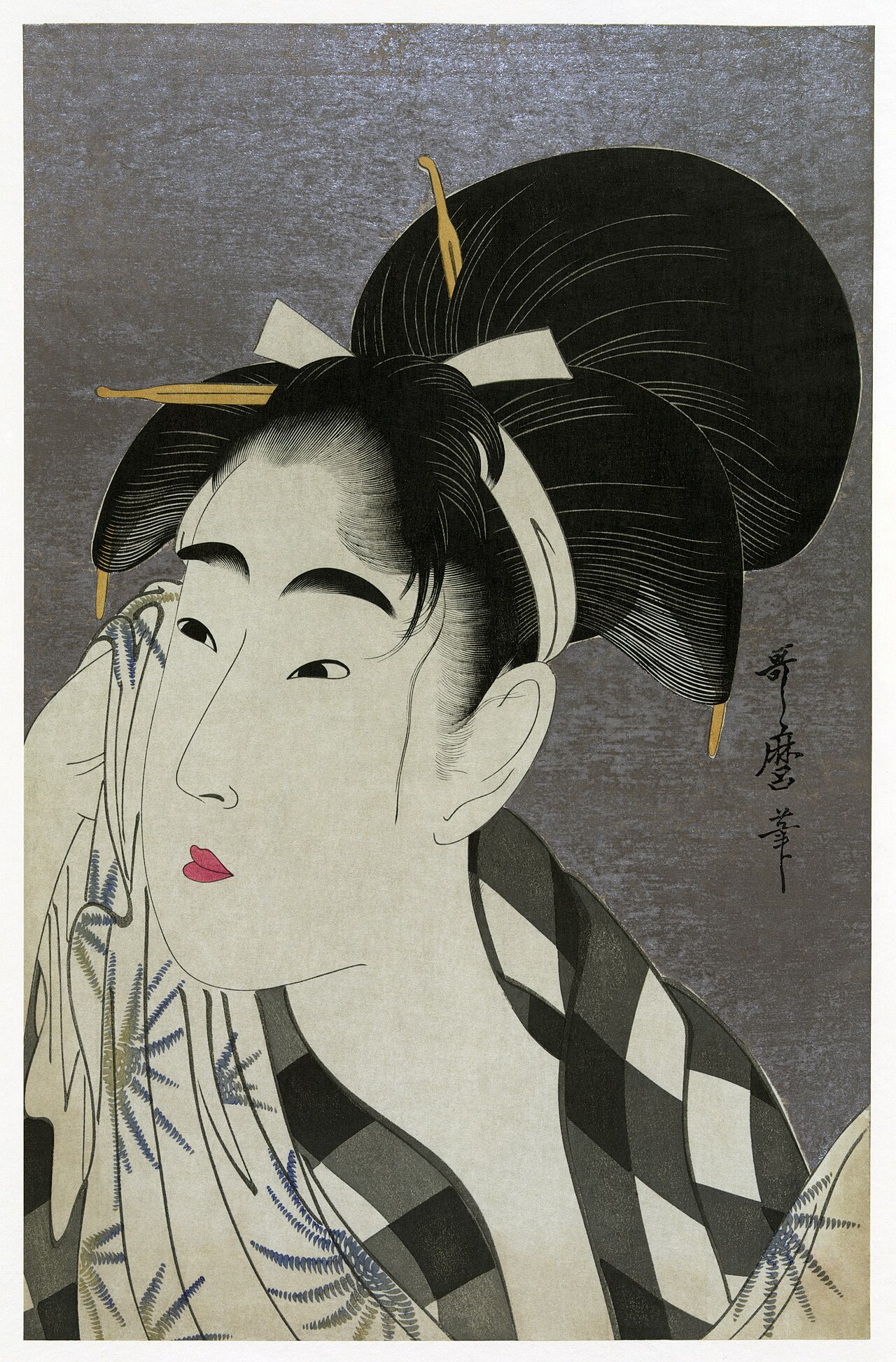
"Woman Wiping Sweat" (汗を拭く女, Ase o fuku onna), a large-head (okubi-e) portrait by Kitagawa Utamaro, c. 1798. Public domain, Library of Congress, via Wikimedia Commons.
Kitagawa Utamaro (喜多川歌麿, c. 1753–1806) was a 浮世絵 (ukiyo-e, "pictures of the floating world") 絵師 of the mid-to-late Edo period, and the artist most responsible for turning 美人画 (bijin-ga, "pictures of beautiful women") into a vehicle for genuine psychological portraiture. Where earlier prints of women were often decorative and generic, Utamaro pushed in close, isolating a face and upper body to capture a specific, momentary mood — a technique known as 大首絵 (ōkubi-e, "large-head picture"). Alongside Hokusai and Hiroshige, he stands as one of the three names most Westerners associate with Japanese woodblock art, even though his own subject was people rather than landscape.
Meaning
Utamaro's reputation rests on how he reimagined the female portrait. Prior to him, bijin-ga prints tended to show full-length figures in elaborate kimono, valued as much for costume and setting as for the individual depicted. Utamaro instead zoomed in, cropping the composition at the chest or shoulders so the face filled the frame. This let him render subtleties that full-body prints couldn't: a sidelong glance, a parted lip, the tension in an eyebrow, the specific way a courtesan or teahouse waitress held her expression while gossiping, drinking tea, or catching her own reflection in a mirror.
His best-known series applying this idea, Ten Types of Female Physiognomy (婦人相学十躰, Fujin Sōgaku Juttai) and its companion series Ten Learned Studies of Women (婦女人相十品, Fujo Ninsō Juppin), treated women almost like specimens of temperament and character — cataloguing "types" the way a physiognomist might read faces for personality. Prints such as Woman Wiping Sweat, The Poem of the Pillow (歌まくら, Uta-makura), and portraits of famous beauties of his day like Naniwa Okita and Takashima Ohisa (real teahouse women whose faces became recognizable "celebrity" likenesses across Edo) show the same instinct: catch an ordinary private gesture and elevate it to something monumental.
Usage
In discussions of Japanese art history, Utamaro's name functions as shorthand for the bijin-ga genre at its peak, much as Hokusai's does for landscape prints:
歌麿は大首絵という手法で美人画に新しい表現をもたらした。 Utamaro wa ōkubi-e to iu shuhō de bijin-ga ni atarashii hyōgen o motarashita. "Utamaro brought a new form of expression to bijin-ga through the technique known as ōkubi-e."
彼の作品は遊女や町娘の一瞬の表情を繊細に描いている。 Kare no sakuhin wa yūjo ya machimusume no isshun no hyōjō o sensai ni egaite iru. "His works delicately depict the fleeting expressions of courtesans and townswomen."
Collectors and museums still use "an Utamaro" as a category label the way one might say "a Rembrandt portrait" — implying a close, expressive, individualized face rather than a generic figure.
Biography
Details of Utamaro's early life are hazy — even his birth year is disputed (sources give 1753 or 1754) — but he trained under the artist Toriyama Sekien in Edo (modern 江戸/Tokyo) before beginning his own print career in the 1770s and 80s. His breakthrough came through his partnership with the publisher Tsutaya Jūzaburō, one of the most influential 版元 (print publishers) of the era, who backed increasingly ambitious print series and illustrated books through the 1790s — the decade generally considered Utamaro's artistic peak.
Utamaro's career ended badly: in 1804 he was arrested and briefly imprisoned, then placed under a form of house arrest, after producing prints depicting the 16th-century warlord Toyotomi Hideyoshi with his concubines — a subject the Tokugawa shogunate's censors considered disrespectful toward a historical ruler, and by extension an implicit criticism of the current regime. He died not long after, in 1806, his health reportedly broken by the ordeal.
Legacy and Influence on the West
Like Hokusai, Utamaro's prints reached Europe in the wave of Japanese art that flooded the continent after Japan reopened to trade in the 1850s–60s, fueling the craze known as Japonisme. His close, cropped compositions and flattened decorative backgrounds directly informed how French Impressionist and Post-Impressionist painters approached portraiture. Edgar Degas and Henri de Toulouse-Lautrec both studied Utamaro's bold cropping and unconventional angles when painting dancers, cabaret performers, and women at their toilette; Mary Cassatt's prints of women bathing and dressing borrow Utamaro's intimate, voyeuristic framing almost directly. Claude Monet and other collectors owned his prints alongside Hokusai's and Hiroshige's.
Today Utamaro's work is held in major collections worldwide, including the British Museum, the Museum of Fine Arts Boston, and the Library of Congress. Because ukiyo-e prints were produced in multiples from carved 版画 woodblocks for a mass audience, many original impressions of his most famous designs survive, letting museums mount frequent exhibitions. His close-up portrait format is often cited as a distant ancestor of the modern photographic headshot and even of the close-up shot in film — a way of making an ordinary face carry the emotional weight of an entire scene.
Related Terms
| Term | Reading | Meaning |
|---|---|---|
| 浮世絵 | ukiyo-e | The woodblock print art style Utamaro worked in |
| 美人画 | bijin-ga | "Pictures of beautiful women," the genre Utamaro perfected |
| 大首絵 | ōkubi-e | "Large-head picture," the close-cropped portrait format he pioneered |
| 錦絵 | nishiki-e | Multi-color "brocade picture" print technique used for his prints |
| 版元 | hanmoto | The print publisher (e.g. Tsutaya Jūzaburō) who financed and distributed ukiyo-e |
Related Dictionary Words
ukiyo-e; ukiyoe; Edo-period woodblock print
portrait of a beautiful woman (esp. ukiyo-e); bijin-ga
ukiyo-e portrait of the upper body with emphasis on the facial expression
nishiki-e; multi-colour woodblock print
woodcut; woodblock print; art print
painter; artist
painter; artist
Edo (shogunate capital; former name of Tokyo); Yedo
Edo period (1603-1868)
prostitute; harlot
publisher