奈良美智
Nara YoshitomoInternationally celebrated contemporary Japanese painter and sculptor known for wide-eyed, defiant-looking children rendered in a deceptively simple style shaped by punk rock and folk art.
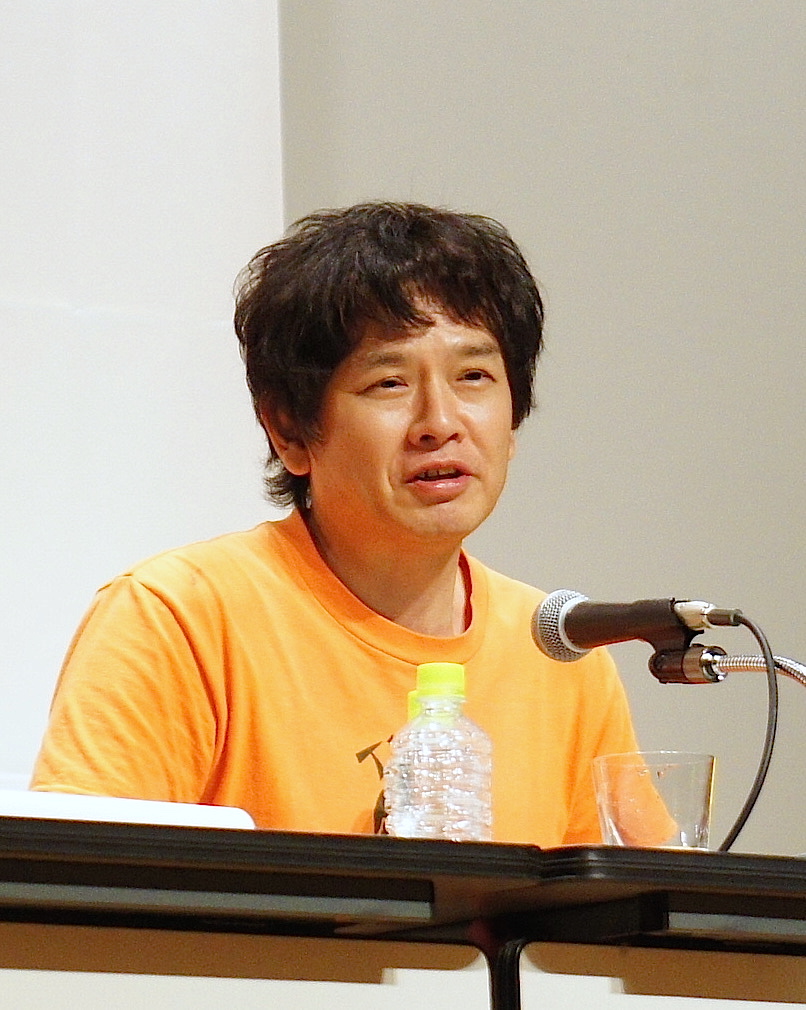
Yoshitomo Nara at a press conference for his retrospective, Yokohama Museum of Art, 2012. Photo: Hsinhuei Chiou, CC BY-SA 4.0, via Wikimedia Commons.
Meaning
奈良美智 (Nara Yoshitomo, born 1959) is one of the most internationally recognized living Japanese 画家 (gaka, "painters"), celebrated for a instantly recognizable cast of large-headed, wide-eyed children — usually solitary 少女 (shōjo, "girls") — rendered against flat, almost blank backgrounds in a deceptively simple, pop-influenced style. His figures look, at first glance, like 可愛い picture-book characters. Look again and many hold a knife or cigarette behind their back, bare a row of sharp teeth, or return the viewer's gaze with a narrowed, suspicious stare — a quiet 反抗 (hankō, "defiance") lurking just beneath a cute surface.
Nara works across painting, drawing, ceramics, bronze and fiberglass sculpture, and large mixed-media installations (small houses filled with his drawings and possessions), but the painted child — some version of the same wary, ambiguous face he has returned to for over three decades — remains his signature motif.
Style and Themes
Nara's mature style, developed from the mid-1990s onward, pairs an economical, almost naïve drawing style with psychologically loaded content:
- The child as avatar, not portrait. Nara's children are not individualized likenesses; they function more like a recurring stand-in for feelings of isolation, boredom, stubbornness, and quiet rebellion — closer to a self-portrait of an inner state than a picture of an actual kid.
- Cute surface, uneasy content. Early-to-mid-1990s works are the most confrontational, showing children wielding knives or saws, smoking, or grinning with jagged teeth. Later work softens visibly — many 2010s and 2020s paintings show the same faces at rest, eyes closed or gazing gently outward — but an undercurrent of melancholy and solitude persists throughout.
- Punk and folk-music roots. Nara has repeatedly named music, not manga, as his deepest influence — particularly American and British punk and folk artists such as the Ramones, the Stooges, and Dan Penn (his 2010 U.S. retrospective at Asia Society, Nobody's Fool, took its title from a Dan Penn song). He plays records constantly while working, decorates studio walls with band flyers and album art, and has said the direct, stripped-down energy of punk shaped his own economical drawing style more than any painting tradition.
- Folk-art and children's-book economy. Alongside punk, Nara cites European folk art, 浮世絵-adjacent flatness, German Neo-Expressionism, and children's illustration as sources for his simplified forms and outlined, poster-like compositions.
- A daily drawing practice. Nara produces enormous numbers of quick drawings — on paper, envelopes, cardboard, even napkins — treating drawing as a diary-like, almost compulsive daily habit that feeds the more considered paintings.
Biography
Nara was born in 1959 in Hirosaki, a castle town in Aomori Prefecture in Japan's snowy northern Tōhoku region, where as a latchkey-generation only child he has said he spent long solitary hours with the family dog and pet cat, reading comics and listening to a local U.S. military radio station — an isolated, rural childhood he has cited as the emotional source of his solitary child imagery. He studied oil painting at the Aichi Prefectural University of Fine Arts and Music, completing a graduate degree in 1987.
In 1988 Nara moved to Germany and enrolled at the Kunstakademie Düsseldorf, studying first under Michael Buthe and then under the German Neo-Expressionist painter A. R. Penck. Penck's instruction to paint "as if drawing" — spontaneous, direct, unlabored mark-making — became formative for Nara's mature technique. After finishing his studies in 1993, Nara settled in Cologne, where he lived and worked until 2000. This Cologne period (1994–2000) was extraordinarily productive: cut off from Japan, working largely alone, he developed the wide-eyed, defiant child imagery that would define his career, including celebrated paintings such as Mumps and Pancake Kamikaze.
Nara returned to Japan in 2000, settling near Tokyo, and has since become one of the country's most exhibited and collected contemporary artists. In 2018 he opened N's Yard, a private museum and studio-adjacent gallery in Nasu, Tochigi Prefecture, presenting his own work alongside objects, records, and folk art from his personal collection.
Notable Works and Exhibitions
| Work / Exhibition | Description |
|---|---|
| Knife Behind Back (2000) | Large canvas of a child with a knife concealed behind her back; sold for $24.9 million at Sotheby's Hong Kong in 2019, then a record for the artist and for any living Japanese artist at auction |
| Fountain of Life (2001) | Motorized sculptural installation of stacked heads with closed eyes, set in a giant teacup, streaming water down the figures' cheeks like tears; Nara's only motorized work |
| I DON'T MIND, IF YOU FORGET ME (2001) | Nara's first major museum survey, at the Yokohama Museum of Art, later traveling to several Japanese venues |
| White Ghost (2010) | Pair of large white fiberglass dog-child hybrid sculptures installed like guardian statues outside New York's Asia Society and Park Avenue Armory |
| Yoshitomo Nara: Nobody's Fool (2010–11) | First major New York museum exhibition, at the Asia Society Museum, spanning his career from the 1980s onward and framing his work within global punk and youth-subculture sensibilities |
| N's Yard (2018–present) | Private museum in Nasu, Tochigi, built around Nara's own studio, collection, and archive |
Cultural Context
Nara emerged in the 1990s alongside a wave of Japanese artists — including 村上隆 and 草間彌生 — who found international success by working through, rather than against, Japan's postwar visual culture of cuteness, cartooning, and mass reproduction. Unlike Murakami, who built an explicit theory (Superflat) linking 浮世絵 and otaku 美術, Nara's connection to that culture is more oblique: his simplified, 表情 (hyōjō, "expression")-driven faces echo children's-book illustration and folk toys as much as anime, and he has resisted being grouped tightly with the manga-and-anime-derived Superflat movement, emphasizing instead his roots in Western punk and folk music.
Nara's work is often discussed as both embracing and quietly subverting 可愛い (kawaii) aesthetics. His children have the round faces and oversized eyes of conventionally "cute" character design, but the emotional register — sullen, defensive, sometimes armed — refuses the passivity typically associated with cute imagery. Critics and curators frequently read this tension as a commentary on childhood vulnerability, isolation, and quiet resistance, resonating with viewers well outside Japan even without shared cultural references to specific anime or manga.
Commercial Success and Global Standing
Nara is among the most commercially successful living Japanese artists. His 2019 auction result for Knife Behind Back made him briefly the most expensive living Japanese artist at auction, part of a broader boom in prices for his major canvases through the 2010s and 2020s. His paintings, drawings, and sculptures are held by major institutions worldwide, including the Museum of Modern Art (New York), LACMA, the Guggenheim Bilbao, and the Aomori Museum of Art in his home prefecture, which holds one of the largest institutional Nara collections. He has staged large-scale retrospectives at the Yokohama Museum of Art, the Asia Society Museum in New York, the Los Angeles County Museum of Art, and the Guggenheim Bilbao, among many others, and continues to exhibit new work internationally.
Related Terms
| Term | Reading | Meaning |
|---|---|---|
| 芸術家 | geijutsuka | Artist |
| 現代美術 | gendai bijutsu | Contemporary art |
| 反抗 | hankō | Defiance; resistance |
| 少女 | shōjo | Girl; young woman |
| 可愛い | kawaii | Cute; adorable |
| 展覧会 | tenrankai | Exhibition |
Related Dictionary Words
art; the arts
artist
art; fine arts
painting; picture
girl (usu. between 7 and 17); young lady
eye; eyeball
puncture; flat tyre (tire); blowout
lock
carving; engraving; sculpture
opposition; resistance; insubordination; defiance; hostility; rebellion
contemporary art
painter; artist