新世紀エヴァンゲリオン
shinseiki evangerionA landmark 1995-96 anime by Hideaki Anno and Gainax that deconstructed the giant-robot genre through psychological trauma and Judeo-Christian symbolism, reshaping the entire anime industry.
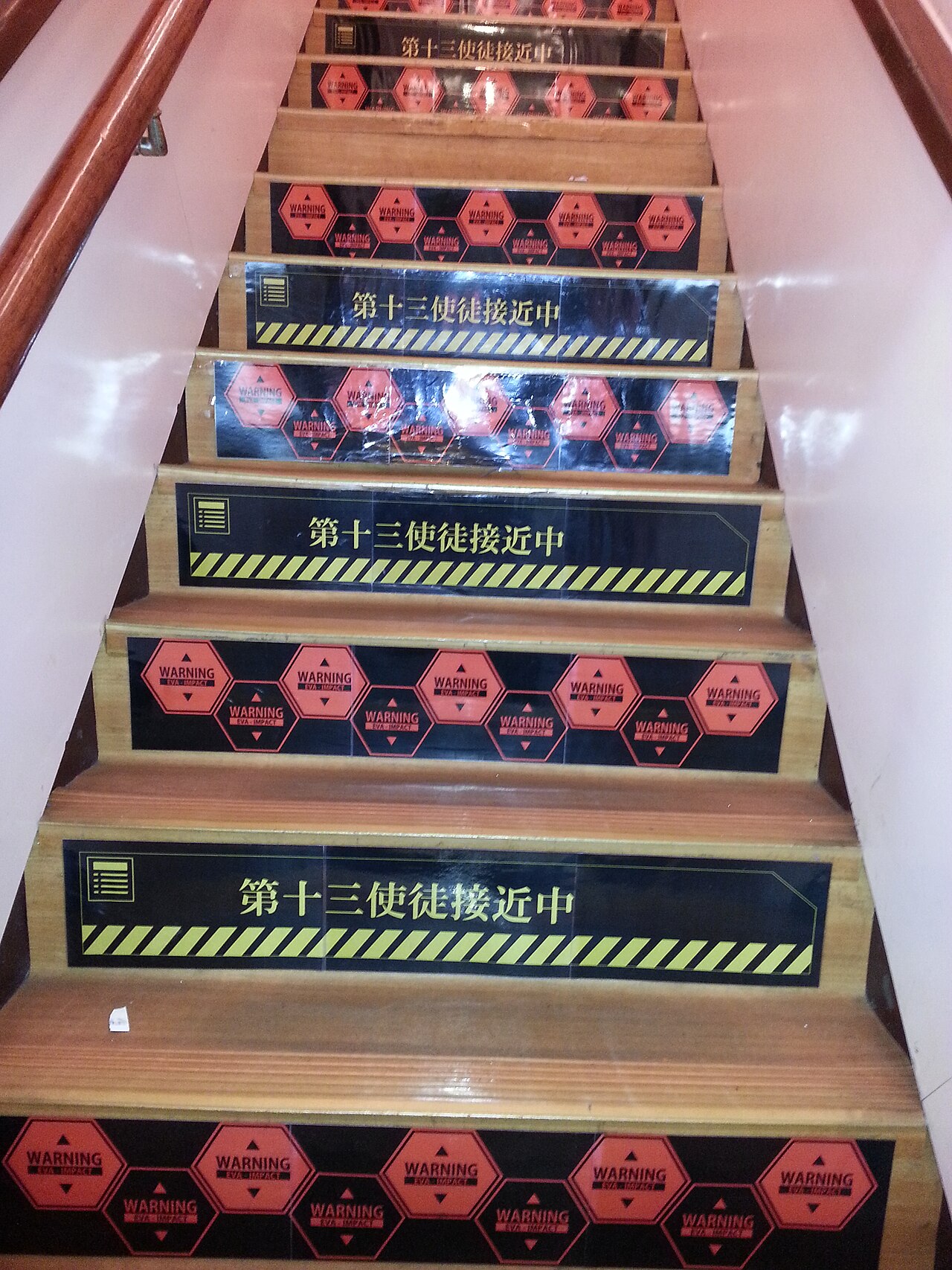
A staircase at an ACG (anime/comic/games) goods store decorated in Evangelion's signature warning-alert style, reading 第十三使徒接近中 ("13th Angel Approaching") — a small example of how deeply the series' visual language has soaked into otaku retail culture. Photo: Desdemond Chieng, CC BY 2.0, via Wikimedia Commons.
Meaning
新世紀エヴァンゲリオン (Shinseiki Evangerion), known in English as Neon Genesis Evangelion, is a 26-episode television anime that aired on TV Tokyo from October 1995 to March 1996, produced by Studio Gainax and written and directed by Hideaki Anno. On the surface it is a ロボット (mecha) show: a 少年 named Shinji Ikari is conscripted by his estranged father to pilot a bio-mechanical weapon called an Evangelion, defending the fortified city of Tokyo-3 against mysterious invaders called Angels (使徒, shito). Underneath that premise, the series is widely regarded as a deconstruction of the mecha genre — using its trappings to explore depression, trauma, isolation, and the difficulty of connecting with other people, rather than straightforward heroics.
The title itself blends 新世紀 ("new century"), evoking the show's near-future setting, with the loanword "Evangelion," derived from the Greek for "good news" or "gospel" — an early signal of the dense Judeo-Christian and Kabbalistic imagery layered throughout the story.
Plot and Setting
Set in the reconstructed city of Tokyo-3 in the year 2015, fifteen years after a global cataclysm known as Second Impact, the story follows an organization called NERV as it fights the Angels using giant biomechanical robots called Evangelions (巨人-sized, though technically not robots at all but cloned flesh encased in armor). The Evangelion units are piloted almost exclusively by teenagers, chiefly Shinji Ikari, alongside Rei Ayanami and Asuka Langley Soryu, under the command of Shinji's cold, secretive father Gendo Ikari.
As the series progresses, the 心理 struggles of its young pilots take center stage over combat, and the story reveals a conspiracy involving the shadowy organization SEELE, the origins of life on Earth (embodied by two beings called Adam and Lilith), and a plan to force the next stage of 人類 evolution.
Religious and Philosophical Symbolism
Evangelion is famous — and frequently parodied — for wrapping its story in Judeo-Christian and Kabbalistic iconography that is largely aesthetic and atmospheric rather than doctrinally precise:
| Motif | Appears as |
|---|---|
| Angels (使徒) | The invading beings NERV fights, named after entities from Judeo-Christian and Gnostic tradition (Sachiel, Ramiel, Zeruel, etc.) |
| Adam and Lilith | The two "First Ancestral Races" whose cells are the biological basis of Angels and Evangelions |
| Kabbalah / Tree of Life | Diagrams referencing the Sephirot appear throughout NERV's control rooms and title cards |
| Cross-shaped explosions | Angels and Evangelions frequently die or detonate in enormous crucifix-shaped blasts |
| Instrumentality | SEELE's Human Instrumentality Project seeks to dissolve individual boundaries and merge all souls into one being |
Anno has said the imagery was chosen largely because it looked striking and exotic to a Japanese audience rather than to make a specific theological argument — but it fused with the show's psychological core (drawn heavily from Anno's own experience with depression) to create something far weightier than a typical mecha series. Central to that psychology is the AT Field (An Absolute Terror Field), an invisible barrier that lets Evangelions and Angels resist physical and spiritual intrusion — and which the story uses as a metaphor for the walls people build around their hearts to avoid being hurt.
Usage
In Japanese and English fan discourse, several terms coined or popularized by the series entered general otaku vocabulary:
ATフィールド全開だな。 AT fīrudo zenkai da na. "Your AT Field is at full strength" — said of someone being emotionally guarded or standoffish.
「エヴァ」観た? 全然話について行けなかった… "Eva" mita? Zenzen hanashi ni tsuite ikenakatta... "Did you watch 'Eva'? I couldn't follow the story at all..."
Fans commonly shorten the title to just エヴァ (Eva), and phrases like シンジくんのATフィールドみたい ("like Shinji's AT Field") or 使徒襲来 ("Angel attack incoming") are still used jokingly to describe someone shutting people out or an unexpected crisis arriving.
Cultural Context and Legacy
When it first aired, Evangelion's ambiguous, introspective final two episodes — which abandoned action almost entirely for abstract psychoanalysis of its characters — divided audiences and became one of the most argued-over endings in anime history. That controversy, plus the theatrical follow-up The End of Evangelion (1997) which retold the ending with more conventional apocalyptic imagery, only deepened the franchise's cult status. Merchandise, model kits, コミケット doujin circles, and endless critical essays followed; by the mid-2000s the franchise had generated well over ¥150 billion in related sales.
Evangelion is widely credited with reviving a struggling anime industry in the mid-1990s and legitimizing psychologically complex, adult-oriented storytelling within a genre previously dominated by straightforward heroics — clearing the path for later works praised for similar ambition. Anno eventually left Gainax to found Studio Khara, which produced the four-film Rebuild of Evangelion series (2007–2021), a re-telling and eventual continuation of the story that culminated in Evangelion: 3.0+1.0 Thrice Upon a Time, giving the saga a definitive conclusion 26 years after it began.
The series' visual and narrative fingerprints — brooding teenage pilots, absent or manipulative parental figures, world-ending stakes tied to intimate personal trauma, and cliffhangers resolved through abstract psychological imagery — can be traced through countless subsequent mecha and otaku-adjacent works, and its Tokyo-3 setting, NERV logo, and "warning" alert graphics (as seen decorating merchandise and even public spaces, above) remain instantly recognizable across Japanese pop culture three decades on.
Related Terms
- 使徒 (shito) — "Angel," the series' antagonists
- エヴァ (Eva) — common fan shorthand for the franchise
- ATフィールド (AT Field) — the psychological/physical barrier motif
- 人類補完計画 (Human Instrumentality Project) — SEELE's plan to merge all souls into one