特撮
tokusatsuJapanese live-action entertainment genre defined by spectacular practical special effects, encompassing franchises like Kamen Rider, Super Sentai, and Ultraman.
Meaning
特撮 is a contraction of 特殊[とくしゅ]撮影[さつえい] (tokushu satsuei), meaning "special photography" or "special effects filming." The term broadly describes a Japanese genre of live-action film and television that relies on elaborate practical effects — miniature sets, suitmation (actors in monster suits), pyrotechnics, wirework, and optical compositing — to portray larger-than-life spectacles. While the technical craft itself is ancient, the word tokusatsu has come to refer almost exclusively to a recognizable aesthetic: masked or armored heroes, colossal monsters, colorful transformation sequences, and battles fought in defense of humanity.
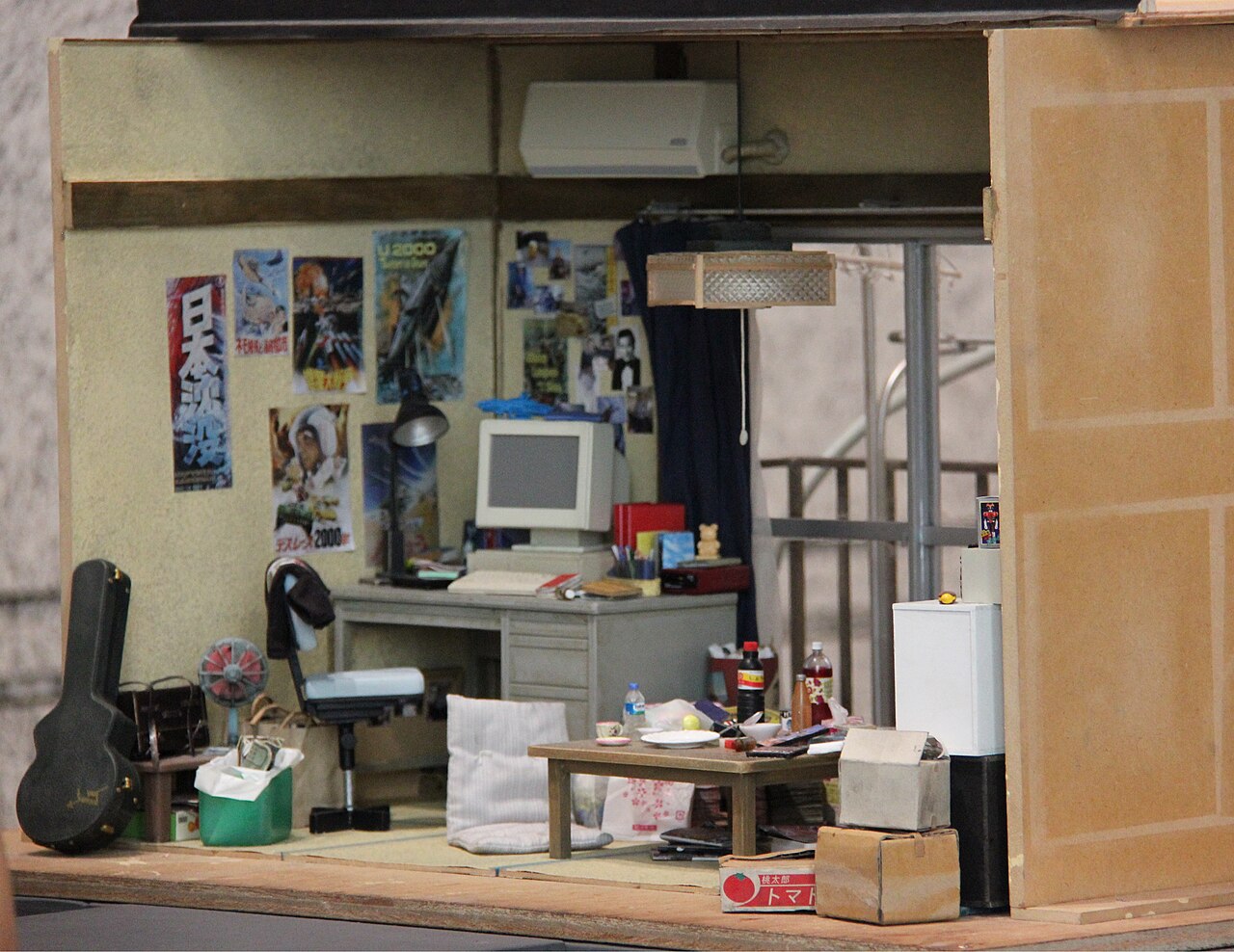
Exhibits at the TOKUSATSU Special Effects Museum, organized by Hideaki Anno (2012). Photo: Laika ac, CC BY-SA 2.0, via Wikimedia Commons.
Origins: Postwar Cinema and the Birth of Kaiju
Modern tokusatsu traces its roots to postwar Japan and the genius of special-effects director Eiji Tsuburaya. Working for Toho Studios, Tsuburaya pioneered the use of detailed miniature cities and rubber-suited monsters (kaijū, 怪獣) to represent apocalyptic destruction. His techniques debuted to worldwide audiences in Gojira (ゴジラ, 1954) — known in the West as Godzilla — a film whose radioactive monster was a thinly veiled metaphor for the atomic bombings of Hiroshima and Nagasaki.
Tsuburaya went on to found Tsuburaya Productions in 1963, which would launch the Ultraman franchise in 1966. Meanwhile, Toei Company began producing superhero serials aimed at younger audiences. The infrastructure, techniques, and narrative grammar established in these Showa-era productions became the template the entire genre still follows today.
The Three Major Pillars
Kamen Rider (仮面ライダー)
Kamen Rider ("Masked Rider," 仮面 + Rider) debuted in 1971, created by manga artist Shotaro Ishinomori and produced by Toei. The original series followed a modified human turned against his creators — the villainous Shocker organization — fighting to protect the innocent. The hero's insect-inspired helmet, transformation belt (henshin belt), and motorcycle became instantly iconic.
The franchise pioneered the concept of the lone, tormented superhero in Japanese popular culture. Each new Kamen Rider series features a different protagonist and contemporary themes — trauma, identity, corporate greed — while retaining the core of a masked fighter performing a dramatic transformation (henshin) before battle.
Super Sentai (スーパー戦隊)
Super Sentai ("Super Squadron") launched in 1975 with Himitsu Sentai Gorenger and has run continuously ever since, making it one of the longest-running tokusatsu franchises in history. Its defining innovation was the team: a group of color-coded heroes who combine their individual powers and vehicles into a single giant robot (mecha) to battle oversized monsters.
The themes of friendship, teamwork, and unity are central. Red leads, Blue supports, Yellow provides levity — the archetypes are universal enough that when Haim Saban and Shuki Levy licensed Sentai footage for American audiences in 1993, the resulting Mighty Morphin Power Rangers became a global phenomenon. Over 20 Sentai series have been adapted into the American Power Rangers franchise, introducing tokusatsu's visual vocabulary to generations of Western children.
Ultraman (ウルトラマン)
Created by Eiji Tsuburaya, Ultraman (1966) features alien giants of justice who shrink to human size to live among people, then grow to enormous height to battle kaiju threatening the Earth. The franchise's emotional hook is the hero's human host — an ordinary person who momentarily becomes something extraordinary, then returns to normal life with all its uncertainties.
Ultraman is arguably the most recognizable Japanese superhero globally, with a simple color-blocked design that reads across cultures. The franchise remains actively produced by Tsuburaya Productions, with recent entries like Ultraman Trigger and a CGI Ultraman series streaming on Netflix.
Themes and Visual Language
Across all its sub-genres, tokusatsu shares a consistent thematic vocabulary:
| Element | Japanese | Description |
|---|---|---|
| Transformation | 変身 henshin | Hero activates powers, usually via a device and a cry |
| Monster of the week | 怪人・怪獣 | A new villain appears each episode |
| Final attack | 必殺技 hissatsu waza | Named finishing move, often shouted aloud |
| Giant robot | 巨大ロボ | Mecha summoned for the climactic battle |
| Evil organization | 悪[の組織] | Shadowy villain group opposing the heroes |
The genre consistently champions protecting the weak, self-sacrifice, and the idea that ordinary people can find extraordinary courage. These themes resonate with adults who grew up watching, driving a massive nostalgia market alongside the core children's audience.
Tokusatsu Goes Global
The genre's international footprint extends far beyond Power Rangers:
- VR Troopers (1994–1996) and Big Bad Beetleborgs (1996–1998) drew on Toei's Metal Hero and other archives
- Saban's Masked Rider (1995) adapted Kamen Rider Black RX
- The Kamen Rider and Ultraman franchises have been officially broadcast or streamed across Southeast Asia, Latin America, and parts of Europe
- Starting in the 2010s, Toei and Tsuburaya Productions began releasing official subtitled content directly on YouTube and streaming platforms, bypassing traditional licensing
The Heisei era (1989–2019) saw a dramatic reinvention of both Kamen Rider and Super Sentai. Kamen Rider Kuuga (2000) launched what fans call the "Heisei Rider" era, bringing cinematic production values and adult-oriented storytelling. Kamen Rider Gaim (2013), written by Gen Urobuchi (Puella Magi Madoka Magica), received widespread critical acclaim beyond the typical tokusatsu fanbase.
The Fan Community
Tokusatsu has one of Japan's most dedicated fan communities. Collector culture around chogokin (diecast metal robot toys), sofubi (soft vinyl kaiju figures), and Kamen Rider henshin belt props supports a robust secondary market. At events like Comiket, tokusatsu cosplay is a major presence. Many otaku trace their entry into Japanese pop culture specifically through childhood exposure to Sentai or Ultraman.
The term tokusatsu itself has become a genre label used by international fans in the same way "anime" describes Japanese animation — a single word encompassing a vast creative tradition. Online communities produce subtitled fansubs of series never officially localized, video essay channels analyze decades of lore, and fan films recreate scenes with remarkable craft.
Modern Tokusatsu
The Reiwa era (2019–present) continues the genre's evolution:
- Kamen Rider Zero-One (2019) explores artificial intelligence and labor rights
- Kamen Rider Geats (2022) uses survival game mechanics as social commentary
- Donbrothers (2022) is a critically praised Super Sentai entry that subverted the team-hero formula entirely
- Ultraman Blazar (2023) returned to a grounded, military-focused tone
Toei's Kamen Rider and Super Sentai series air Sunday mornings on TV Asahi in Japan and are simulcast internationally via streaming services. Tsuburaya's Ultraman content is available on platforms including Netflix and the official TSUBURAYA IMAGINATION service.
For international fans, the barrier to entry has never been lower — official subtitled episodes, streaming rights, and active English-language communities make the full breadth of tokusatsu's 70-year history more accessible than at any point before.
Related Dictionary Words
special effects; SFX
metamorphosis; disguise; transformation; shapeshifting; morphing
monster
mask
movie; film; motion picture
hero
justice; right; righteousness
squadron
photography (still or motion); photographing; filming; shooting; (video) recording
special effects
super hero belt; transformation belt
postwar period; period after Second World War
Shōwa era (1926.12.25-1989.1.7)
friendship; fellowship; camaraderie