ジェンダーレス系
jendaaresu keiA Japanese fashion and beauty trend, mainly among young men, that blends soft makeup, dyed hair, and unisex clothing into a cute, gender-blurring everyday style.
Meaning
ジェンダーレス系 (jendāresu-kei, lit. "genderless type/style") is a Japanese fashion and beauty 流行 that blurs the visual line between conventional 男性 and 女性 presentation. The suffix 系 (-kei, "type/style/lineage") is the same one used across Japanese 若者 fashion tribes such as visual-kei, gyaru-kei, and mori-kei — it labels a recognizable look rather than a formal category.
In practice, genderless kei is worn almost entirely by young men, who are often called ジェンダーレス男子 (jendāresu danshi, "genderless boys"). The style pairs a slim, softly proportioned silhouette with visibly feminine-coded grooming: 化粧 such as BB cream and concealer for flawless skin, lightly defined eye makeup, tinted lip balm, groomed or shaped 眉, and often colored contact lenses. Hair is usually dyed in soft or pastel tones and styled in a rounded, layered cut. Clothing draws on unisex and women's-adjacent silhouettes — oversized knitwear, cropped jackets, pastel colors, floral prints, and accessories like chokers and rings — combined into an overall look that reads as 可愛い (kawaii, cute) rather than conventionally masculine or overtly feminine.
Unlike a costume worn for a single event, genderless kei is an everyday personal style. It is not a uniform with fixed rules; it's better understood as a shared aesthetic vocabulary that individual young men and, in a mirrored form, some young women (ジェンダーレス女子) adapt to their own taste.
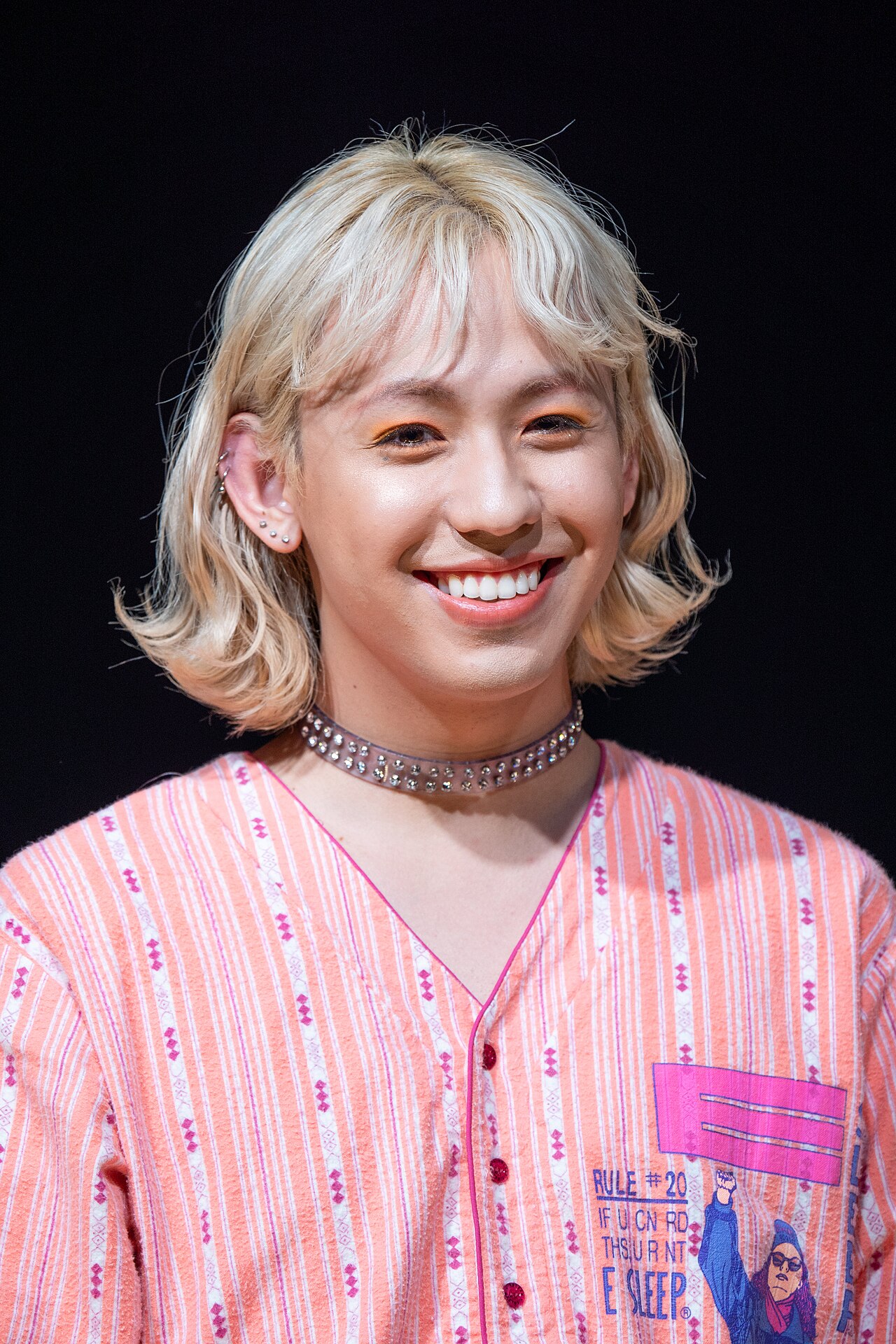
Ryuchell at a "Super! C CHANNEL" talk event in Tokyo, 2019 — dyed hair, soft eye makeup, and a choker, all signature elements of the genderless kei look. Photo: Dick Thomas Johnson, CC BY 2.0, via Wikimedia Commons.
The Look
| Element | Typical treatment |
|---|---|
| Skin | BB cream, concealer, aiming for an even, "flawless" finish |
| Eyes | Light shadow, subtle liner, sometimes colored contacts |
| Brows | Shaped, softened, sometimes lightly filled in |
| Lips | Tinted balm or gloss rather than bold 口紅 |
| Hair | Dyed (ash, beige, pastel tones), rounded or layered cuts |
| Clothing | Unisex or women's-adjacent cuts, pastels, florals, cropped silhouettes |
| Accessories | Chokers, rings, delicate jewelry, tote bags |
| Body ideal | Slim, softly built rather than muscular |
None of these elements is new in isolation — Japanese men have worn makeup on stage or dyed their hair for decades — but genderless kei bundles them into a coherent daily-life 美意識 (aesthetic sensibility) aimed at a general audience rather than a specific music scene.
Rise of the Trend
Genderless kei crystallized as a named trend around 2015, when Japanese media and marketers began using the term ジェンダーレス男子 to describe a small group of young men who were breaking through on television and social media with this look. The term is usually credited to talent manager Takashi Marumoto, who coined it to describe his client Toman (Toman Sasaki), a model and TV personality who became one of the trend's first widely recognized faces, frequently appearing on variety and talk shows to explain and defend the style to a curious, sometimes skeptical, mainstream audience.
Around the same time, the TV personality Ryuchell (Ryucheru, 1995–2023) became the trend's most visible ambassador. Ryuchell's bleached and pastel-dyed hair, soft makeup, and colorful, playful fashion sense — combined with an outgoing television presence and, for several years, a highly publicized marriage to the model Peko — made "genderless" household terminology in Japan well beyond fashion-conscious youth circles. Other models and タレント followed, and by 2016 the look had crossed over from a Harajuku-adjacent niche into national magazines, variety shows, and year-end "buzzword" rankings.
The trend also intersected with, and drew visual cues from, several adjacent scenes: the theatrical androgyny of ヴィジュアル系 rock musicians going back to the 1980s–90s, the polished androgynous styling of Korean boy-band idols popular with Japanese teens, and the general 原宿 culture of using fashion as personal experimentation. Fast-fashion retailers noticed too — chains such as GU introduced explicitly gender-neutral clothing lines around 2015–2016, giving the look mass-market accessibility rather than leaving it to specialty boutiques.
Genderless kei remains a live and evolving trend rather than a closed chapter of 2010s fashion history. It has continued through shifting faces and platforms — moving from TV variety shows toward Instagram, TikTok, and YouTube — with new models, アイドル, and influencers picking up and reinterpreting the aesthetic each year rather than treating it as a fixed retro style.
Cultural Context: Beauty Not Bound to One Gender
Genderless kei fits into a much older thread in Japanese aesthetics in which "beautiful" and "cute" have never been strictly gendered categories the way they often are in Western beauty culture. The idealized 美 of a smooth complexion, delicate features, and graceful bearing has historically been applied to elegant men as readily as to women — visible in the bishōnen (beautiful youth) archetype running through classical literature, kabuki's onnagata actors who specialized in playing women's roles, and centuries of art depicting androgynous courtly beauty.
可愛い itself has never been an exclusively feminine value in Japan the way "cute" tends to code in English; it describes small animals, characters, food, and people of any gender, and being described as kawaii is not inherently emasculating for a Japanese man in the way an equivalent compliment might be read elsewhere. Genderless kei draws directly on this cultural reservoir: its practitioners are, in the language surrounding the trend, praised for looking kawaii rather than criticized for failing to look conventionally masculine.
This is one reason the trend was able to move so quickly from a subcultural corner of Harajuku into mainstream magazines, TV variety programming, and boy-band styling — it extended an existing, culturally legible idea of beauty rather than importing an entirely foreign concept.
How It Differs from Western Androgyny and Drag
Genderless kei is frequently compared by non-Japanese observers to Western androgynous fashion or drag performance, but the framing is different in a few important ways.
- Not primarily a statement about sexual orientation or gender identity. Genderless kei is a style choice, not a declaration. Some men who wear the look are gay, bisexual, or transgender, and some are straight and cisgender — the fashion itself does not signal or determine any of that, and it would be inaccurate and unfair to assume a wearer's sexual orientation or gender identity from their clothing and makeup alone. Coverage and commentary on the trend in Japan has repeatedly stressed this point, since it is easy for outside observers to project Western assumptions onto it.
- Not performance in the way drag is. Drag is typically an exaggerated, theatrical persona assembled for the stage, a club, or a specific performance context, then set aside. Genderless kei is worn as an everyday, offstage personal style — to school, work, or simply out with friends — much closer in spirit to how anyone else wears their preferred fashion.
- Softness rather than exaggeration. Where a lot of Western androgynous fashion (or drag) leans into deliberate contrast, contradiction, or spectacle, genderless kei generally aims for a soft, harmonious, "natural-looking cute" — closer to blending traits than juxtaposing them.
- A generational mood, not a subcultural uniform with strict membership. It overlaps with a broader loosening of gender expectations among younger Japanese, who as a cohort report more relaxed attitudes toward men wearing makeup or "feminine" clothing than older generations do, without necessarily framing this as activism or identity politics in the way gender-nonconforming fashion is often discussed in English-language media.
None of this means genderless kei is disconnected from real conversations about gender in Japan — several of its most visible figures have spoken candidly, in their own terms, about identity, relationships, and social expectations, and the trend is often cited by commentators as one visible symptom of shifting norms among younger Japanese. The point is simply that the fashion itself doesn't map cleanly onto a single Western category, and treating "wears genderless kei" as equivalent to "is gay" or "is doing drag" overgeneralizes what is, for most of its wearers, first and foremost a style.
Visibility in Media and Fashion
Genderless kei moved quickly through the standard channels of Japanese youth trend diffusion. Fashion and lifestyle magazines ran style guides and reader spreads on "how to get the genderless look"; TV variety and talk shows booked Toman, Ryuchell, and other figures as recurring guests, often specifically to discuss the trend itself rather than unrelated work; and it became a fixture of year-end buzzword and trend rankings in the mid-2010s. Harajuku street-fashion photography, both in print and later on Instagram, regularly features genderless-styled young men alongside more established Harajuku tribes.
The aesthetic also shaped アイドル and boy-band styling more broadly — softer makeup, pastel hair, and androgynous silhouettes became more common in idol group image design during the same years, partly independent of and partly reinforcing the named genderless kei trend. Social media has been essential to its longevity: as TV variety exposure has ebbed and flowed, Instagram, TikTok, and YouTube have kept the look circulating through new creators who may never use the original mid-2010s vocabulary but visibly continue the same aesthetic lineage.
Usage
彼はジェンダーレス系のファッションが好きで、メイクにもこだわっている。 He likes genderless-kei fashion and is particular about his makeup too.
最近はジェンダーレス男子がテレビでよく取り上げられている。 Lately, genderless danshi have often been featured on TV.
The term is used descriptively, both for the overall style (ジェンダーレス系, ジェンダーレスファッション) and for individuals who wear it (ジェンダーレス男子 / ジェンダーレス女子). It is not typically used as a slur or a joke term in contemporary Japanese media, though like any trend label it can be used dismissively by critics of the style.
Related Terms
- ヴィジュアル系 (visual-kei) — the earlier rock-music subculture whose androgynous stage makeup and styling prefigured some genderless kei aesthetics, though visual-kei is explicitly performance-oriented.
- 中性的 (chūseiteki) — "androgynous," a general adjective often used to describe genderless kei's overall effect.
- 男の娘 (otoko no ko) — a distinct, more costume/cosplay-oriented category of men presenting as women, generally understood as separate from genderless kei's everyday, still-recognizably-male presentation.
- 草食系男子 (sōshoku-kei danshi, "herbivore men") — an earlier, related 2000s–2010s label for young Japanese men seen as gentler and less aggressively masculine than older stereotypes, which helped set the cultural stage for genderless kei's reception.
Related Dictionary Words
man; male
woman; female
make-up; makeup; cosmetics
cute; adorable; charming; lovely; pretty
beauty; good figure; (beautiful) appearance; (beautiful) features
hair (on the head)
eyebrow; eyebrows
young person; youngster; young people; (the) youth
boy
neutrality (incl. chemical, electrical, etc.); indifference
sense of beauty; aesthetic sense
fashion; trend; vogue; craze; fad; popularity
(TV or radio) entertainer; television personality; radio personality
performer (usu. in a boy band or girl group) with an image cultivated to foster a dedicated fan following; Japanese idol
lipstick