ガンプラ
ganpuraGunpla — a portmanteau of "Gundam" and "plastic model" — refers to the plastic model kits of mecha from the Mobile Suit Gundam anime franchise, and the massive hobbyist culture of building, painting, and customizing them.
Meaning
ガンプラ (ganpura) is a portmanteau of "Gundam" and プラモデル (puramoderu, "plastic model"). It refers to the injection-molded plastic 模型 (mokei, model) kits of the giant humanoid robots — called mobile suits — from the Mobile Suit Gundam anime franchise, manufactured almost exclusively by the toy company Bandai (now Bandai Spirits). By extension, "gunpla" also describes the hobby itself: buying kits, snapping or gluing them together, painting and weathering the surfaces, and sometimes modifying them into entirely custom designs.
A gunpla kit arrives as trees of unpainted plastic parts called sprues (called ランナー, rannaa, in Japanese), molded in the correct base colors so a simple kit looks reasonably accurate straight out of the box with no paint at all. Builders cut parts free with nippers, remove the small nub marks left behind, and assemble the frame and armor with plastic-to-plastic snap joints — most modern kits require no 接着剤 (setchakuzai, glue) at all. From there, the hobby branches into an entire spectrum of skill: some people build a kit in an afternoon and display it as-is, while others spend weeks on custom 塗装 (tosou, painting), panel-line detailing, and full-scale 改造 (kaizou, modification/kitbashing).
Grades and Scale
Bandai organizes gunpla into a small number of "grades" that signal complexity, articulation, and price. The most common lines:
| Grade | Full name | Scale | Notes |
|---|---|---|---|
| HG | High Grade | 1/144 | The standard entry point; simple, affordable, good detail |
| RG | Real Grade | 1/144 | HG-sized but with MG-level internal frames and detail |
| MG | Master Grade | 1/100 | Larger, with inner skeleton frames and more articulation |
| PG | Perfect Grade | 1/60 | Huge, highly detailed, often with LED-light gimmicks |
| SD | Super Deformed | Chibi | Cute, simplified proportions, easiest to build |
Higher grades cost more and take longer to assemble, but reward builders with tighter proportions, hidden inner frames, and more posable joints — a PG kit of the original RX-78-2 Gundam can have over 400 部品 (buhin, parts).
Usage
週末は新しいガンプラを組み立てるつもりです。 Shuumatsu wa atarashii ganpura o kumitateru tsumori desu. "I'm planning to build my new gunpla kit this weekend."
このガンダムは自分で塗装して改造したんだ。 Kono gandamu wa jibun de tosou shite kaizou shita nda. "I painted and modified this Gundam myself."
In everyday conversation, ガンプラ can refer to an unbuilt kit still in its box ("新しいガンプラを買った" — "I bought a new gunpla"), a finished, displayed model ("棚にガンプラが並んでいる" — "gunpla are lined up on the shelf"), or the hobby as a whole ("ガンプラにハマっている" — "I'm hooked on gunpla"). Builders are sometimes called ガンプラビルダー (ganpura birudaa, "gunpla builders"), and a particularly skilled one may be praised as a 職人 (shokunin, craftsman).
Cultural Context
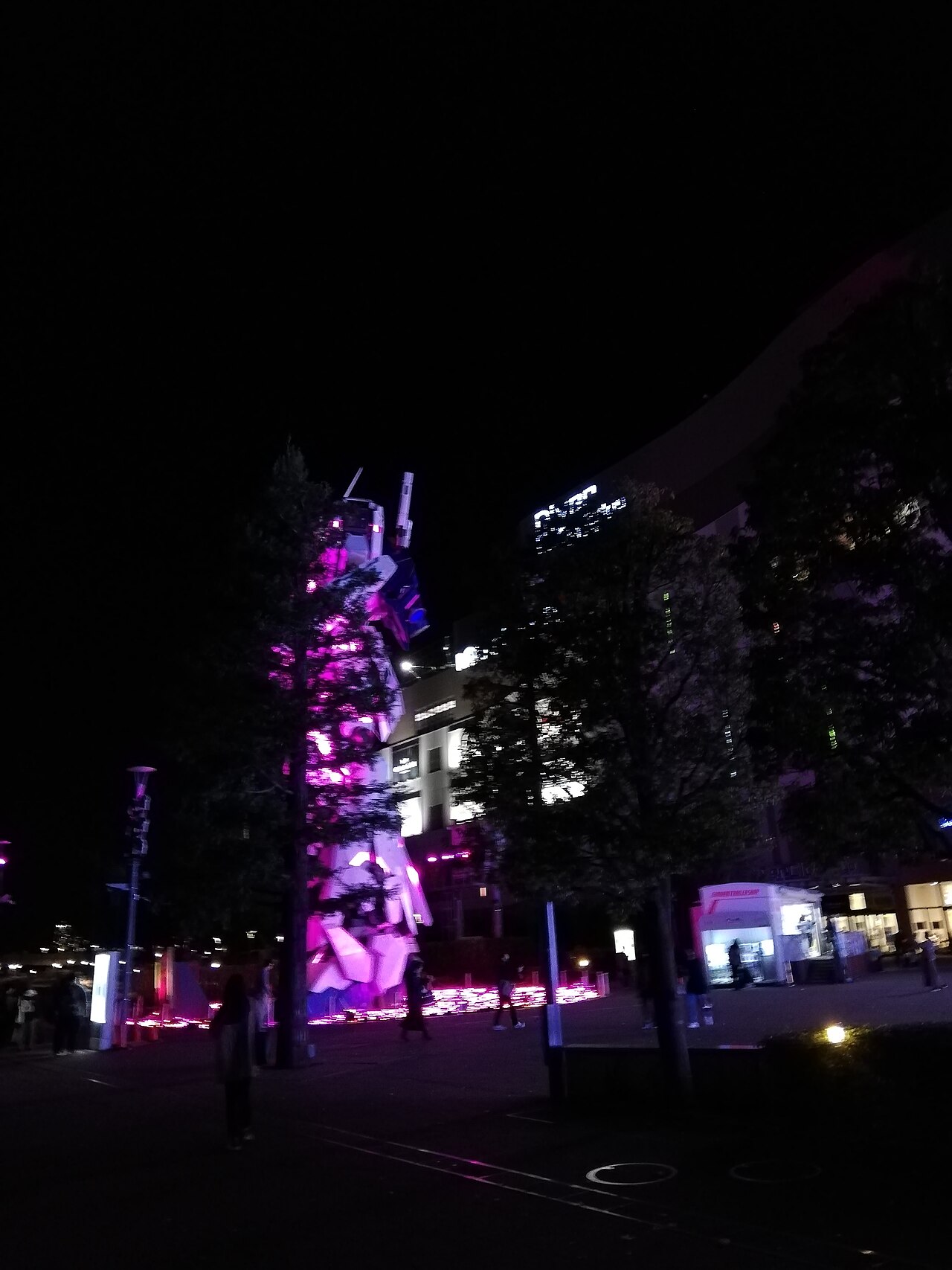
A life-size (1:1 scale) RX-0 Unicorn Gundam statue outside DiverCity Tokyo Plaza in Odaiba — a landmark for both anime fans and gunpla builders. Photo: 先従隗始, public domain (CC0), via Wikimedia Commons.
Gunpla exists because of Mobile Suit Gundam (機動戦士ガンダム, Kidou Senshi Gandamu), the 1979 television anime created by director Yoshiyuki Tomino and Sunrise studio. The show reinvented the giant-robot genre by treating its mobile suits as mass-produced military hardware piloted by ordinary soldiers rather than singular heroic super-robots, and it needed toys to match that grounded, realistic tone. Bandai released its first 1/144 scale Gundam plastic kits in 1980; the line was an immediate hit, and "ガンプラ" became the accepted shorthand for the whole product category. Bandai has since sold well over 700 million gunpla kits worldwide, across the original Universal Century timeline and the many spin-off Gundam series that followed.
Unlike static die-cast toys, gunpla kits are engineered for hobbyists: real screws are rare, joints use polycap (soft plastic) inserts for durability, and even entry-level kits snap together without tools. This turned gunpla into a genuine crafting hobby closely related to plastic modeling of cars, ships, and military vehicles, but centered on anime mecha. Specialty tools — nippers, hobby knives, sandpaper, panel-line accent color, and airbrushes — support a hobbyist ecosystem sold in hobby shops throughout Japan, especially in otaku districts like Akihabara.
Competitive and community building culture is organized around the Gunpla Builders World Cup (GBWC), an international contest Bandai has run since 2010 in which builders submit heavily customized, painted, and dioramized kits for judging; regional finals are held across Asia, Europe, and the Americas before a Japan final. The hobby also has a strong online display culture on social media and video platforms, where builders share painting techniques, weathering methods borrowed from military modeling, and full scratch-built dioramas.
Gunpla's popularity is visible well beyond hobby shops. Bandai and its partners have erected several full-scale, 1:1 statues of famous mobile suits as public landmarks and tourist attractions: an 18-meter RX-78-2 Gundam stood in Shizuoka and later Odaiba's DiverCity Tokyo Plaza (later replaced by an RX-0 Unicorn Gundam that transforms on a schedule), and the Gundam Factory Yokohama hosted a moving, full-scale RX-78-2 that could walk, kneel, and gesture, developed with real robotics engineering. These statues function as pilgrimage sites for fans and casual tourists alike, reinforcing gunpla's place as one of Japan's most visible exports of anime-adjacent physical craft.
Related Hobbies and Terms
- 食玩 (shokugan) and gashapon — other Bandai collectible-toy formats, sometimes overlapping with gunpla-adjacent figures
- スクラッチビルド (scratch build) — building custom parts or entire kits from raw plastic sheet rather than a kit
- ジャンクパーツ (junk parts) — spare parts from other kits reused in customization/kitbashing
- ウェザリング (weathering) — painting techniques that simulate battle damage, rust, and dirt, borrowed from military scale-modeling
- 一年戦争 (Ichinen Sensou, "One Year War") — the fictional conflict of the original series that many classic kits like the RX-78-2 Gundam and MS-06 Zaku II come from
Many gunpla builders are also part of broader otaku fandom, attending conventions and sharing finished work at hobby shows; some overlap exists with tokusatsu and kaiju fandoms, since giant-monster and giant-robot media are often enjoyed by the same audiences, even though gunpla itself is rooted in animation rather than live-action special effects.
Related Dictionary Words
plastic model
model; dummy; maquette
construction; framework; erection; assembly; organization; organisation
coating; painting
adhesive; glue
arms; weapon; ordnance
robot
hobby; pastime
completion; perfection; accomplishment
parts; accessories; components
Gundam (titular giant robot of anime "Mobile Suit Gundam")
transformation; variation; metamorphosis; modification; deformation; variety; deformity; monster
union; combination; coalescence; amalgamation; merger; incorporation
remodeling; remodelling; reconstruction; conversion; alteration; renovation; modification; reshuffling (e.g. a cabinet); reorganization; restructuring
to paint; to spread; to plaster; to apply (cream, lotion); to smear; to lacquer; to varnish; to put up (wallpaper)
to cut; to cut through; to perform (surgery)
(printed) instructions; manual; explanatory leaflet (pamphlet, note); description
box; case; chest; package; pack; crate
finished product; finished goods; completed article
craftsman; artisan; tradesman; worker; workman
exhibition; display