伊藤潤二
Itō JunjiJapanese manga artist and three-time Eisner Award winner celebrated as the modern master of horror manga, known for Tomie, Uzumaki, Gyo, and the Netflix anime anthology Junji Ito Maniac.
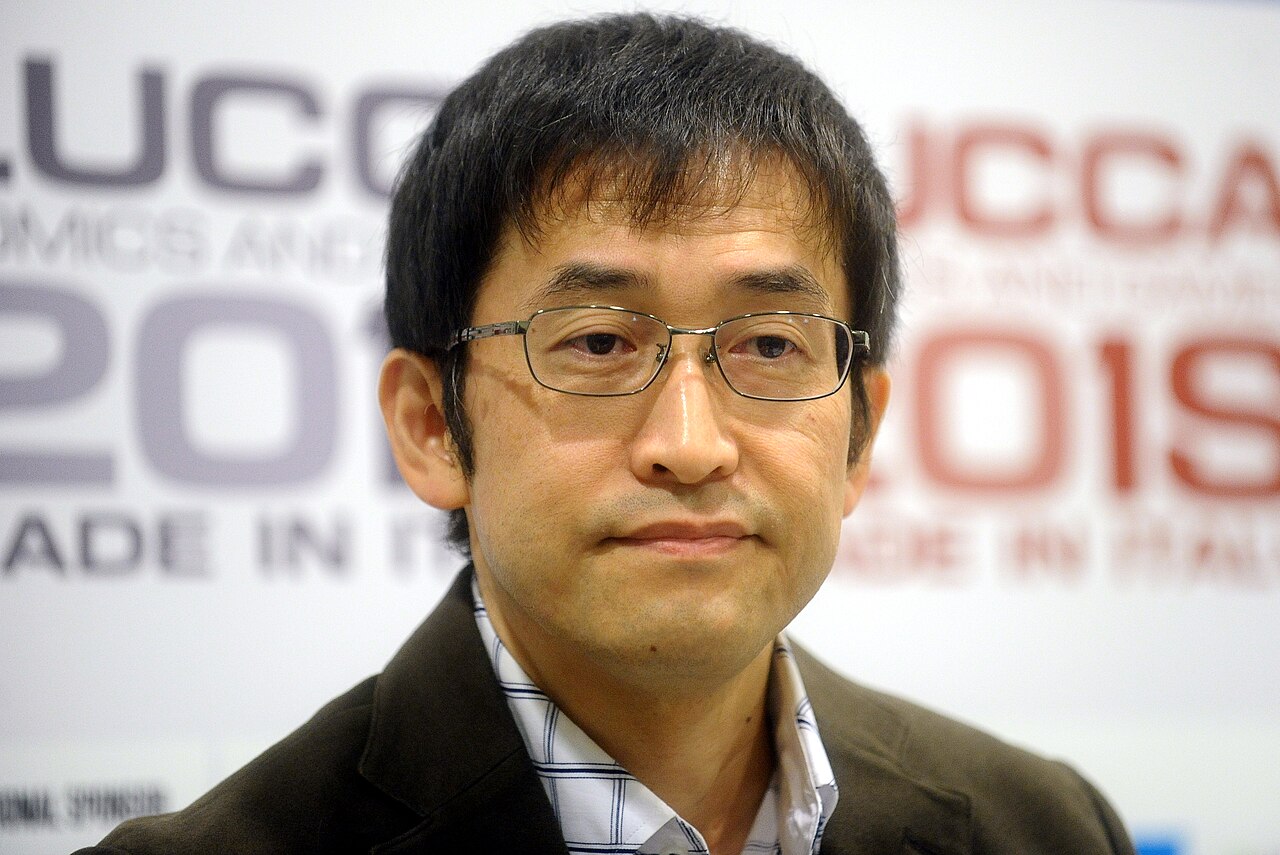
Junji Ito at Lucca Comics & Games, 2018. Photo: Niccolò Caranti, CC BY-SA 4.0, via Wikimedia Commons.
Meaning
Junji Ito (伊藤潤二, Itō Junji, born July 31, 1963) is a Japanese 漫画 (manga) artist widely regarded as the reigning master of horror manga. Since his 1987 debut he has built a body of work defined by 恐怖 (kyōfu, "dread/terror") that unfolds less through jump scares than through a slow, clinical escalation from the mundane into the cosmically wrong. Titles such as Tomie, Uzumaki (Spiral), Gyo, and The Enigma of Amigara Fault have made him one of the very few manga creators as celebrated abroad — with multiple Eisner Awards — as he is in Japan.
Ito's name is now effectively shorthand for a specific flavor of horror: exquisitely detailed pen-and-ink art, ordinary small-town settings, and a single uncanny idea (a shape, a curse, a disease) pursued to its most nightmarish logical conclusion.
Career
Ito grew up in Nakatsugawa, Gifu Prefecture, where he and his sisters drew manga as children, inspired by horror pioneers like Kazuo Umezu and Hideshi Hino. He trained and worked for several years as a dental technician before submitting his short story "Tomie" to Gyorai Comics' Umezu Kazuo Award in 1987. The story — about a beautiful, unkillable girl who regenerates from any fragment of her body and drives the men obsessed with her to murder and madness — won an honorable mention and launched his career. Ito soon quit dentistry to draw manga full-time.
Through the late 1980s and 1990s he serialized stories in horror anthology magazines, developing recurring casts (including the sadistic delinquent Souichi) and refining the meticulous, almost architectural linework that became his signature. His three-volume masterpiece Uzumaki (1998–1999) cemented his international reputation, followed by Gyo (2001–2002). Since then he has continued to publish steadily — Gyo, Slug Girl, Fragments of Horror, No Longer Human (an adaptation of Osamu Dazai's novel), a manga adaptation of Frankenstein, and original works like Remina and Venus in the Blind Spot — while becoming a fixture at international comics conventions such as Lucca Comics & Games, Anime Expo, and San Diego Comic-Con.
Signature Horror Style
Ito's horror rarely relies on monsters jumping out of the dark. Instead it works through escalation: a strange but explainable event repeats, mutates, and spreads until an entire town, family, or body is consumed by it. Recurring elements include:
- Body horror — flesh, faces, and anatomy warp, fuse, or spiral into impossible new forms, often triggered by obsession, vanity, or disease.
- Cosmic dread — the horror is frequently indifferent and unexplainable, closer to Lovecraft than to a slasher film; there is no villain to defeat, only a shape or force that simply is.
- The spiral (螺旋, rasen) — 渦巻き motifs recur across his work, most famously in Uzumaki, where an entire town becomes possessed by the geometry of the spiral itself, down to the 呪い-cursed ceramics and human bodies twisting into coils.
- Contrast of style and content — his linework is dense, precise, and almost old-fashioned in its craftsmanship, and his characters are often drawn in a clean, attractive style that makes the grotesque transformations they undergo feel all the more disturbing.
- Everyday settings — schools, hospitals, apartment blocks, and sleepy rural towns ground the 怪奇 (strange/mysterious) events in relatable normalcy before pulling them apart.
Fans and critics have also noted how effectively his work exploits specific fears such as 集合体恐怖症 (trypophobia, fear of clusters of holes) and body-based 悪夢 (nightmare) logic — his images tend to lodge themselves in memory as トラウマ (trauma) long after the story ends.
Iconic Works
| Title | Year | Premise |
|---|---|---|
| Tomie (富江) | 1987–2000 | An eternally beautiful, unkillable girl regenerates from any severed piece and drives every man who loves her to violence. |
| Uzumaki (うずまき, Spiral) | 1998–99 | A coastal town becomes obsessed with, and consumed by, the shape of the spiral. |
| Gyo (魚) | 2001–02 | A plague of walking, mechanically-legged fish carries a stench that reanimates the dead. |
| "The Enigma of Amigara Fault" | 1997 | Human-shaped holes appear in a mountain fault after an earthquake, each one calling an individual person to crawl inside. |
| Souichi's Diary of Curses | 1990s | Comedic-horror stories following a delinquent boy obsessed with curses and occult rituals. |
| No Longer Human | 2017–18 | Manga adaptation of Osamu Dazai's classic novel. |
| Frankenstein | 2018 (Eng. release 2019) | Adaptation of Mary Shelley's novel; won the 2019 Eisner Award for Best Adaptation from Another Medium. |
| Remina | 2005 (Eng. 2020) | A newly discovered planet named after a scientist's daughter turns out to be a living creature devouring everything in its path. |
| Junji Ito Maniac: Japanese Tales of the Macabre | 2023 (Netflix) | 20-episode anime anthology adapting many of his short stories. |
| Uzumaki (anime) | 2024 (Adult Swim) | Black-and-white, four-episode animated adaptation closely following the original manga's art. |
Cultural Context and Influence
Ito emerged from — and pushed forward — a lineage of Japanese horror manga running through Kazuo Umezu (The Drifting Classroom) and Hideshi Hino, and stands alongside earlier genre forerunners like Shigeru Mizuki, whose folklore-inflected supernatural stories helped establish yokai as mainstream manga subject matter. Where Mizuki's horror drew on traditional monsters, Ito's draws on modern anxieties: contagion, conformity, deformity, and the body's betrayal of the self.
His international breakout came through licensed English translations of Uzumaki and Tomie in the early 2000s, at a moment when Japanese horror cinema (Ringu, Ju-On) was also crossing over to Western audiences. Ito's manga found a parallel cult following, praised by figures like Guillermo del Toro, and referenced across Western film, television, and games — from indie horror titles openly modeled on his art (such as World of Horror) to games such as P.T., where Hideo Kojima reportedly sought Ito's input on creature design for the cancelled Silent Hills project. Streetwear collaborations, gallery exhibitions ("The Junji Ito Exhibition" toured Japan and abroad), and repeated Netflix and Adult Swim adaptations have kept his work continuously visible to new generations of horror fans who may never read manga otherwise.
Ito has won three Eisner Awards — for Frankenstein (2019), and both Remina and Venus in the Blind Spot (2021) — an unusually high honor for a manga artist in the American comics industry's most prestigious award. Today "Junji Ito-esque" functions almost as its own subgenre label among horror fans, describing any story that turns a simple visual idea (a hole, a spiral, a repeated shape) into an engine of dread through patient, methodical escalation rather than sudden shock.
Related Terms
- ホラー漫画 (horā manga) — horror manga as a genre
- 怪談 (kaidan) — traditional ghost/supernatural stories, a folklore root of the genre
- Jホラー (J-horror) — the broader wave of Japanese horror film and media Ito's manga is often grouped with
Related Dictionary Words
cartoon; comic; comic strip; manga
fear; dread; dismay; terror; horror; scare; panic
whirlpool; maelstrom; vortex; eddy; swirl
spiral; helix
curse; spell; malediction
urban legend
nightmare; bad dream
trypophobia (fear of irregular patterns or clusters of small holes)