おみくじ
omikujiRandom paper fortune slips drawn at Shinto shrines and Buddhist temples, ranked from great blessing to curse.
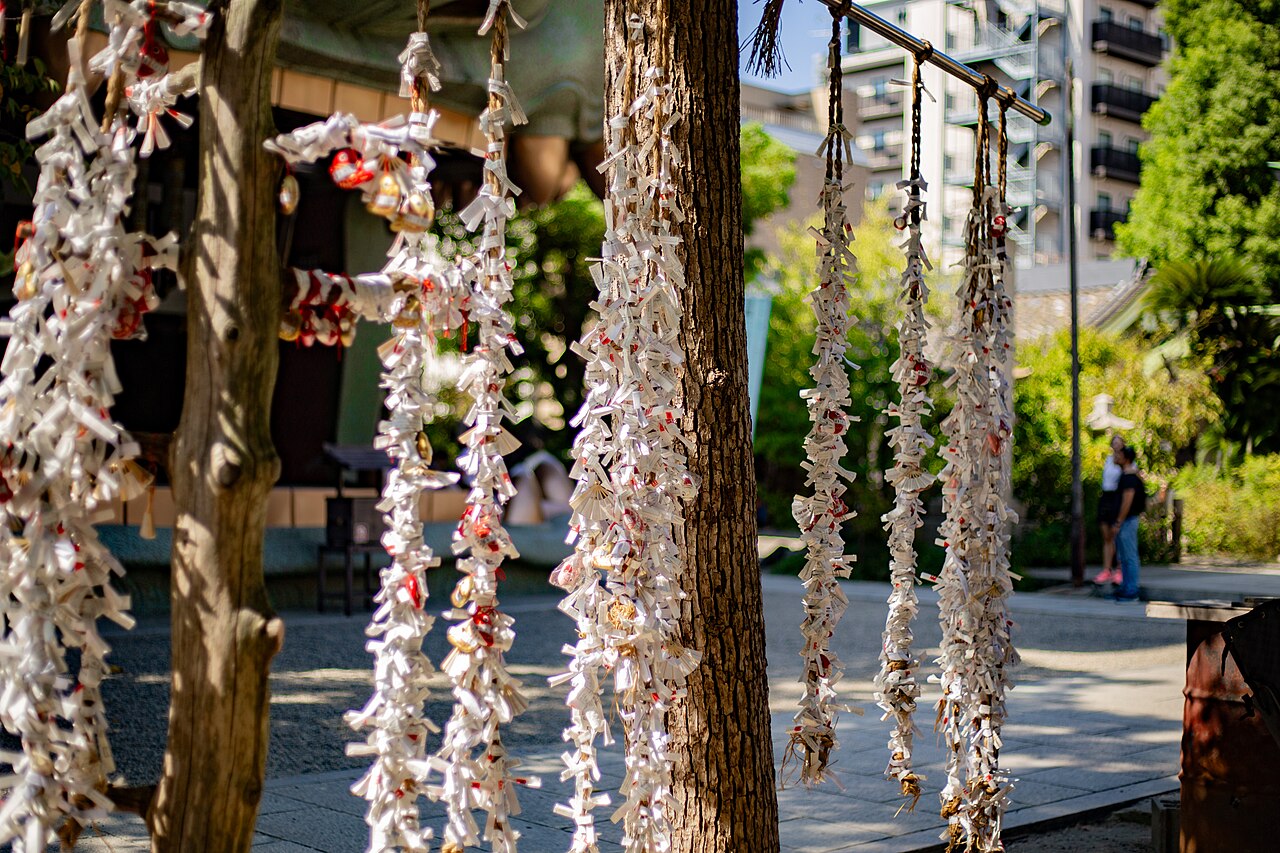
Rows of tied omikuji at Namba Yasaka Shrine, Osaka. Visitors who draw a bad fortune knot the paper strip onto a rack rather than take it home. Photo: Ian G Shingler, CC BY-SA 4.0, via Wikimedia Commons.
Meaning
Omikuji (おみくじ, also written お神籤 or 神籤) are random paper fortune slips available at 神社 (Shinto shrines) and Buddhist temples across Japan. Each slip prints a fortune ranking — from the best possible luck down to outright misfortune — along with more detailed predictions for specific areas of life such as love, health, business, travel, and study.
The word breaks down as the honorific prefix o- (お), mi (神/御, a further honorific), and kuji (籤, "lot" or "lottery slip"). It's the same kuji used in words like 占い (fortune-telling) — omikuji is best understood as a form of lot-casting divination rather than a horoscope: the fortune is determined by chance at the moment you draw it, not by your birth date or personal details.
Fortunes are traditionally ranked on a scale that runs, roughly, from best to worst:
| Rank | Kanji | Reading | Meaning |
|---|---|---|---|
| Great blessing | 大吉 | だいきち | Great blessing / great luck |
| Middle blessing | 中吉 | ちゅうきち | Middle blessing |
| Small blessing | 小吉 | しょうきち | Small blessing |
| Blessing | 吉 | きち | Blessing / good luck |
| Half-blessing | 半吉 | はんきち | Half-blessing (used by some shrines) |
| Ending blessing | 末吉 | すえきち | Blessing that comes later |
| Curse | 凶 | きょう | Curse / bad luck |
| Great curse | 大凶 | だいきょう | Great curse / very bad luck |
Not every shrine uses all eight ranks — many simplify to a shorter scale of daikichi → kichi → kyō → daikyō — and the exact proportion of each rank in the box varies by shrine, though most weight the boxes so that good fortunes are more common than bad ones.
Usage
There are two common ways to draw an omikuji, and both are described with the verb 引く (hiku, "to draw/pull"):
- Shaking a numbered stick from a box (o-mikuji-bako): You shake a hexagonal wooden 箱 containing numbered wooden sticks until one slides out through a small hole. The 番号 (number) on the stick corresponds to a drawer containing pre-printed fortune slips; you open the matching drawer and take a slip.
- Drawing directly: At many shrines and temples, especially larger or more modern ones, you simply pay a small fee (typically ¥100–200) and pull a folded slip directly from a large box or dispenser — no numbered stick involved.
おみくじを引いたら、大吉が出た! Omikuji o hiitara, daikichi ga deta! "When I drew an omikuji, I got a great blessing!"
今年のおみくじは凶だった。木の枝に結んでおいた。 Kotoshi no omikuji wa kyō datta. Ki no eda ni musunde oita. "This year's omikuji was a curse. I tied it to a tree branch."
After reading the general rank, most slips also print short verses or specific predictions under headings like 恋愛 (romance), 健康 (health), 商売 (business), 学業 (studies), and 旅行 (travel) — so even a middling overall rank might carry an encouraging note about a specific part of your life, or vice versa.
Cultural Context
Omikuji trace back to older Chinese and Japanese traditions of lot-casting for divination and decision-making, which were used historically for things as consequential as choosing a temple's next abbot. The practice was gradually adapted into a form of everyday personal fortune-telling available to any visitor, and the modern mass-printed paper-slip format familiar today took shape through the Meiji and early 20th century, when a Tokyo shrine started producing standardized printed fortunes that other shrines and temples across the country adopted.
What to do with a bad fortune: If you draw a kyō (凶) or daikyō (大凶), tradition holds that you shouldn't simply pocket it and walk away — the bad luck is thought to cling to the paper. Instead, visitors fold or tie the slip onto a designated wire rack, rope, or 木 (tree) branch within the shrine or temple grounds, a gesture symbolically read as 結ぶ ("to tie/bind") the misfortune to the shrine rather than carrying it home — related to musubi (結び), the Shinto concept of binding or connection. Many shrines provide a designated frame for this purpose specifically so that trees on the grounds aren't damaged by the sheer volume of tied paper. Good fortunes, by contrast, are often kept — tied to the rack anyway as an offering, taken home as a charm, or folded into a wallet or bag to "hold onto" the luck.
When people draw them: Omikuji are drawn year-round, but by far the busiest time is 初詣 (hatsumōde), the first shrine or temple visit of the New Year, when millions of visitors line up to draw a fortune for the year ahead. They're also popular during major festivals, at graduation and coming-of-age milestones, and simply as a casual activity on any shrine visit — passing through the 鳥居 (torii gate), paying respects, dropping a coin in the 賽銭 box, and then drawing an omikuji is a familiar sequence for both worshippers and tourists.
Related Practices
Omikuji sit alongside other shrine customs but serve a different purpose from each:
- Ema (絵馬) — wooden votive tablets on which visitors write a specific wish or prayer and hang at the shrine, rather than receiving a random fortune.
- Omamori (お守り) — protective amulets purchased to carry with you, offering ongoing protection or luck for a specific purpose (health, safety, exams) rather than a one-time reading.
- Hatsumōde (初詣) — the New Year's first shrine visit, the single most common occasion for drawing an omikuji.
- Torii (鳥居) — the gate marking the entrance to shrine grounds where these practices take place.
Fortune Categories
A typical omikuji slip covers several life areas beyond the headline rank, often including:
| Category | Japanese |
|---|---|
| Romance / relationships | 恋愛 |
| Health | 健康 |
| Business / work | 商売 |
| Academic study | 学業 |
| Travel | 旅行 |
| Lost items | 待ち人 / 失せ物 |
| Childbirth | 出産 |
Because these sub-predictions can diverge from the overall rank, an omikuji is often read less as a single verdict and more as a small collection of advice — a way of pausing to reflect on different parts of one's life at a shrine visit, regardless of whether the headline fortune is good or bad.
Related Dictionary Words
fortune slip (usu. bought at a shrine)
Shinto shrine
excellent luck (esp. in fortune-telling)
bad luck; ill fortune; misfortune
good fortune (esp. omikuji fortune-telling result); good luck; auspiciousness
moderately good luck (in fortune-telling)
slightly good luck (as a fortune telling result)
terrible luck (esp. on an omikuji slip); very bad luck
tree; shrub; bush
branch; bough; limb; twig; sprig; spray
marriage; marriage tie; love knot
first shrine visit of the New Year
torii (Shinto shrine archway)
miko; shrine maiden; young girl or woman (trad. an unmarried virgin) who assists priests at shrines
monetary offering; offertory
going and worshipping (at a shrine or temple); visit (to a shrine or temple to worship)
wish; desire; request; prayer
love; romance; tender passion; emotion; affections
trade; business; commerce
health
fortune; luck
fortune-telling; divination
to pull; to tug; to lead (e.g. a horse)
pole; rod; stick; baton
box; case; chest; package; pack; crate
number; series of digits
studies; schoolwork; classwork
travel; trip; journey; excursion; tour
person being waited for
lost article
childbirth; (giving) birth; delivery; parturition
ending; conclusion