お土産
omiyageThe Japanese custom of bringing back individually wrapped local snacks as near-obligatory gifts for coworkers and family after a trip.
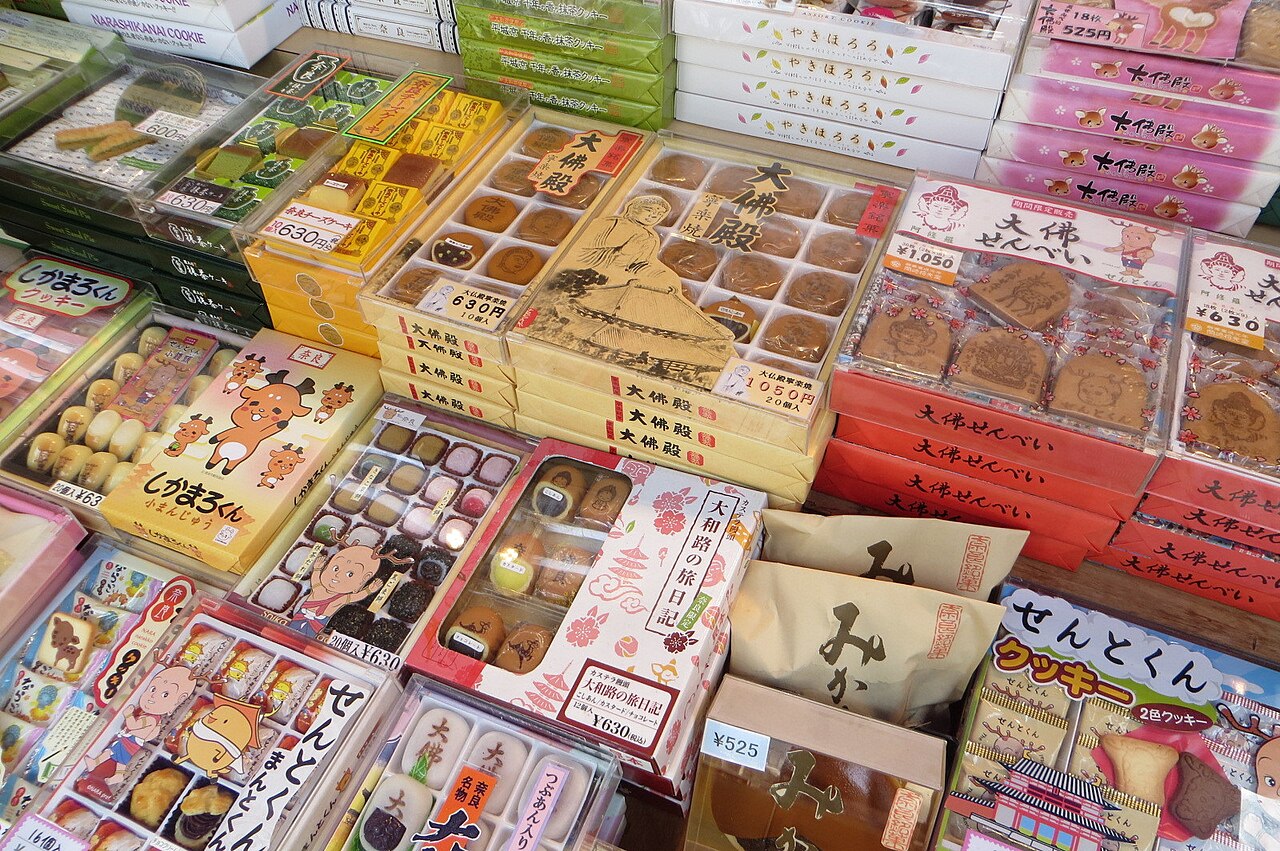
Boxes of regional 銘菓 (meibutsu-gashi, "famous local sweets") — each box contains many individually wrapped pieces, the format that makes omiyage easy to hand out at work. Photo: Jorge from Brazil, CC BY 2.0, via Wikimedia Commons.
Meaning
お土産 (omiyage) literally means "local product" or "regional specialty," but in practice it refers to a very specific social ritual: bringing back a gift — almost always food — for the people back home after a trip. The core meaning is broader than the English word "souvenir." A souvenir, in Western usage, is something a traveler buys for themselves to remember a trip. Omiyage is the opposite in spirit: it is bought for other people, and giving it is treated less as a nicety than as a near-obligatory social debt that must be settled the moment someone returns from a trip.
The most common form of omiyage is a box of 個包装 (kobōsō) — individually wrapped — local sweets or crackers: think Tokyo Banana from Tokyo, Shiroi Koibito from Hokkaido, or momiji manju from Miyajima. The individual wrapping is not incidental; it is the entire point. A single box can be broken up into 12, 20, or 30 small packets, letting one traveler distribute a token gift to an entire office, classroom, or extended family without anyone being left out.
Usage
Omiyage culture runs on a simple, largely unspoken script:
旅行に行ったら、会社の同僚にお土産を買って帰るのが普通です。 Ryokō ni ittara, kaisha no dōryō ni omiyage o katte kaeru no ga futsū desu. "If you go on a trip, it's normal to buy omiyage for your coworkers to bring back."
これ、京都のお土産です。よかったらどうぞ。 Kore, Kyōto no omiyage desu. Yokattara dōzo. "Here, this is a souvenir from Kyoto. Please have one, if you'd like."
A related, slightly more personal term is 手土産 (temiyage) — a small gift brought by hand when visiting someone's home or office, regardless of travel. Omiyage overlaps with temiyage but is specifically tied to travel and a specific 名物 (meibutsu, "famous local product") of the place visited.
The distribution ritual, especially in an office, follows a near-fixed pattern:
- The traveler returns from a business trip or vacation.
- On the first day back, they place a box of individually wrapped sweets in a common area (break room table, near the coffee machine) or walk it around desk by desk.
- A short note or verbal script accompanies it: "つまらないものですが" (tsumaranai mono desu ga, "it's nothing much, but…") — a self-deprecating phrase that is pure formula and not meant to be taken literally.
- Coworkers each take one individually wrapped piece, say thank you, and the debt is considered settled.
Skipping this step, especially after being away on the company's time, can genuinely register as a breach of etiquette — coworkers may not say anything, but the omission is noticed.
Cultural Context
Giri and the logic of obligation
Omiyage culture is best understood through the lens of 義理 (giri) — a sense of social duty and reciprocal obligation that runs through much of Japanese interpersonal life. When someone takes time off work, their absence places a small burden on coworkers who cover for them. Omiyage functions as a symbolic repayment: a tangible, edible acknowledgment that "I was gone, thank you for covering, here is something in return." It is less about the monetary value of the gift (a box of crackers rarely costs more than a few thousand yen) and more about the act of reciprocation itself — the visible fulfillment of a social script that everyone recognizes and expects.
This is also why the gifts are consumable and cheap rather than valuable or personal. A box of local sweets creates no lasting obligation of its own (unlike an expensive present, which itself might demand a return gift) and disappears within a day or two, closing the loop cleanly.
Built into the infrastructure
Because omiyage-buying happens under time pressure — usually in the final minutes before a train or flight — Japan's transit hubs have built entire retail ecosystems around it. Shinkansen stations have long corridors of omiyage kiosks selling boxed regional specialties; airports like Haneda and Narita devote entire terminal wings to prefecture-specific sweets; and department stores build their basement food halls, known as depachika, partly around omiyage-grade gift boxes. Highway service areas (michi-no-eki) do the same for road trips. The entire retail category exists because the social obligation to bring something back is assumed to be nearly universal — missing the shop before departure is treated as a real problem, not just an inconvenience.
Packaging design reflects this too: boxes are engineered to travel well, list a clear "best by" date, and — critically — state the item count on the box, so a buyer can match the number of pieces to the number of people they need to give one to (an office of 15 needs a box of at least 15).
Omiyage vs. personal travel keepsakes
It's worth separating two categories that get blurred in English by the single word "souvenir":
| Omiyage (お土産) | Personal keepsake | |
|---|---|---|
| Who it's for | Coworkers, family, neighbors | The traveler themselves |
| What it typically is | Individually wrapped local food, often 銘菓 | Postcards, trinkets, clothing, photos |
| Obligation level | Socially expected, especially from work trips | Optional, purely personal |
| Where it's bought | Station/airport omiyage shops, meibutsu stores | Museum shops, boutiques, markets |
| When it's given | Immediately upon return | Kept or given at leisure |
A traveler might buy both on the same trip: a keychain for their own shelf, and a box of individually wrapped sweets for the office. Only the latter is "omiyage" in the strict sense.
A piece of a larger gift economy
Omiyage sits within a much wider Japanese culture of structured, calendar-bound gift-giving. The clearest parallel is the seasonal gift exchange of お中元 (o-chūgen, given in midsummer) and お歳暮 (o-seibo, given at year's end), where individuals send gifts — often food or household goods — to bosses, teachers, and business contacts to maintain long-term relationships. O-chūgen and o-seibo are scheduled and relationship-maintaining; omiyage is event-triggered (a trip) and debt-settling. Both share the same underlying grammar: a modest, appropriately-priced gift, given with ritual humility, that reinforces a social bond rather than expressing personal affection. Understanding omiyage is, in that sense, a doorway into how gift-giving in Japan generally works — visible, expected, and reciprocal rather than spontaneous and purely personal.
Modern variations
- Omiyage for oneself: A newer, half-joking trend is 自分土産 (jibun miyage, "omiyage for yourself") — buying a small treat as a reward, separate from the obligatory office gifts.
- Online omiyage: Some regional specialty makers now sell directly online, letting people send omiyage-style gifts without having physically traveled — a sign the format (individually wrapped, regionally branded, modestly priced) has outgrown the literal travel requirement.
- Konbini omiyage: Convenience stores near stations, including many konbini, now stock a small selection of prefecture-branded snacks for travelers who ran out of time to visit a dedicated shop.
Related Dictionary Words
local specialty or souvenir bought as a gift while traveling (travelling)
local specialty or souvenir bought as a gift while travelling
present (brought by a visitor); gift
duty; sense of duty; honor; honour; decency; courtesy; debt of gratitude; social obligation
humanity; empathy; kindness; sympathy
excellent sweet; confection of an established name
individual packaging; individual wrapping
famous product; special product; speciality; specialty
mid-year gift; summer gift
year-end gift
coworker; co-worker; colleague; associate
travel; trip; journey; excursion; tour