ポケットモンスター
poketto monsutāThe Japanese media franchise about catching, training, and battling creatures called Pokémon, created by Satoshi Tajiri at Game Freak and now the highest-grossing media franchise in the world.
Meaning
ポケットモンスター — universally shortened to ポケモン (Pokémon) — literally means "pocket monster." It is the name of a Japanese media franchise centered on fictional creatures that trainers catch, raise, 進化させる (evolve), and pit against each other in 対戦 (battles). What began in 1996 as a pair of Game Boy role-playing games has grown into video games, an anime series now in its third decade, a long-running manga, a trading card game, and one of the best-selling toy and merchandise lines in history.
The word covers both the franchise as a whole and, informally, an individual creature — "a Pokémon" — of which there are now well over a thousand distinct species, from the electric mouse Pikachu (ピカチュウ) to the legendary birds and dragons that headline each generation's mythology.
Origin
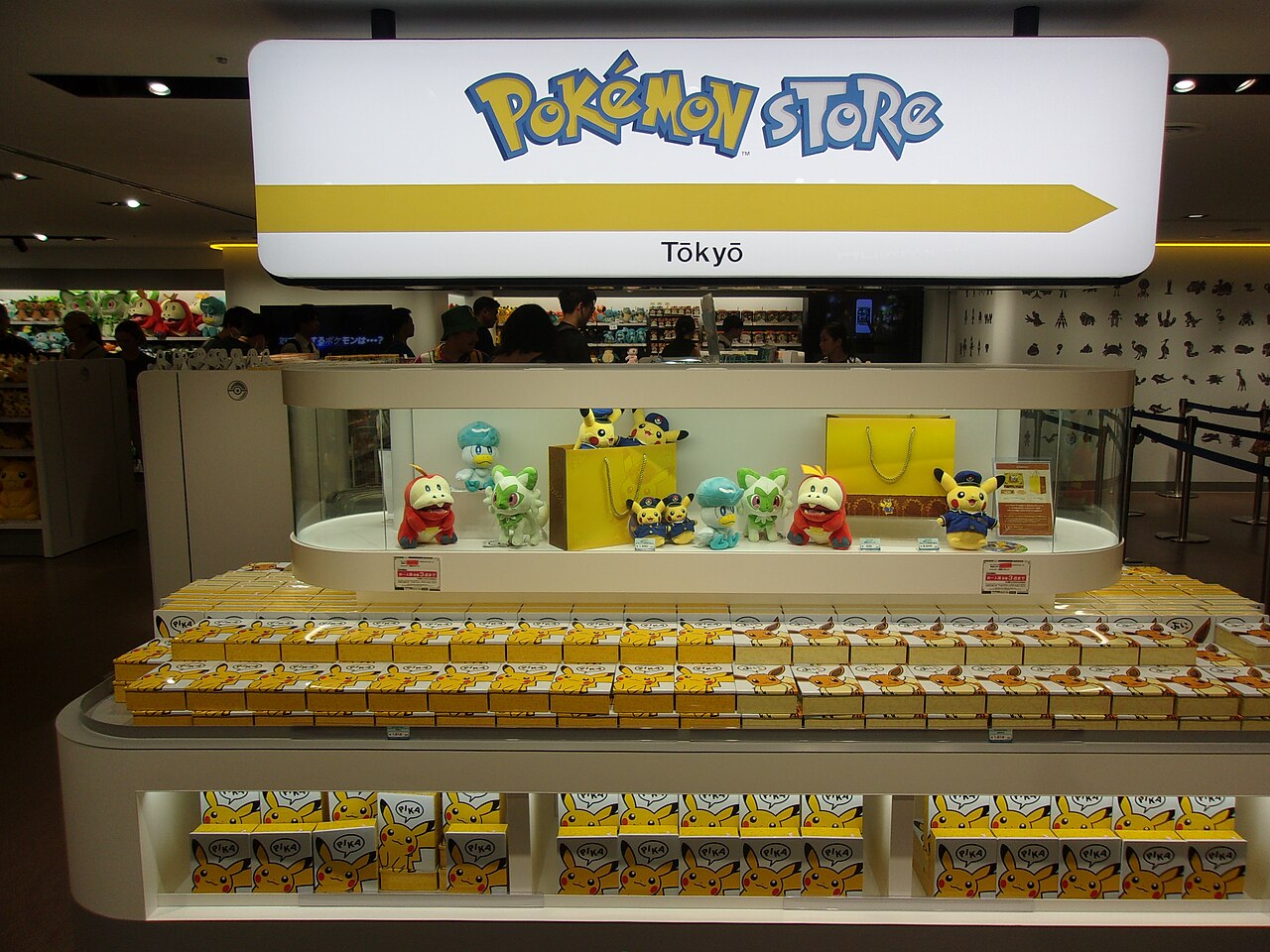
A Pokémon Store display at Tokyo Station. Public domain (CC0), via Wikimedia Commons.
The franchise was created by Satoshi Tajiri (田尻智), founder of the game developer Game Freak. As a child growing up in Machida, a suburb of Tokyo, Tajiri spent his free time 収集 — collecting — insects, fish, and tadpoles from local streams and rice paddies, earning him the nickname "Dr. Bug" among friends. He has said that watching rapid urban development pave over those childhood collecting grounds left a lasting impression, and that he wanted to recreate the thrill of insect collecting for a generation of kids who no longer had easy access to it.
That idea crystallized after Tajiri saw the Game Boy's link cable, which let two units communicate directly. He imagined creatures that could travel down the cable between games — the seed of the series' defining mechanic: catching monsters in one version of a game and trading with a friend to complete the set. Tajiri pitched the concept to Nintendo in the late 1980s; it took roughly six years of development, much of it self-funded and nearly bankrupting Game Freak, before Pocket Monsters: Red and Green finally launched in Japan in February 1996. Producer Shigeru Miyamoto, creator of Mario and Zelda, mentored the project at Nintendo and helped push it to release.
The Games and "Gotta Catch 'Em All"
The core video games are turn-based RPGs built around a simple but endlessly replayable loop: explore a region, catch wild Pokémon in 図鑑-tracked pocket balls, train them by battling, and challenge Gym Leaders and rivals en route to the regional championship. The dual-version release — Red/Green (later Red/Blue outside Japan), Gold/Silver, and every main generation since — was a deliberate design choice: each version has creatures the other lacks, driving players to 対戦 and trade with friends to complete their 図鑑 (Pokédex), the in-game encyclopedia of every species. That built-in social mechanic, distilled into the English marketing slogan "Gotta catch 'em all," is widely credited as the franchise's central engine of both gameplay and commercial success.
Nintendo, Game Freak, and card/anime studio Creatures Inc. jointly own the franchise through The Pokémon Company, formed in 1998 specifically to manage its explosive growth. As of the mid-2020s the games alone have sold over 480 million units worldwide, and Pokémon as a whole is regularly cited as the highest-grossing media franchise ever created, with lifetime revenue estimated above $100 billion once merchandise, the trading card game, and licensing are included — ahead of Star Wars, Marvel, Mickey Mouse, and Hello Kitty.
Anime, Manga, and Trading Cards
The anime series debuted in Japan in April 1997, following ten-year-old trainer Satoshi (localized internationally as Ash Ketchum) and his partner Pikachu as they travel between regions collecting Gym Badges. It has run continuously for well over 1,000 episodes and aired in more than 190 countries, making the young trainer's journey one of the most widely broadcast pieces of Japanese animation in the world. A notorious 1997 episode, "Dennō Senshi Porygon," triggered seizures in hundreds of Japanese viewers due to a strobing red-blue effect and was permanently pulled from rebroadcast — an incident still studied in discussions of photosensitive epilepsy and television safety standards.
Alongside the anime, 漫画 adaptations such as Pokémon Adventures (ポケットモンスターSPECIAL) have run since 1997, following the game protagonists more closely than the anime does. The Pokémon Trading Card Game, launched in Japan in October 1996, became a cultural phenomenon of its own; rare holographic cards from the original sets now sell at auction for hundreds of thousands of dollars, and the card game remains one of the best-selling in the world alongside Magic: The Gathering and Yu-Gi-Oh!.
Cultural Context
In Japan, Pokémon sits at the intersection of children's entertainment and a much broader design philosophy sometimes described as kawaii commercialism — turning collectible, huggable characters into an ecosystem of games, toys, and media that keeps a single IP relevant across decades and age groups. Pikachu in particular has become a de facto secondary mascot for the country itself, appearing on Japan Airlines jets, in Nintendo's Shibuya flagship store, and as a parade float in the annual Pikachu Outbreak event in Yokohama.
The franchise is also frequently cited as one of Japan's most successful examples of soft power — cultural export that builds international goodwill and familiarity with Japan without direct government promotion, alongside anime and manga more broadly. Pokémon GO, the 2016 augmented-reality mobile game from Niantic, briefly became a global cultural event in its own right, sending millions of players into the streets to catch Pokémon overlaid on real-world locations and demonstrating the franchise's ability to reinvent itself for new platforms three decades after its creation. Tajiri's original inspiration — a boy chasing insects through the fields around Tokyo before they disappeared under new construction — remains visible in the games' core verb: to walk outside, and catch what you find.
Related Terms
| Japanese | Reading | Meaning |
|---|---|---|
| ポケモン | ぽけもん | Pokémon (short form) |
| 図鑑 | ずかん | picture book / index (as in Pokédex) |
| 進化 | しんか | evolution |
| 対戦 | たいせん | battle / match |
| 収集 | しゅうしゅう | collecting |
Related Dictionary Words
Pokémon
Pocket Monsters; Pokemon (RPG series)
monster; monstrosity
evolution
to raise; to rear; to bring up
collecting; accumulating; gathering
card (information, filing, etc.)
game
animation; animated film; animated cartoon; anime
cartoon; comic; comic strip; manga
worldwide; global; international; universal
adventure; venture
fighting (against); taking on (an opponent); facing; confronting; competing (with); battle; fight; contest; match
trading card; collectible card
pictorial book; picture book; illustrated reference book; identification manual; field guide