渋谷系
shibuya-keiAn eclectic alternative pop movement born in early-1990s Tokyo, blending French yé-yé, bossa nova, jazz, and lounge music through the lens of Shibuya's obsessive record-store culture.
What is Shibuya-kei?
渋谷系 (Shibuya-kei) literally means "Shibuya style" or "Shibuya type" — the 系 suffix (meaning type, style, or affiliated with) is the same suffix used in terms like ヴィジュアル系 (visual-kei). But unlike a neatly defined genre with fixed rules, Shibuya-kei was always a slippery label: part music scene, part aesthetic sensibility, part marketing category born from the racks of Shibuya's legendary record shops.
At its core, Shibuya-kei described a generation of Japanese musicians who were voracious consumers of obscure Western pop — French yé-yé, Brazilian bossa nova, 1960s sunshine pop, lounge exotica, soul, jazz, and hip-hop — and who recombined those influences into something self-consciously sophisticated and unmistakably Tokyo. Critics and artists alike debated whether it was a coherent genre or simply a useful shorthand for "cool records sold in Shibuya." That ambiguity is part of its charm.
Origins
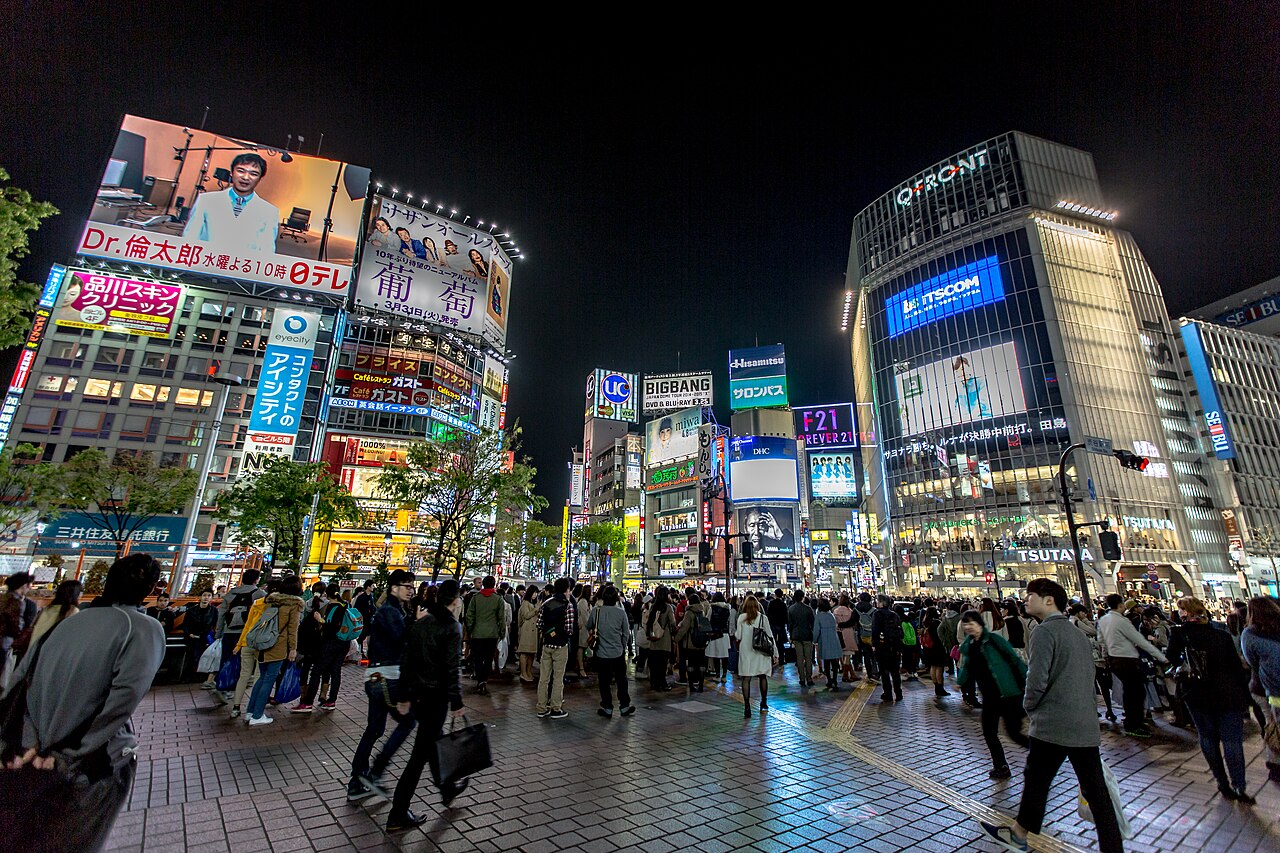
The neon-lit streets of Shibuya, 東京 — the neighbourhood whose record shops gave 渋谷系 its name. Photo: IQRemix, CC BY-SA 2.0, via Wikimedia Commons.
The story begins in Japan's bubble economy of the late 1980s. Flush with disposable income, a new generation of urban 若者 (young people) had access to something their parents could only dream of: hundreds of thousands of imported records and CDs, curated and stocked by the specialist shops that had colonised Shibuya's backstreets.
Three stores in particular shaped the scene. Wave (opened 1983, run by Sony) was the first — an architectural statement in Roppongi before a branch opened in Shibuya, stocking imports that Japanaese distributors ignored. Tower Records Shibuya, which opened its landmark nine-floor building in 1990, became the cathedral of the movement, with floor-by-floor sections devoted to every imaginable microgenre. HMV Shibuya complemented it with a particularly strong selection of British indie and French pop.
The young musicians who would define Shibuya-kei spent their weekends in these stores, hunting for obscurities: forgotten French 45s, Brazilian bossa nova LPs, Italian library music, Phil Spector productions, Serge Gainsbourg records. This crate-digging obsession was itself a kind of cultural practice — knowing the right record was social currency.
Sound
Shibuya-kei's sound is easier to describe by listing its ingredients than by pointing to a single defining characteristic. The movement drew from:
| Influence | Examples |
|---|---|
| French yé-yé | France Gall, Françoise Hardy |
| Bossa nova / Brazilian pop | João Gilberto, Astrud Gilberto |
| 1960s sunshine pop | The Beach Boys, The Mamas & The Papas |
| Lounge / exotica | Esquivel, Burt Bacharach |
| Jazz & soul | Blue Note records, Motown |
| Hip-hop sampling | Public Enemy, De La Soul |
| British indie / new wave | Orange Juice, The Smiths |
サンプリング (sampling) was central to the production approach. Rather than treating sampling as mere quotation, Shibuya-kei producers used it as a compositional tool, layering loops, drum breaks, and melodic fragments into densely referential collages. The result was music that rewarded the listener who could catch each reference — a knowing wink for fellow crate-diggers.
The production aesthetic was consistently polished and urban: crisp beats, lush arrangements, often bilingual lyrics mixing Japanese with English or French. If city-pop had been the sound of Japan's economic optimism in the 1980s, Shibuya-kei was the sound of its cultural self-confidence in the 1990s — looking outward at the world and remaking it on Japanese terms.
Key Artists
ピチカート・ファイヴ (Pizzicato Five) are the act most associated with Shibuya-kei in the Western imagination. Formed in 1984, the group — eventually a duo of Yasuharu Konishi (小西康陽, こにしやすはる) and vocalist Maki Nomiya (野宮真貴, のみやまき) — built their sound around a love of French pop, jazz, and mod aesthetics. Their 1993 album BossaNova2001 (produced by Cornelius) and the 1994 Overdose brought them international recognition. Their bilingual songs and sharp retro visuals made them the face of Shibuya-kei abroad.
ピチカート・ファイヴの音楽は、ジャズとポップスの境界を軽やかに越えていた。 Pizzicato Five's 音楽 (music) glided effortlessly across the boundary between jazz and pop.
フリッパーズ・ギター (Flipper's Guitar) were arguably the movement's founding act. The duo of Keigo Oyamada (小山田圭吾, おやまだけいご) and Kenji Ozawa (小沢健二, おざわけんじ) began with a jangly British indie sound before pivoting sharply to sample-heavy, bossa nova-inflected pop. Their 1990 album Camera Talk is a key document of early Shibuya-kei. The group disbanded in 1991.
コーネリアス (Cornelius) — Keigo Oyamada's solo project after Flipper's Guitar — pushed the aesthetic to its logical extreme. His 1997 album Fantasma is widely considered the pinnacle of the genre: a dizzying cut-and-paste record that flips between surf rock, bossa nova, hip-hop, folk, and electronic music within single songs. Cornelius later became an internationally acclaimed artist, contributing music to films and art installations.
小沢健二 (Ozawa Kenji), the other half of Flipper's Guitar, released a series of beloved solo albums in the mid-1990s that blended orchestral pop with hip-hop beats and literary Japanese lyrics. His 1994 Life is considered a masterpiece of Japanese pop.
Fantastic Plastic Machine (ファンタスティック・プラスチック・マシーン) — the project of producer Tomoyuki Tanaka (田中知之, たなかともゆき) — took the lounge and electronic end of Shibuya-kei further, making club-ready tracks steeped in 1960s aesthetic.
カヒミ・カリィ (Kahimi Karie) brought a breathy, intimate vocal style influenced by Françoise Hardy and Astrud Gilberto. Her collaborations with Cornelius and Pizzicato Five's Konishi placed her at the centre of the scene, and her deliberately childlike, whispered delivery became one of Shibuya-kei's most distinctive vocal signatures.
The Shibuya Record Store Scene
The record stores were not merely retail outlets — they were the infrastructure of the scene. Staff picks, hand-written recommendation cards, and in-store events shaped the tastes of an entire generation of musicians and listeners. Tower Records Shibuya had a dedicated import section that stocked records from France, Brazil, and the UK that were essentially unavailable elsewhere in Japan.
This geography mattered. The concentration of specialist shops within walking distance of each other in Shibuya created a physical community — a place where musicians, producers, and fans could browse the same racks, overhear the same recommendations, and build shared references. In this sense, Shibuya-kei was as much a social network as a musical genre, held together by the shared experience of レコード hunting.
The 流行 (trend) spread partly because labels like Trattoria Records (run by Pizzicato Five's Konishi) and Escalator Records signed and promoted acts within the scene, creating a recognisable branded aesthetic. Matador Records and Polystar distributed several Shibuya-kei acts internationally, bringing Pizzicato Five and Cornelius to Western audiences.
Fashion and Aesthetic
Shibuya-kei was inseparable from its visual identity. Album artwork drew on 1960s mod graphics, Italian cinema posters, French new wave film stills, and op-art patterns. Artists like Pizzicato Five cultivated a look of vintage European chic — sharp cuts, bold primary colours, geometric prints — that signalled cultural literacy as clearly as the music did.
The overall aesthetic was one of knowing sophistication: ironic but not cynical, retro but not nostalgic, cosmopolitan but distinctly Japanese. It sat in deliberate contrast to the louder, more theatrical ヴィジュアル系 scene developing simultaneously in Japan, and equally apart from the earthier grunge and alternative rock sounds dominating Western charts.
Decline and Legacy
By the late 1990s, the scene had peaked. Several factors contributed to its decline. The original artists moved on — Flipper's Guitar had already disbanded in 1991; Pizzicato Five dissolved in 2001. As Shibuya-kei's distinctive formula became familiar, imitators multiplied and the sound lost its edge of surprise. The economic stagnation that followed Japan's bubble collapse shifted the cultural mood, and アイドル groups and the emerging Akihabara subculture captured youth attention.
Yet the legacy proved durable. Shibuya-kei made it possible for Japanese indie 音楽 to reach international audiences on its own terms — not as J-pop novelty but as cosmopolitan art music. Cornelius' later work earned critical acclaim worldwide. The genre's influence can be heard in artists from Cibo Matto (New York-based, but deeply rooted in Shibuya-kei's aesthetic) to Capsule and HALCALI in Japan.
The global revival of シティポップ from the 2010s onward drew renewed attention to Shibuya-kei as a parallel current in Japan's pop history. Younger listeners discovering Pizzicato Five or Cornelius on streaming services encounter music that sounds startlingly fresh — a testament to the movement's deep investment in timeless influences over contemporary trends.
Shibuya-kei also modelled a mode of cultural production — the obsessive collector who transforms influences into something new — that resonates far beyond Japan. In an era of algorithmic playlists, there is something appealing about a scene built on the physical act of crate-digging, on the discovery of a perfect record in the right shop at the right moment.