進撃の巨人
shingeki no kyojinA landmark manga and anime by Hajime Isayama about humanity's last survivors fighting man-eating titans behind walled cities, celebrated for its dark, politically charged storytelling and divisive ending.
Meaning
進撃の巨人 (Shingeki no Kyojin, literally "Advancing Giants," released internationally as Attack on Titan) is a Japanese 漫画 written and illustrated by Hajime Isayama (諫山創). Serialized from 2009 to 2021, it was adapted into a landmark アニメ television series (2013–2023) that became one of the most influential and widely discussed anime of its generation.
The story is set in a world where the last remnants of humanity live inside three concentric 壁, walled cities built to keep out man-eating 巨人 — mindless giants who devour people seemingly for no reason. When a Colossal Titan breaches the outer wall, teenager Eren Yeager watches his mother killed and vows to exterminate every titan on Earth. He joins the Survey Corps, a military unit that ventures beyond the walls, and the series follows the slow, brutal unraveling of the truth behind the titans, the walls, and the wider world outside them.
Story and Setting
What begins as a monster-siege survival story steadily transforms into a sprawling political and historical epic. Around the one-third mark, the manga executes one of the most talked-about tonal pivots in modern storytelling: the isolated walled world is revealed to be a small, engineered corner of a much larger 世界観, and the "mindless" titans turn out to be transformed humans, tied to a real-world-adjacent nation, ethnic persecution, and a genocide allegory involving the Eldians and Marleyans. Eren's journey from sympathetic protagonist to a figure willing to commit atrocities in the name of freedom became the series' central moral question, and its handling of 戦争, inherited hatred, and the impossibility of a clean "good side" set it apart from typical 少年漫画.
Isayama has cited Neon Genesis Evangelion, Blame!, and Kentaro Miura's Berserk as influences, and the series wears those inspirations openly: giant, uncanny 怪物 antagonists; a claustrophobic, crumbling world; and a willingness to kill off major characters without warning. Combined with Isayama's rougher, more expressive early art style — later refined and supported by studio production teams as the story grew — Attack on Titan built a reputation for unpredictability that kept both manga readers and anime viewers constantly guessing.
Cultural Impact and Popularity
Attack on Titan is one of the best-selling manga of all time, with more than 100 million copies in circulation worldwide, and it helped drive a wave of international interest in seinen-adjacent, morally complex anime during the 2010s. The anime adaptation by Wit Studio (later MAPPA for the Final Season) was a global streaming phenomenon, and its second opening theme, "紅蓮の弓矢" (Guren no Yumiya), and the Final Season's openings became instantly recognizable touchstones of anime fandom even among people who had never watched the show.
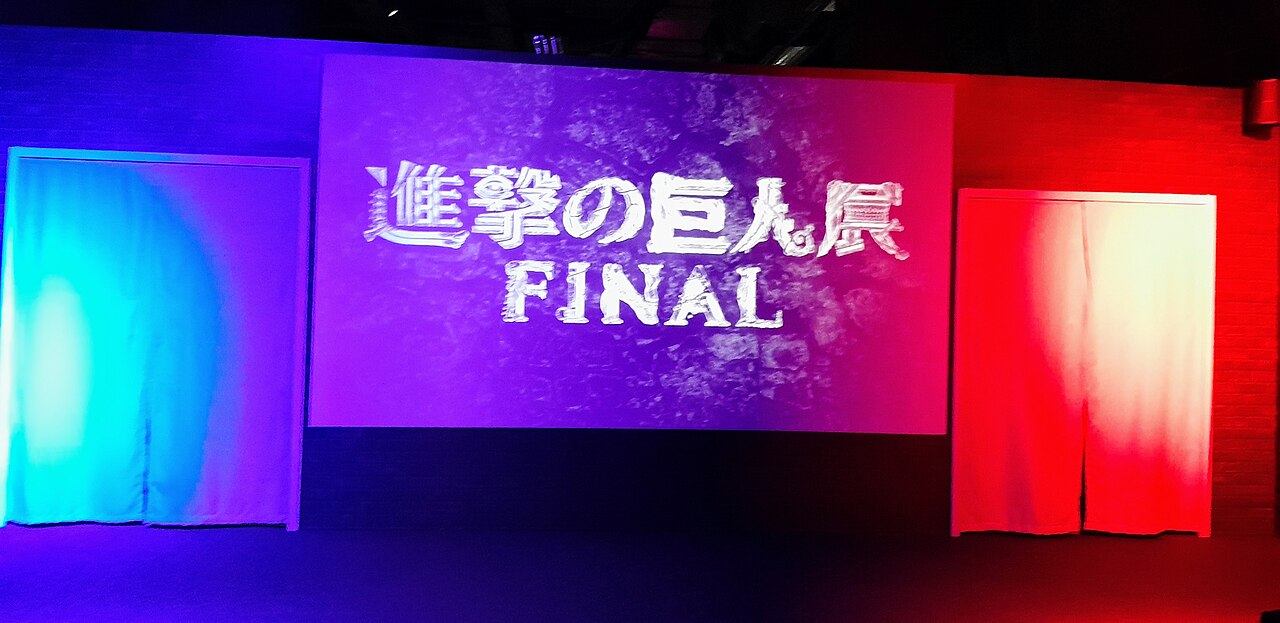
Entrance signage for 進撃の巨人展 FINAL, the official touring exhibition held in Japan to mark the series' conclusion. Photo: VulcanSphere, CC BY 4.0, via Wikimedia Commons.
The franchise's reach extends well beyond the page and screen: official touring exhibitions such as 進撃の巨人展 (the Attack on Titan Exhibition) have been held in major Japanese museums and galleries, giant titan-themed ice sculptures have appeared at the Sapporo Snow Festival, and the town of Hita in Ōita Prefecture — whose landscapes partly inspired the walled setting — leans into "pilgrimage" tourism from fans. Merchandising, mobile games, stage plays, and two live-action films rounded out a media mix typical of a top-tier modern manga property.
Critical Acclaim and Controversy
For most of its run, Attack on Titan was near-universally praised for its pacing, its willingness to subvert shōnen conventions, and its ambition in tackling themes of 自由, cyclical violence, and the dehumanization required to wage 戦争. It won the Kodansha Manga Award and topped numerous "best anime of the decade" lists.
Its 2021 完結 (and the anime's final episodes airing through 2023), however, proved 賛否両論 — divisive — among longtime fans. Some praised the ending's bleak insistence that Eren's genocidal war brought no true resolution, only further 犠牲 and an uneasy peace; others felt the final chapters rushed a story that had spent a decade building toward something more conclusive, and criticized what they saw as a muddled resolution to Eren's arc. The anime's Final Season also drew scrutiny for its long, staggered release schedule (split across multiple "parts" from 2020 to 2023) and a mid-series animation studio handoff from Wit Studio to MAPPA, which fans debated at length. Despite the controversy, the ending's very divisiveness kept the series in the cultural conversation for years, spawning extensive fan analysis videos, essays, and re-evaluation discourse that continues today.
Influence on the "Dark Fantasy" Boom
Attack on Titan is widely credited with helping popularize — and legitimize commercially — a wave of "dark fantasy" and morally ambiguous anime aimed at older audiences, alongside contemporaries like Tokyo Ghoul and later Chainsaw Man and Jujutsu Kaisen. Its combination of high stakes, frequent character deaths, body horror, and a refusal to offer easy heroes and villains influenced how studios and publishers pitched "serious" anime to Western streaming audiences in the Crunchyroll and Netflix era. Many later hits explicitly positioned themselves in its lineage, and industry commentary regularly cites Attack on Titan as the show that proved a bleak, politically charged shōnen/seinen hybrid could become a global mainstream hit rather than a niche one.
Legacy
More than a decade after its debut, 進撃の巨人 remains a reference point in conversations about modern anime and manga — both as a technical and narrative achievement and as a case study in how a beloved series' ending can reshape its legacy. It launched Studio Wit and cemented MAPPA's reputation for high-stakes productions, influenced a generation of manga-ka toward morally complex antagonists, and remains one of the most-streamed and most-discussed anime franchises worldwide.
See Also
Related Dictionary Words
giant; great man
cartoon; comic; comic strip; manga
animation; animated film; animated cartoon; anime
freedom; liberty
worldview; outlook on the world; Weltanschauung
conclusion; completion
voice actor or actress (radio, animation, etc.)
arguments for and against; pros and cons; mixed reception; mixed reviews