呪術廻戦
jujutsu kaisenJujutsu Kaisen, Gege Akutami's dark-fantasy manga and anime about sorcerers who fight man-eating Curses born from human negativity, became one of the defining shōnen franchises of the 2020s alongside Demon Slayer.
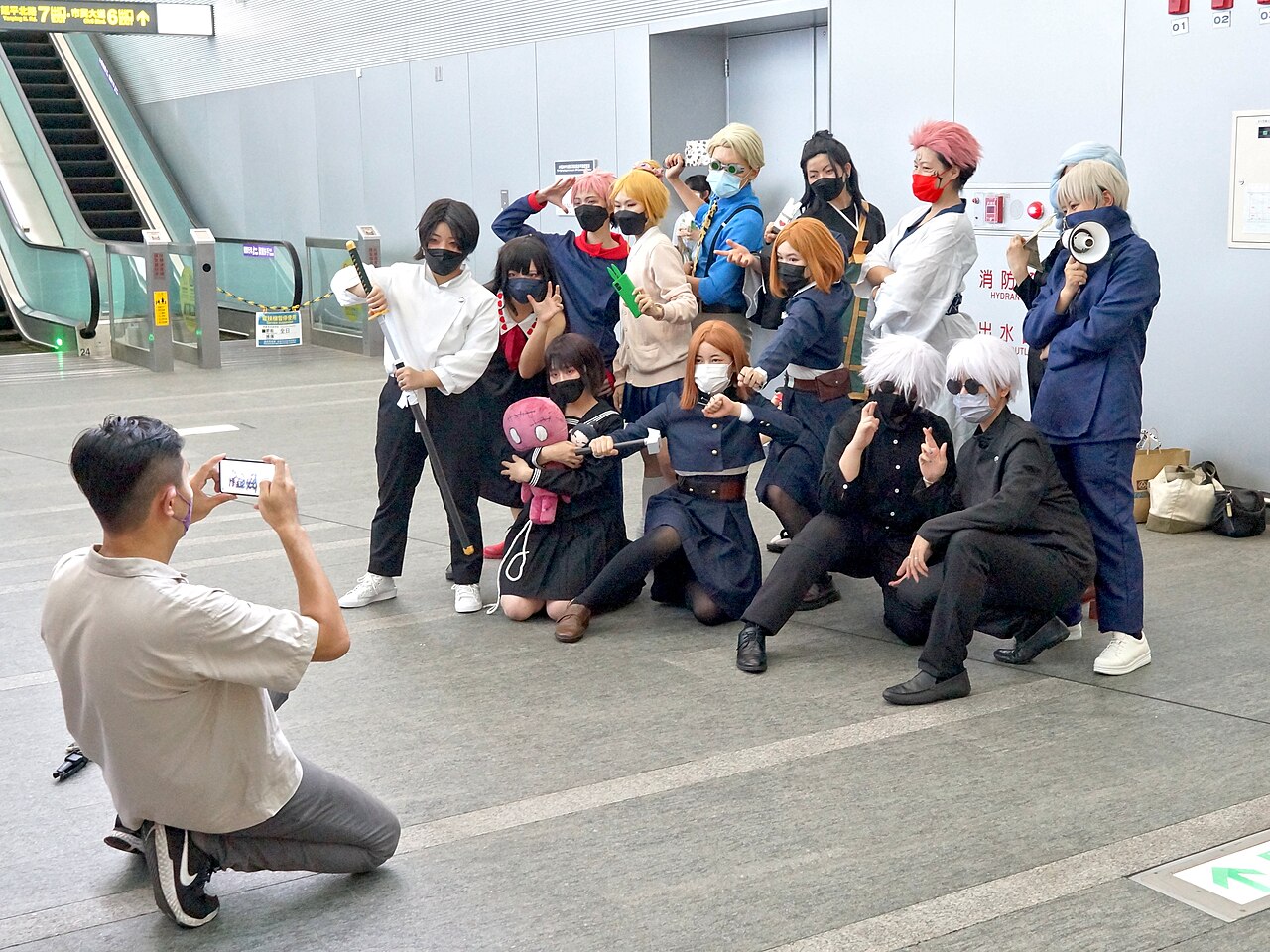
Cosplayers as Jujutsu Kaisen characters at the Bahamut Market convention in Taipei, 2022. Photo: Solomon203, CC BY-SA 4.0, via Wikimedia Commons — a representative fan photo, not official franchise artwork.
Meaning
呪術廻戦 (Jujutsu Kaisen, literally "Sorcery Fight") is a Japanese 漫画 series written and illustrated by Gege Akutami, serialized in 集英社's Weekly 少年ジャンプ from 2018 to 2024. Its title combines 呪術 (jujutsu, "sorcery" or "curse magic") with 廻戦 (kaisen, "wheeling battle" or "recurring fight"), signaling from the cover page that this is a story about sorcerers locked in an ongoing war against monstrous curses. The anime adaptation by studio MAPPA, which began airing in 2020, turned the series into one of the defining shōnen franchises of the early 2020s, standing alongside 鬼滅の刃 as one of the two anime that most shaped the decade's global anime boom.
The story follows Yuji Itadori, an ordinary high schooler with freakish physical strength, who swallows a cursed finger — one of twenty relics of the powerful curse Sukuna — to save his friends from a rampaging monster. Doing so makes him Sukuna's living vessel, and he's recruited into Tokyo Jujutsu High, a school that trains 呪術師 ("jujutsu sorcerers") to exorcise curses before they can kill ordinary people. The premise sets up a dual clock: Yuji must eat the rest of Sukuna's fingers to eventually destroy the curse trapped inside him, all while curses of escalating power threaten the world around him.
Usage
In everyday conversation the title is nearly always shortened to 呪術 (jujutsu) or the initialism JJK, the way fans write "Demon Slayer" instead of the full Japanese title. The word 呪術 itself predates the manga by centuries — it's the ordinary Japanese term for occult sorcery or curse-based ritual magic, historically associated with practices like 陰陽師 (onmyōji, court sorcerers of the Heian period). The franchise borrowed that pre-existing vocabulary rather than inventing new terms, which is part of why its jargon feels grounded even at its most fantastical.
呪術廻戦にハマって、もう全巻読んじゃった。 Jujutsu Kaisen ni hamatte, mō zenkan yonjatta. "I got hooked on Jujutsu Kaisen and already read every volume."
五条先生の「領域展開」、アニメで見るとやばすぎる。 Gojō-sensei no "ryōiki tenkai," anime de miru to yaba-sugiru. "Seeing Sensei Gojo's 'Domain Expansion' animated is just insane."
The World: Curses, Cursed Energy, and Sorcerers
Jujutsu Kaisen builds a tightly internally consistent magic system around the idea that human negative emotion is literally toxic:
| Term | Reading | Meaning in-story |
|---|---|---|
| 呪力 (jujutsuryoku) | じゅじゅつりょく | "Cursed energy" — a power generated by negative human emotion (fear, envy, shame) that fuels all sorcery |
| 呪霊 (jurei) | じゅれい | "Curses" — monsters spontaneously born from accumulated negative emotion, ranging from harmless nuisances to city-leveling threats |
| 術式 (jutsushiki) | じゅつしき | A sorcerer's unique innate technique, used to manipulate cursed energy in a personal, often hereditary way |
| 領域展開 (ryōiki tenkai) | りょういきてんかい | "Domain Expansion" — an advanced technique that instantly manifests a private pocket dimension guaranteeing a decisive hit on the target |
| 特級 (tokkyū) | とっきゅう | "Special grade" — the rank given to the deadliest curses and strongest sorcerers, the series' de facto S-rank |
| 悪霊 (akuryō) | あくりょう | "Evil spirit" — an older, more general Japanese word for a malevolent ghost, distinct from the series' specific "curse" terminology |
Unlike the demons of Demon Slayer, which are transformed former humans, Jujutsu Kaisen's curses are closer to psychological pollution given monstrous form — a modern reinterpretation of Japan's older 妖怪 (yōkai) tradition of spirits born from human fear and neglected objects, filtered through a distinctly contemporary, almost body-horror sensibility. 除霊 (jorei, "spiritual exorcism") is the sorcerers' basic job description, but the manga treats it less like folk ritual and more like superhero-style combat, complete with named special moves and elaborate power hierarchies familiar to any 少年 manga reader.
Why It Became a Phenomenon
Jujutsu Kaisen's rise mirrors — and in some ways outpaces — the Demon Slayer boom that immediately preceded it:
- A cursed-energy magic system built for animation: MAPPA's adaptation rendered the series' domain expansions and technique battles with a fluid, high-budget style that made individual fight scenes into viral moments in their own right, especially the Shibuya Incident arc.
- A genuinely popular villain and breakout star: Satoru Gojo, the eccentric, overwhelmingly powerful teacher who wears a blindfold to suppress his own cursed technique, became one of the most merchandised and cosplayed characters in modern anime — arguably as recognizable internationally as Tanjiro Kamado.
- A viral opening theme: the first season's opening song "Kaikai Kitan" (廻廻奇譚) by Eve, and the choreographed hand-sign dance that accompanies it, spread across TikTok and YouTube well beyond the anime's existing fanbase, turning the show into a recognizable cultural reference even for casual viewers who had never watched an episode.
- The Jujutsu Kaisen 0 movie: released in Japan in December 2021 as a prequel, it became one of the highest-grossing anime films ever released in North America at the time, evidence that the franchise's audience extended well past Japan.
- Timing inside an anime boom already in motion: airing right after Demon Slayer's peak, Jujutsu Kaisen benefited from a global streaming and merchandising infrastructure — and an audience appetite for dark-fantasy shōnen — that Demon Slayer itself had helped build.
Cultural Context
Jujutsu Kaisen sits within a long Japanese storytelling tradition of exorcists battling malevolent spirits, one that stretches back to Heian-period tales of onmyōji like the historical Abe no Seimei. What distinguishes it from that older folklore, and from contemporaries like 鬼滅の刃, is how squarely it frames curses as a byproduct of ordinary human ugliness — jealousy, cruelty, despair — rather than an external supernatural threat. That framing gives the series room for a bleaker, more morally ambiguous tone than most Weekly Shōnen Jump series attempt, including a willingness to kill off major characters that surprised even longtime shōnen readers.
The series' explosive popularity has powered the same fan ecosystems documented elsewhere on this wiki: it is a perennial top seller at 同人 circles and コミケット events, its 声優 cast (including Junya Enoki as Yuji and Yuichi Nakamura as Gojo) have become major convention draws, and its songs are staples of アニソン playlists and karaoke nights. Cosplay of its cast — Gojo's blindfold and school uniform especially — is now a fixture at conventions worldwide, as seen in the photo above. Alongside Demon Slayer and My Hero Academia, it's frequently cited by international fans as one of the shows that pulled them into anime fandom during the 2020s streaming era.
Legacy
The manga concluded its main story in September 2024 after 271 chapters, but the anime continued adapting later arcs into subsequent seasons, and the franchise remains a fixture of merchandise shelves, gacha games, and convention cosplay lines years after the source material wrapped. Together with Demon Slayer, it's regularly cited as one of the two series that defined what a "modern mega-hit shōnen anime" looks like commercially — a case study in how a weekly manga serialization can become a globally recognized multimedia franchise almost entirely on the strength of its anime adaptation.
Related Dictionary Words
Jujutsu Kaisen (manga series)
magic; sorcery; incantation
curse; spell; malediction
witch doctor; shaman
magical power; mystical force
evil spirit
exorcism
surgical method; operative method; surgical technique; procedure
high grade; special grade; classy
diviner; sorcerer; exorcist; medium
cartoon; comic; comic strip; manga
animation; animated film; animated cartoon; anime
Shōnen Jump (weekly magazine)
Shueisha (publisher)
serialization; serialisation; serial story
standalone book (i.e. not part of an anthology, series, etc.); (book published as a) single volume
movie; film; motion picture
box-office takings; box-office revenue
educational institution; school; academy; campus
pupil; student; schoolchild
training; practice; discipline; study
ghost; apparition; phantom; spectre; specter; demon; monster; goblin; yōkai