チェンソーマン
chainsaw manChainsaw Man, Tatsuki Fujimoto's ultraviolent, genre-scrambling manga and MAPPA anime about a debt-ridden teenager fused with his pet chainsaw devil, became one of the defining and most stylistically unusual shōnen franchises of the 2020s.
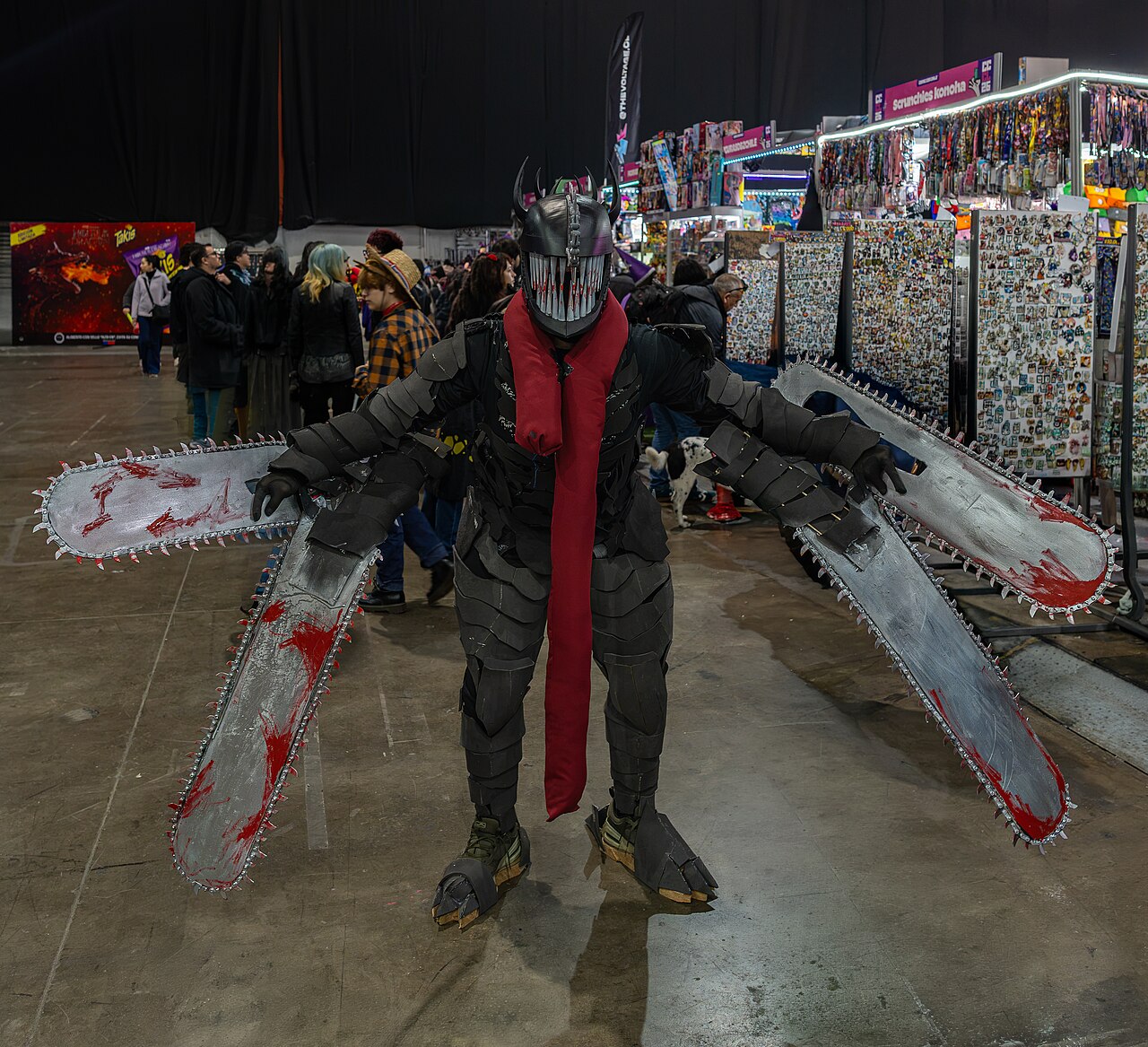
A cosplayer as the Chainsaw Devil at Comic Con Chile. Photo: Rjcastillo, CC BY-SA 4.0, via Wikimedia Commons — a representative fan photo, not official franchise artwork.
Meaning
チェンソーマン (Chainsaw Man) is a Japanese 漫画 series written and illustrated by Tatsuki Fujimoto. Part 1 (the "Public Safety Saga") ran in 集英社's Weekly 少年 Jump from December 2018 to December 2020; Part 2 (the "Academy Saga") resumed in July 2022 on the digital platform Shōnen Jump+. The アニメ adaptation by studio MAPPA, which premiered in October 2022, and the 2025 theatrical film Chainsaw Man — The Movie: Reze Arc, turned it into one of the biggest anime properties of the decade — and one of the strangest, most tonally unpredictable ones ever to reach that scale.
The story follows Denji, a teenager so poor he sold parts of his own body to pay off his dead father's 借金 (debt) to the Yakuza, working as a low-rent Devil Hunter alongside his pet devil Pochita, a small chainsaw-headed creature. Left for dead, Denji makes a 契約 (contract) with Pochita to fuse hearts and survive, and gains the power to transform — by pulling a ripcord embedded in his chest — into a monstrous chainsaw-devil hybrid: Chainsaw Man, blades bursting from his head and forearms. Recruited into Public Safety's elite Devil Hunter division, Denji trades a life of squalor for a life of violence, still chasing embarrassingly small dreams — bread with jam, a girlfriend, the chance to touch a woman's chest — in between fights that can level city blocks.
Usage
Fans and Japanese media almost always shorten the title to チェンソー or simply write it as チェンソーマン in full; unlike some franchises it doesn't have a widely used acronym. Because Part 1 and Part 2 have different protagonists and settings, fans distinguish them as 第一部 (dai-ichibu, "Part 1") and 第二部 (dai-nibu, "Part 2"), or informally as the "Denji arc" and the "Asa arc."
チェンソーマンの新作映画、公開初日に見に行った。 Chainsaw Man no shinsaku eiga, kōkai shonichi ni mi ni itta. "I went to see the new Chainsaw Man movie on opening day."
デンジの願いが庶民的すぎて逆に好き。 Denji no negai ga shomin-teki sugite gyaku ni suki. "Denji's wishes are so mundane that I actually love him for it."
Devils, Contracts, and Fear as Currency
Chainsaw Man's world runs on a single, elegant rule: 悪魔 (devils) are born from human 恐怖 (fear), and their power scales directly with how widely and intensely that fear is felt.
| Term | Reading | Meaning in-story |
|---|---|---|
| 悪魔 (akuma) | あくま | A devil — a monster given form and strength by a specific human fear; the more universal the fear, the stronger the devil |
| デビルハンター (Devil Hunter) | でびるはんたー | A professional, often working for Public Safety, who fights devils for money, usually by making a pact with a devil of their own |
| 契約 (keiyaku) | けいやく | A pact between a human and a devil, exchanging a body part, memory, or lifespan for the devil's power |
| 心臓 (shinzō) | しんぞう | "Heart" — the organ Pochita fuses with Denji's own, the literal engine of his transformation |
| 悪魔憑き (akuma-tsuki) | あくまつき | A "devil-possessed" hybrid like Denji: part human, part devil, fused rather than merely contracted |
| 特級悪魔 (tokkyū akuma) | とっきゅうあくま | "Special-grade devil" — the rank given to the most powerful devils, such as the Gun Devil or the Control Devil |
This premise lets Fujimoto turn abstract anxieties into monsters with visual logic: the Gun Devil, born from humanity's collective fear of firearms, is powerful enough to have killed over a million people in a single, off-panel rampage before the story even begins; the Darkness Devil embodies fear of the dark. It's a framework similar in spirit to 呪術廻戦's cursed-energy system — human negativity given monstrous shape — but Chainsaw Man pushes the metaphor toward things people are embarrassed, rather than horrified, to admit they fear.
Why It Stands Out
Chainsaw Man arrived into a "dark shōnen" landscape already crowded with hits — 呪術廻戦, 鬼滅の刃, Attack on Titan — and carved out a reputation as the weirdest and most formally adventurous of the bunch:
- A protagonist who wants almost nothing noble. Where most shōnen heroes are driven by justice, revenge, or the desire to protect others, Denji's motivations stay defiantly small and physical — food, sleep, a girlfriend — even as the stakes around him become apocalyptic. That gap between the scale of the violence and the size of Denji's dreams is the series' central joke and its emotional core simultaneously.
- Whiplash tone. A single chapter can move from stomach-churning body horror to broad slapstick to genuine melancholy without a tonal seam, an instability that critics frequently cite as Fujimoto's signature — closer to gross-out comedy and arthouse film pacing than to a conventional Jump adventure.
- Cinematic paneling. Fujimoto is an outspoken cinephile, and his page layouts — long wordless sequences, unconventional pacing, sudden cuts — are widely discussed by critics and fans as reading like storyboards, a departure from typical manga grammar.
- A willingness to kill or demote main characters. Part 1's cast is thinned out with a bluntness rare even among the genre's grimmer titles, and its structure — a first arc that reads almost like a complete, self-contained film — surprised readers used to decade-long Jump serializations.
- MAPPA's polish plus deliberately uncool production choices, like rotating a different licensed J-pop or rock ending theme every single episode of the anime's first cour, a deliberate departure from franchise norms that became a talking point in its own right.
The MAPPA Anime and the Reze Arc Film
Studio MAPPA — also behind 呪術廻戦 and the final seasons of Attack on Titan — produced the Chainsaw Man television anime, which premiered in October 2022 and was praised for its film-grade animation and sound design, with director Ryū Nakayama and composer Kensuke Ushio both drawn from live-action and arthouse backgrounds rather than typical anime staff. The show's popularity, combined with Part 2's ongoing manga run, kept the franchise a fixture of streaming charts and convention merchandise through the mid-2020s.
That momentum culminated in Chainsaw Man — The Movie: Reze Arc, released in Japan in September 2025 and in North America the following month. Adapting one of the manga's most acclaimed story arcs — a doomed 恋愛 between Denji and a mysterious girl named Reze who turns out to be an enemy bomb-devil hybrid — the film became MAPPA's highest-grossing release, passing $150 million worldwide and edging past Jujutsu Kaisen 0 to become the studio's biggest box-office hit to date.
Cultural Context
Chainsaw Man's grotesque, fear-fueled devils sit inside a much older Japanese tradition of turning intangible dread into monstrous, named form — the same lineage that produced the yōkai tradition and, more recently, the curse-monsters of 呪術廻戦. What sets Fujimoto's version apart is its refusal to treat that horror reverently: devils are terrifying and often tragic, but the series is just as interested in a chainsaw-devil hybrid's crude teenage libido as it is in citywide massacres, a combination that reads as deliberately anti-sentimental in a genre built on earnest self-improvement arcs.
The manga and anime have generated an outsized international fandom relative to their run time, driven heavily by social media: gifs and stills from the anime's ending-theme rotation, viral discussion of the Reze arc's animation, and a large English-language 同人 and fan-art community online. Fujimoto's smaller one-shot works — particularly Look Back and Goodbye, Eri, both adapted into acclaimed short films — extended his reputation as an auteur-like figure within Weekly Shōnen Jump, a magazine not typically associated with that kind of authorial voice. Cosplay of Denji's Chainsaw Man form, instantly recognizable by its chainsaw-blade limbs and stitched, mask-like head, is now a convention staple worldwide, as pictured above.
Legacy
Part 1 remains a self-contained 97-chapter story frequently cited by critics as one of the tightest, most complete single arcs in modern Jump history, while Part 2's ongoing Academy Saga has continued to expand the cast and mythology under a new protagonist, Asa Mitaka, alongside a returning Denji. Together with 呪術廻戦 and 鬼滅の刃, Chainsaw Man is now routinely named among the anime that defined the 2020s — not for outselling them, but for proving that a shōnen manga could be this formally strange, this openly horny and horrifying at once, and still become a global mainstream hit.
Related Dictionary Words
cartoon; comic; comic strip; manga
animation; animated film; animated cartoon; anime
devil; demon; fiend
contract; compact; agreement
heart
debt; loan; liabilities; borrowing money
boy
Shueisha (publisher)
love; romance; tender passion; emotion; affections