たい焼き
taiyakiFish-shaped sweet pastry filled with red bean paste, sold at Japanese festivals and street stalls year-round.
Meaning
たい焼き (鯛焼き) is a popular Japanese sweet treat made from a thin wheat-flour waffle batter poured into a fish-shaped mould and filled with sweet あんこ (red bean paste). The name combines 鯛 (tai, sea bream — a fish considered auspicious in Japanese culture) and 焼き (yaki, grilled/baked), meaning literally "baked sea bream."
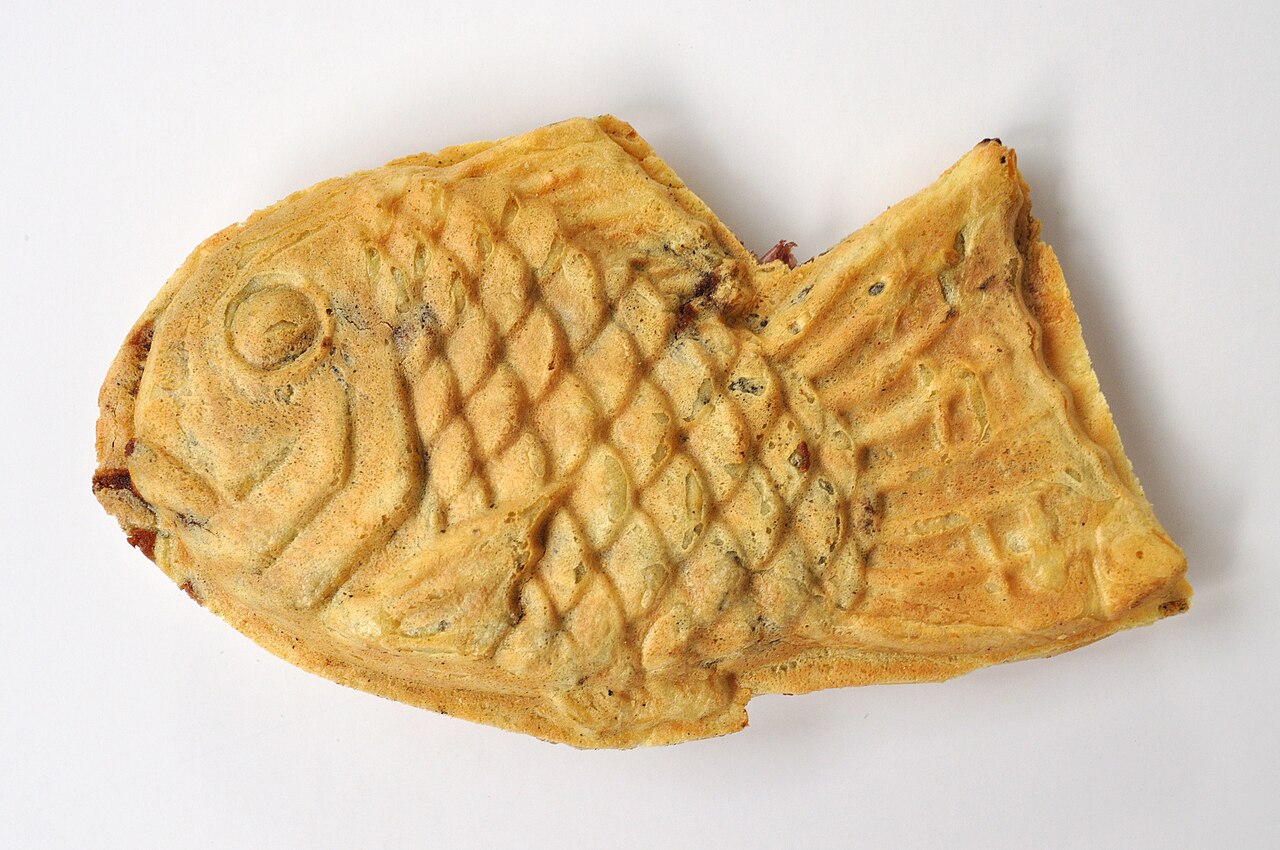
Freshly baked taiyaki, filled with sweet red bean paste. Public domain (CC0), via Wikimedia Commons.
Despite the name, taiyaki contains no fish — the shape is purely ornamental, referencing the auspicious sea bream associated with good fortune and celebration in Japan. The exterior is crispy and slightly sweet, while the interior is soft and filled with a generous portion of smooth 餡.
Origins
Taiyaki traces its lineage to 今川焼き (imagiyaki), a round filled pancake that has been sold in Tokyo since the Edo period. According to food historians, taiyaki emerged in the early 1900s — most accounts point to around 1909 — when a confectioner in Tokyo's Azabu district began pressing imagiyaki batter into iron moulds shaped like the prized 鯛 (sea bream). Sea bream was expensive and considered a luxury fish reserved for festivals and celebrations. By shaping a humble, affordable sweet in the form of this auspicious fish, vendors offered everyday customers a small taste of festivity.
The iron griddle moulds — called taiyaki-ki (たい焼き器) — became a staple of 屋台 (street stalls), and the confection spread steadily across Japan throughout the 20th century.
How It Is Made
Traditional taiyaki is made by pouring a light wheat-flour batter into hinged cast-iron moulds, adding a dollop of あんこ, closing the mould, and cooking over direct heat. Skilled vendors flip the moulds every few seconds to ensure even browning. Freshly made taiyaki has a satisfying crunch on the outside and a hot, soft filling within.
There are two main style traditions:
| Style | Japanese | Description |
|---|---|---|
| One-at-a-time | 一丁焼き (icchō-yaki) | Individual moulds, thicker and crispier shell |
| Multi-mould | 連式 (renshiki) | Rows of moulds, thinner shell, faster output |
Purists often prefer the one-at-a-time style for its crunchier texture.
Fillings
Classic taiyaki is filled with 小豆 (azuki bean) あんこ — either tsubuan (chunky paste) or koshian (smooth paste). Over the decades, vendors and confectioners have introduced a wide range of modern fillings:
- Custard (カスタード) — the most popular alternative
- Chocolate (チョコレート)
- Sweet potato (さつまいも)
- Cheese cream (チーズクリーム)
- Matcha bean paste (抹茶あん)
- Seasonal fillings — sakura cream in spring, chestnut paste in autumn
In recent years, unconventional savory fillings like pizza-flavored or curry paste have also appeared, marketed as novelties.
Cultural Context
"およげ!たいやきくん" — The Song That Made Taiyaki Famous
If any single moment elevated taiyaki to a national icon, it was the 1975 children's song Oyoge! Taiyaki-kun (およげ!たいやきくん — "Swim! Mr. Taiyaki"). Originally composed for the NHK children's television program Hirake! Ponkikki (ひらけ!ポンキッキ), the song tells the story of a taiyaki who escapes the hot iron mould to swim freely in the ocean — only to be caught and eaten by a fisherman in the end.
The song became one of the best-selling Japanese singles of all time, reportedly selling over 4.5 million copies. Its bittersweet narrative — the brief joy of freedom followed by an inevitable fate — resonated with adults as much as children, and many Japanese listeners interpreted the story as a parable for the life of a salaried worker. The song is still widely recognized today and regularly appears on lists of iconic postwar Japanese music.
Festivals and Daily Life
Taiyaki is a quintessential 祭り (festival) food, sold from 屋台 (street stalls) at summer festivals, shrine fairs, and seasonal markets. Unlike many festival foods associated primarily with 夏 (summer), taiyaki is popular year-round — and is arguably at its peak in 冬 (winter), when the warm pastry offers comfort against the cold. It is also sold in shopping arcade stalls, train station kiosks, and convenience stores.
The 和菓子 (traditional Japanese confectionery) tradition generally emphasizes seasonal and aesthetic sensibility. Taiyaki occupies a special place within this tradition: it is approachable, inexpensive, and carried in the hand — a democratic sweet available to all.
The Great Debate: Head First or Tail First?
One of the most enduring cultural talking points surrounding taiyaki is deceptively simple: which end do you bite first?
- Head first (頭から): Proponents argue the head holds more filling, offering a richer first bite. It is also sometimes considered the "proper" or decisive way — eating the most important part first.
- Tail first (尻尾から): Those who start at the tail work toward the filling gradually, savoring the crispy batter before reaching the sweet centre.
Surveys in Japan have repeatedly shown the population fairly evenly split, with slight regional variations. The debate has been featured on television programs and in magazine polls, and is considered a lighthearted but genuine piece of Japanese food culture discourse — the kind of question that reliably sparks lively conversation.
Variations and Related Sweets
| Sweet | Description |
|---|---|
| 今川焼き | Round ancestor of taiyaki; same batter and filling, cylindrical shape |
| 大判焼き (ōban-yaki) | Another name for imagiyaki, common in western Japan |
| ベビーカステラ | Small round sponge cake balls, also sold at stalls |
| 人形焼き (ningyō-yaki) | Doll-shaped filled pastry, specialty of Asakusa in Tokyo |
今川焼き in particular is so similar to taiyaki in taste and preparation that regional naming conventions often determine which term a Japanese person uses — imagiyaki, ōban-yaki, and kaiten-yaki are all regional names for essentially the same round sweet.
Taiyaki Today
Taiyaki remains a beloved and commercially vibrant food across Japan. Specialty shops dedicated entirely to taiyaki operate in major cities, some with cult followings and long queues. The sweet has also spread internationally — taiyaki shops and stalls can be found in Japanese neighborhoods and Asian food markets in the United States, South Korea, Australia, and beyond.
Its cheerful fish shape makes it visually distinctive and highly photogenic, lending itself naturally to social media sharing. The combination of nostalgia, accessibility (priced around ¥150–250 per piece), and flexibility (classic and creative fillings) ensures taiyaki's continued relevance to new generations of Japanese food lovers.
Related Dictionary Words
fish-shaped pancake filled with bean jam
daughter; young lady
sea bream (esp. Pagrus major); porgy
festival; feast; matsuri
cart (esp. a food cart); stall; stand
imagawayaki; thick pancake containing bean jam, served hot
wagashi; traditional Japanese confectionery
adzuki bean (Vigna angularis)
custard