節分
setsubunJapan's annual bean-throwing festival held on February 3rd to drive out evil spirits and welcome the good fortune of the new season.
Meaning
節分 (setsubun) literally means "seasonal division" — a boundary between seasons in the traditional Japanese calendar. The word combines 節 (setsu, season or node) and 分 (bun, division). While there are technically four setsubun each year marking the eve of each new season, the term now almost exclusively refers to February 3rd, the day before 立春 (risshun, the first day of spring). In the old lunisolar calendar, this transition was equivalent to New Year's Eve, making setsubun a time of purification and renewal.
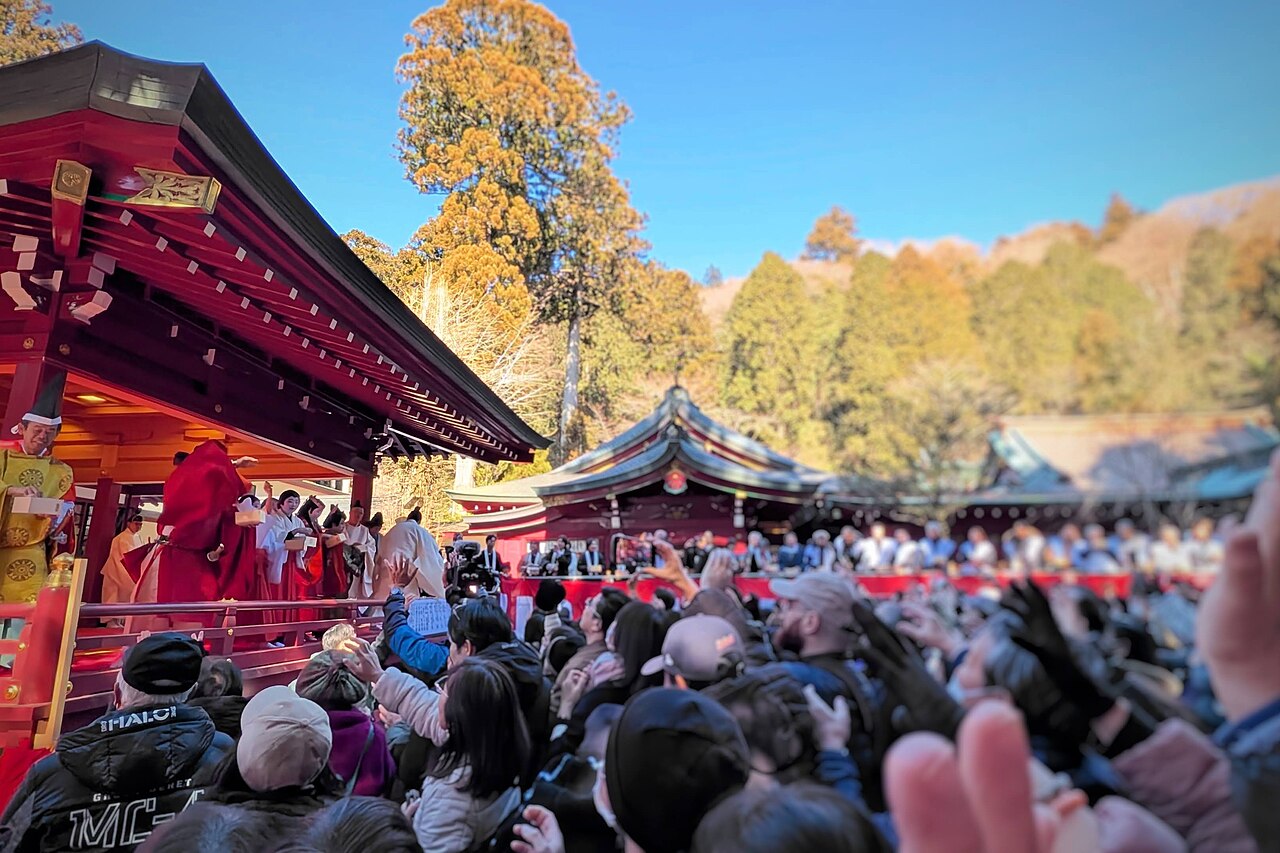
Mamemaki at Hakone Shrine. Photo: KQuhen, CC BY-SA 4.0, via Wikimedia Commons.
Mamemaki: Bean Throwing
豆まき (mamemaki, bean scattering) is the defining ritual of setsubun. Roasted soybeans — called irimame — are thrown either out the front door or at a person wearing an 鬼 (oni) demon mask, while the household chants:
鬼は外!福は内! Oni wa soto! Fuku wa uchi! "Demons out! Good fortune in!"
The 豆 (mame, beans) carry symbolic power: in Japanese, the word mame is a homophone of 魔滅 (mametsu), meaning "destroy evil." Soybeans were traditionally considered the most spiritually potent grain, capable of driving away malevolent forces.
After the throwing, participants eat a number of beans equal to their age (or their age plus one, for the coming year), a practice said to bring good health throughout the year. At major shrines and Buddhist temples across Japan, famous sumo wrestlers, actors, and celebrities are invited to participate in public mamemaki ceremonies, flinging lucky bags of beans into large crowds.
Oni: The Demons
The 鬼 (oni) occupying the role of setsubun villain are horned ogre-demons — a fixture of Japanese folklore dressed in tiger-skin loincloths, wielding iron clubs. Unlike simple monsters, oni in Japanese tradition represent accumulated negative forces: bad luck, illness, and the hardships of winter. Driving them out at the seasonal threshold cleanses the home before the new year begins.
In many family celebrations, a parent dons an oni mask and allows young children to pelt them with beans — a beloved yearly tradition that can be simultaneously terrifying and delightful for small children. Some regions have local variations on the chant, and certain shrines even welcome the oni rather than expel them, offering prayers for the demons to take misfortune with them when they leave.
Eho-maki: The Lucky Direction Roll
恵方巻 (eho-maki, "lucky direction roll") is a thick, uncut sushi roll eaten on setsubun while facing the year's designated auspicious compass direction (恵方, eho). The direction rotates on a five-year cycle based on the Chinese zodiac. The rules are strict and playfully ritualistic:
- Eat the entire roll without cutting it (cutting would sever your good luck)
- Face the year's lucky direction without turning away
- Eat in complete silence from start to finish
- Make a wish while eating
The seven fillings traditionally correspond to the Seven Lucky Gods (七福神, Shichifukujin), ensuring that all forms of good fortune are consumed in one sitting. The roll's length symbolizes a long, unbroken thread of luck.
While eho-maki originated in the Osaka merchant culture of the Edo period, it was a largely regional Kansai custom until convenience store chains — particularly 7-Eleven — began promoting it nationally in the 1980s and 1990s. Today it is ubiquitous across Japan: convenience stores and supermarkets sell pre-made eho-maki for weeks leading up to February 3rd, and the lucky direction is broadcast on television and printed on packaging nationwide.
Iwashi: Sardine Wards
A lesser-known but traditional practice involves 鰯 (iwashi, sardines). The sharp smell of grilled sardine heads — skewered on a sprig of the prickly holly (hiiragi) and placed at the entrance to a home — is said to repel 鬼. Evil spirits, drawn by the smell of roasting fish, approach the door only to be stabbed by the holly's spines. This practice, called hiiragi iwashi, is most visible in the Kansai and Tohoku regions and reflects the pre-modern fusion of folk magic with seasonal ritual.
The sardine also carries a wordplay dimension: one explanation connects iwashi to iwa (rock), suggesting that driving away demons with something humble and smelly adds a layer of humility to the ceremony — 福 (good fortune) comes not to the proud but to the prepared.
Cultural Context
Setsubun has roots stretching back to the Nara period (710–794 CE), when a Chinese court ritual called tsuina was adopted by the Japanese imperial household to exorcise demons at year's end. Over the Heian and Muromachi periods the practice gradually filtered from aristocratic courts to 神社 (jinja, Shinto shrines), Buddhist temples, and eventually ordinary homes.
The 季節 (kisetsu, seasonal) significance is tied to the agricultural calendar: 立春 (risshun) marked the moment the earth began to warm again, crops could be planned, and the harsh 厄 (yaku, hardship or misfortune) of winter could be cast off. Purification before a fresh start is a recurring theme in Japanese religious life, and setsubun channels both Shinto concepts of ritual cleansing (harae) and Buddhist ideas of accumulating merit and dispelling evil.
Modern setsubun is celebrated in homes, schools, and public spaces across Japan. Schools often organize mamemaki with students wearing paper oni horns. Large shrines such as Naritasan Shinshoji Temple and Zojoji Temple in Tokyo draw thousands of spectators. The holiday has no official public holiday status — it falls on a regular working day — but its traditions remain deeply embedded in the rhythm of the Japanese year.
Regional Variations
| Region | Custom |
|---|---|
| Kansai | Eho-maki tradition originated here; hiiragi iwashi common |
| Tohoku | Elaborate hiiragi iwashi displays; some areas use peanuts instead of soybeans |
| Hokkaido / Tohoku | Peanuts thrown instead of soybeans (easier to collect from snow) |
| Kyoto | Traditional yaikagashi (roasted sardine head decoration) widely maintained |
The variation between regions reflects how the festival absorbed local folk customs over centuries, giving setsubun a slightly different flavor depending on where in Japan it is experienced.
Related Dictionary Words
setsubun; last day of winter in the traditional Japanese calendar (usu. February 3 or 4) on which a bean scattering ceremony is held
sowing beans (or pulses, etc.)
legume (esp. edible legumes or their seeds, e.g. beans, peas, pulses); bean; pea
ogre; demon; oni
pilchard (esp. Japanese pilchard, Sardinops melanostictus); sardine
first day of spring (according to the traditional lunisolar calendar, approx. February 4)
festival; feast; matsuri
Shinto shrine
misfortune; bad luck; evil; disaster
good fortune; happiness; blessing; good luck
season; time of year
charm against evil spirits; talisman; amulet