手鞠
temariA traditional Japanese folk craft of colorful, geometrically embroidered thread balls, originally children's toys made from kimono scraps and now prized as decorative art and gifts.
Meaning
手鞠 (temari, literally "hand ball") are decorative balls wrapped and embroidered with brightly colored 糸 (thread) in intricate geometric patterns. The word combines 手 ("hand") and 鞠/毬 ("ball"), reflecting their origin as handmade balls for children to bounce, toss, and catch. Today the word refers less to a toy and more to a refined textile art form: a densely stitched sphere whose surface is covered in symmetrical star, diamond, and chrysanthemum motifs, often given as a 縁起物 (auspicious gift) rather than played with.
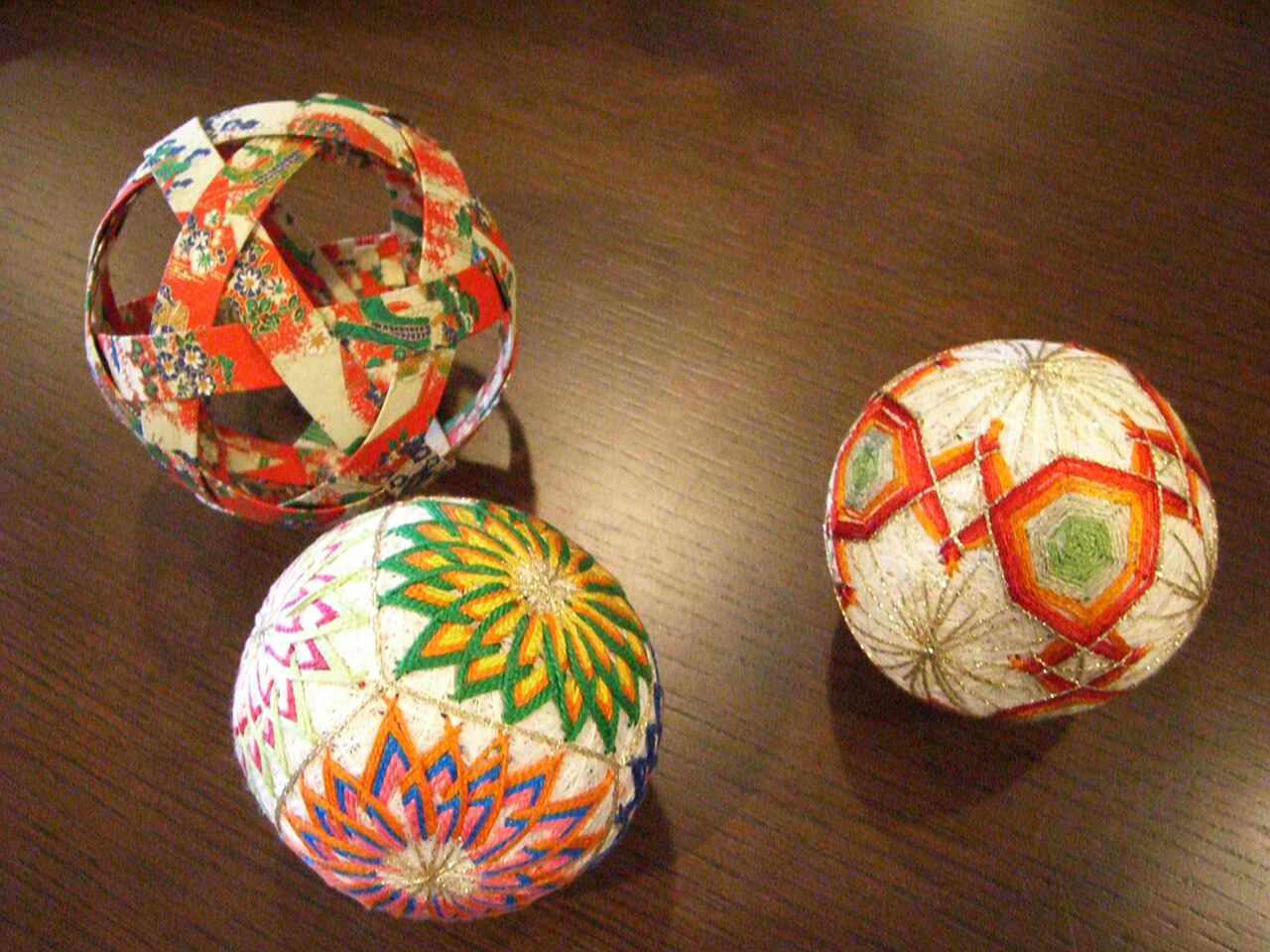
Traditional temari balls showing the dense geometric embroidery that covers a wound thread core. Photo: Conveyor belt sushi, CC BY 2.0, via Wikimedia Commons.
How Temari Are Made
A temari begins with a core, historically made by winding scraps of old 着物 fabric or 端切れ (fabric remnants) around a seed, a bit of ash, or wadded paper until it formed a firm sphere — sometimes wrapped further in 綿 (cotton) for softness. This ball forms the 芯 (core), which is then wound tightly with plain thread to create a smooth, even foundation.
Once the base is complete, the maker divides the sphere into equal sections using pins and guide threads — much like slicing an orange into wedges — to plot out a perfectly symmetrical 幾何学模様 (geometric pattern). Colored thread is then stitched over this guide grid in a technique closer to counted embroidery than weaving, building up bands, stars, and floral motifs row by row. A single elaborate temari can take a skilled maker anywhere from several days to several weeks to complete, and no glue or backing is used — the pattern is held entirely by the tension and layering of the thread itself.
Usage
Temari appear as seasonal decorations, New Year's ornaments, wedding and birth gifts, and souvenirs of regions famous for the craft.
この手鞠は祖母が手作りしたものです。 Kono temari wa sobo ga tezukuri shita mono desu. "This temari was handmade by my grandmother."
お正月に手鞠を飾る家庭も多い。 Oshōgatsu ni temari o kazaru katei mo ōi. "Many households decorate with temari at New Year's."
As a craft hobby, 手芸 enthusiasts in Japan and abroad now learn temari-making from books, workshops, and online tutorials, treating it as a meditative counting-and-stitching practice similar to 刺し子 or cross-stitch.
Cultural Context
Ball games using woven or wrapped spheres reached Japan from China by around the 7th century, related to kemari, the aristocratic kickball game of the Heian period. Court ladies are thought to have developed soft, hand-bounced versions for indoor play, and by the Edo period (1603–1868), the spread of 綿 cotton cultivation and dyed thread made temari accessible to ordinary families across Japan. Mothers and grandmothers wrapped worn-out kimono scraps into balls for daughters, often tucking a bell or a folded paper wish inside so the toy would chime as it bounced — a small hidden blessing for the child's future.
Because the thread is wound round and round back to its starting point, temari came to symbolize deep, unbroken bonds: friendship, loyalty, and a long, harmonious marriage. They were customarily given as 贈り物 (gifts) to mark the New Year, a wedding, or the birth of a child, carrying wishes for happiness and good fortune much like other 縁起物. The introduction of cheap, bouncy rubber balls in the Meiji era (1868–1912) largely ended temari's life as children's plaything, but rather than disappearing, the craft was preserved and elevated by needlework specialists as a purely decorative art.
Regional Traditions
Several regions maintain named temari traditions recognized as local crafts, most famously Sanuki Kagari Temari (讃岐かがり手まり) from Kagawa Prefecture on Shikoku, where threads are hand-dyed with natural plant dyes and the balls are stitched over a core of dried chrysanthemum-flower fiber. Nearly lost after World War II, the Kagawa tradition was revived in 1983 by a local preservation society and was designated an official Traditional Craft of Kagawa Prefecture in 1987. Other notable regional styles include those of Matsue, Iyo, and Kai, each with characteristic color palettes and signature motifs, and city museums and craft centers across Japan still hold 職人 (artisan) demonstrations and classes for visitors.
Temari Today
Modern temari range from museum-quality heirloom pieces to simple kits sold in 郷土玩具 (folk-toy) shops and craft stores. They are popular as home décor, hung individually or in clusters, given as housewarming or retirement gifts, and sold as regional souvenirs alongside crafts like 風呂敷 wrapping cloth and 折り紙 paper folding. International interest in Japanese textile crafts has also turned temari into a popular subject for craft books and workshops outside Japan, where the geometric precision of the stitching appeals to quilters and embroiderers regardless of language.
Related Dictionary Words
traditional Japanese handball game
embroidery
kimono; Japanese traditional clothing (esp. full-length)
scrap of cloth; odds and ends
New Year (esp. first three days)
friendship; fellowship; camaraderie
happiness; well-being; joy; welfare; blessedness
present; gift
ball; sphere; globe; orb
thread; yarn; string
talisman; lucky charm
craftsman; artisan; tradesman; worker; workman
folk toy; traditional toy
cotton
wick; marrow; staple (for stapler); (pencil) lead; stuffing; pith
geometric pattern
traditional craft; traditional handicrafts
handicrafts
charm; amulet; talisman