つまみ細工
tsumami zaikuA traditional Japanese textile craft of folding small squares of silk into flower and shape motifs, historically used to make kanzashi hair ornaments for kimono.
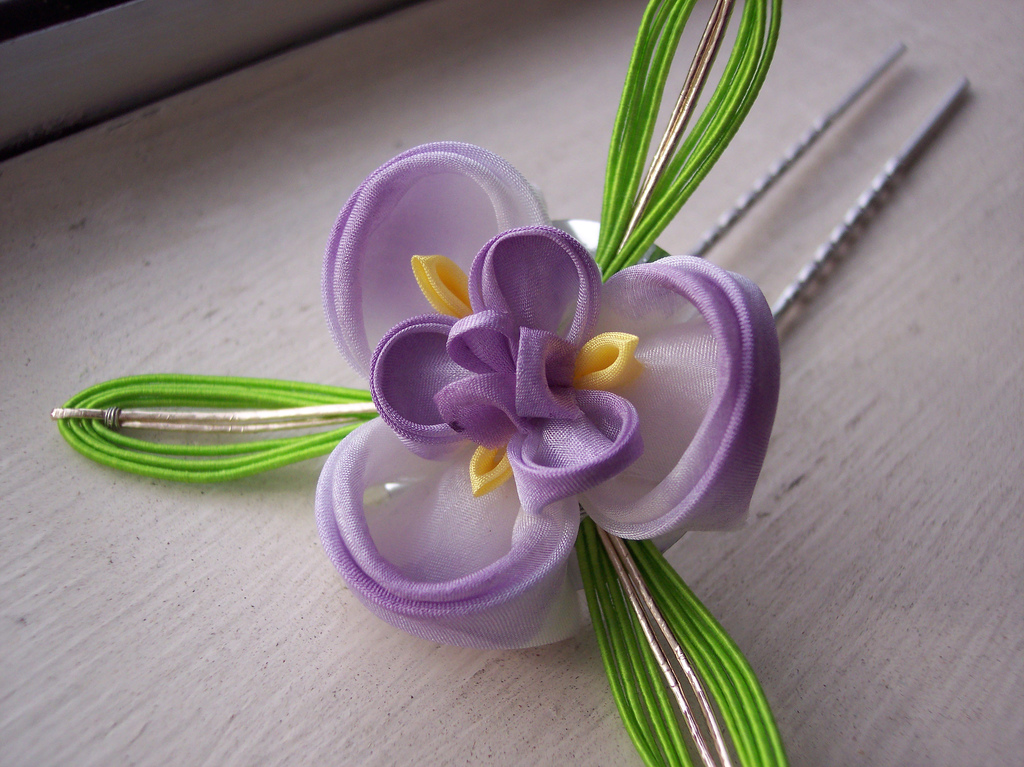
An amateur-made tsumami kanzashi in the shape of an iris (菖蒲, ayame), traditionally worn in May. Photo: amaebi79, CC BY 2.0, via Wikimedia Commons.
Meaning
Tsumami zaiku (つまみ細工, also written 摘み細工) literally means "pinched handiwork" — from つまむ (tsumamu, "to pinch or pick up between the fingers") and 細工 (zaiku, "fine handwork" or "craftsmanship"). It refers to the technique of folding small squares of fabric, traditionally silk, into petals with a pair of tweezers and then assembling dozens of these folded petals into flowers, birds, fans, and other motifs.
The finished pieces are most famously mounted onto 簪 (kanzashi), the ornamental hairpins worn with 着物 (kimono), but the same folding technique is also used for brooches, coin purses, fridge magnets, and other small accessories in the modern hobbyist scene.
Technique
The core unit of tsumami zaiku is a single folded petal, made from a small square of habutae silk (traditionally cut to a precise size, often around 2–3 cm per side). Two main fold styles produce the two classic petal shapes:
| Fold style | Japanese name | Shape produced |
|---|---|---|
| Rounded fold | 丸つまみ (maru-tsumami) | Soft, rounded petal tip, used for plum and cherry blossoms |
| Pointed fold | 剣つまみ (ken-tsumami) | Sharp, pointed petal tip, used for irises and chrysanthemums |
The process, largely unchanged since the Edo period, runs roughly as follows:
- Fabric squares are cut on the bias so the folded petal holds its shape without fraying.
- Each square is folded twice on the diagonal with tweezers (pinsetto or takézasami), then folded a third time to form a triangular petal — rounded or pointed depending on the desired flower.
- A dab of starch paste or glue seals the fold at the base and the excess fabric is trimmed away with scissors.
- Multiple petals (often five, eight, or more) are arranged in a circle and glued onto a round cardboard or paper base to form a single blossom.
- Finished blossoms are wired or glued onto a metal kanzashi frame, sometimes layered with dangling strands (bira-bira kanzashi) that sway with the wearer's movement.
A single elaborate kanzashi can require hundreds of individually folded petals, which is why traditional artisans (職人, shokunin) trained for years before being trusted with fine silk work.
Cultural Context
Edo-period origins
Tsumami zaiku is generally traced to the late Edo period (early 1800s), when the wives of low-ranking samurai in Edo (present-day Tokyo) are said to have folded scraps of leftover kimono silk into flowers to decorate simple hairpins, both as a thrifty craft and a creative outlet. From this domestic beginning, the technique was picked up by professional kanzashi workshops in Edo and Kyoto, where it was refined into the elaborate, seasonally themed ornaments associated with formal kimono dress.
Kanzashi, maiko, and the calendar of flowers
Tsumami zaiku's most iconic application is the kanzashi worn by 舞妓 (maiko, apprentice geisha) in Kyoto's hanamachi (geisha districts). Maiko traditionally change their kanzashi every month to match a specific seasonal flower — plum blossoms in February, cherry blossoms in April, irises in May, wisteria in April/May, and chrysanthemums in autumn, among others — making tsumami zaiku kanzashi a visible, wearable calendar. Because maiko kanzashi are large, ornate, and often trimmed with dangling silk strands, they remain the most recognizable showcase of the craft, even though full 芸者 (geisha) generally wear simpler, more subdued kanzashi as a mark of greater seniority.
Outside the geisha districts, tsumami zaiku kanzashi are worn far more broadly by ordinary people at major life milestones tied to kimono-wearing:
- 七五三 (Shichi-Go-San) — the festival for children aged three, five, and seven, where young girls in kimono often wear a bright tsumami zaiku hairpin.
- 成人式 (Coming of Age Day) — twenty-year-olds celebrating adulthood in furisode (long-sleeved kimono) frequently pair the outfit with an elaborate tsumami kanzashi.
- Weddings and graduation hakama, and other formal kimono occasions.
In each case, the kanzashi is chosen to color-coordinate with the kimono and to mark the season, continuing the same logic that shaped maiko dress.
Modern Revival and Hobbyist Popularity
By the mid-20th century, mass-produced plastic and fabric-print hair accessories had displaced much of the demand for hand-folded silk kanzashi, and the number of professional tsumami zaiku artisans shrank considerably. Since the 2000s, however, the craft has seen a steady revival as a hobbyist pastime, helped along by several factors:
- Instructional books and, later, YouTube/Instagram tutorials made the folding technique accessible to people without a formal apprenticeship.
- Chirimen (crepe silk) and cotton kits sold at 手芸 (craft/needlework) stores let beginners practice with pre-cut squares rather than starting from raw fabric.
- A broader kimono and "wa" (Japanese-style) aesthetic revival among young people, alongside historical dramas and anime set in the Edo period, renewed interest in traditional accessories.
- Crossover into everyday accessories — tsumami-folded flowers now appear as brooches, earrings, and phone charms, detached from kimono entirely, which has widened the hobby's audience well beyond kimono wearers.
Several historic kanzashi workshops in Tokyo (notably in the Asakusa area) and Kyoto have also been recognized for preserving the traditional technique, and some hold the status of long-running traditional craft businesses passing skills down across generations, even as they now sell modern accessories alongside museum-quality maiko kanzashi.
Tsumami Zaiku and Other Japanese Crafts
Tsumami zaiku is often mentioned alongside other traditional Japanese handicrafts that transform a humble material through repeated small, precise actions — conceptually close to 折り紙 (origami, folding paper) and 切り絵 (kirie, cut paper). Where origami folds a single sheet into a complete form and kirie subtracts material by cutting, tsumami zaiku assembles many small folded units into a larger composite motif, closer in spirit to mosaic or beadwork than to origami's one-piece logic — though all three share the same patient, hand-based aesthetic prized in Japanese craft culture.
Related Terms
| Term | Reading | Meaning |
|---|---|---|
| 簪 (kanzashi) | かんざし | Ornamental hairpin worn with kimono |
| びらびら簪 (bira-bira kanzashi) | びらびらかんざし | Kanzashi with dangling, swaying silk strands, common on maiko |
| 丸つまみ (maru-tsumami) | まるつまみ | Rounded petal fold |
| 剣つまみ (ken-tsumami) | けんつまみ | Pointed petal fold |
| ちりめん (chirimen) | ちりめん | Crepe silk fabric often used in modern tsumami zaiku kits |
Related Dictionary Words
ornamental hairpin
kimono; Japanese traditional clothing (esp. full-length)
maiko; apprentice geisha (in Kyoto)
geisha; professional female entertainer, usu. at traditional banquets
silk
flower; blossom; bloom; petal
shichi-go-san; 7-5-3 day; festival day for children aged 7, 5 and 3 held on or around November 15
coming-of-age ceremony
handicrafts
work; workmanship; craftsmanship; handiwork
craftsman; artisan; tradesman; worker; workman
hair ornament