浴衣
yukataA casual, unlined cotton summer kimono worn to festivals, fireworks displays, and hot spring inns.
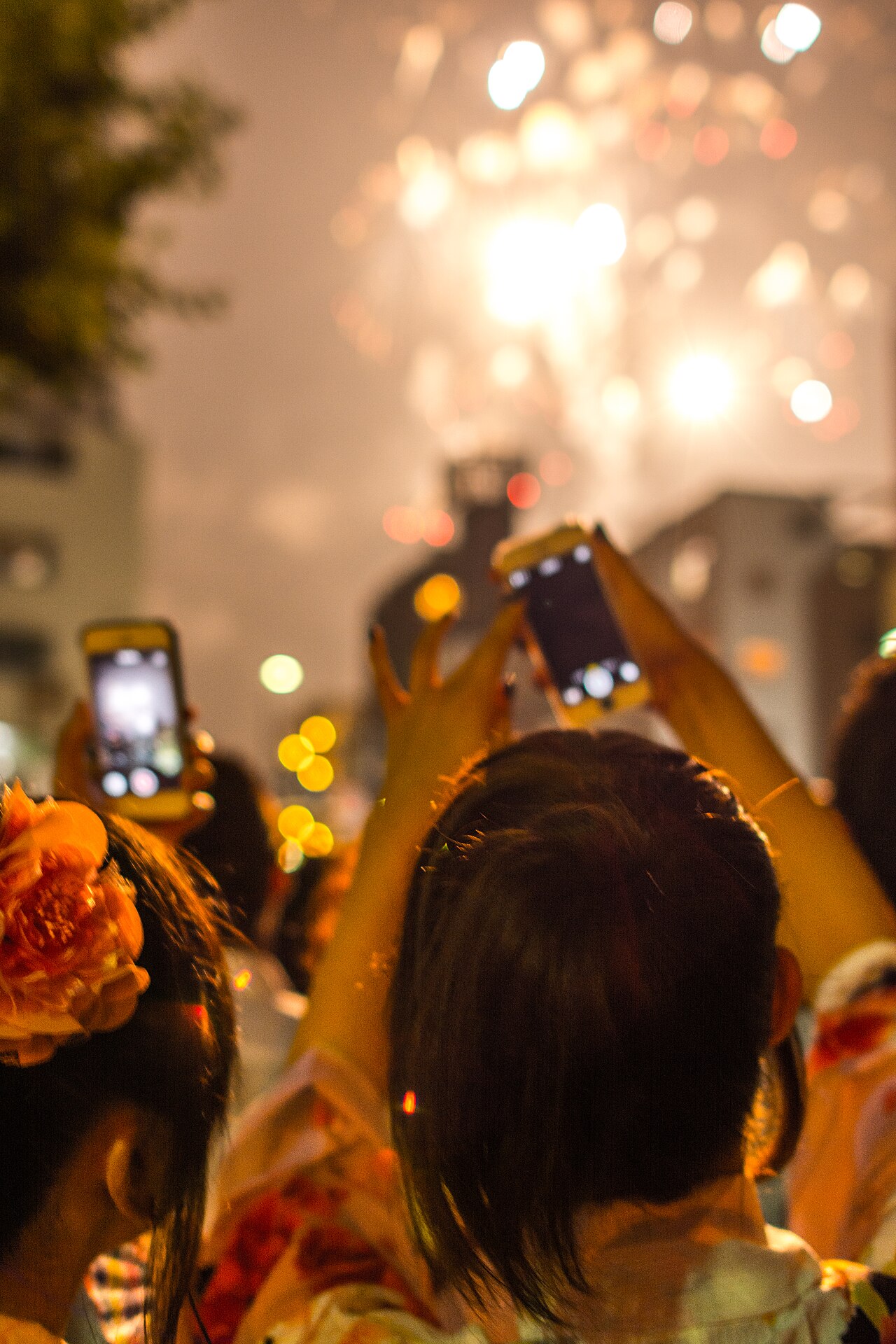
Friends in yukata at the Sumida River Fireworks Festival (隅田川花火大会), Asakusa, Tokyo. Photo: Yoshikazu TAKADA, CC BY 2.0, via Wikimedia Commons.
浴衣 is a casual, unlined cotton kimono worn in the hot summer months, most iconically to outdoor matsuri and 花火 (fireworks) displays. Unlike a formal silk kimono, a yukata is lightweight, easy to put on, and inexpensive, which is why it remains one of the most approachable pieces of traditional Japanese clothing for both Japanese people and visitors alike.
Meaning
The word breaks down into two parts: 湯 (yu, "hot water" or "bath") and 帷子 (katabira, an old word for an unlined summer robe). Put together, 浴衣 literally means "bathing robe." That etymology points directly at its origin: a garment meant to be worn in and after bathing, not the elaborately layered silk kimono worn for weddings, tea ceremonies, or coming-of-age ceremonies.
A yukata differs from a formal kimono in several concrete ways:
| Yukata (浴衣) | Formal Kimono (着物) | |
|---|---|---|
| Fabric | Cotton (sometimes cotton-linen or synthetic blends) | Silk, sometimes wool or fine synthetics |
| Lining | Unlined (single layer) | Often lined, especially for cooler seasons |
| Undergarments | Worn directly over underwear, no juban required | Requires a juban under-robe and multiple layers |
| 帯 (obi) | Simple hanhaba obi or heko obi, tied in an easy bow | Formal fukuro obi or nagoya obi, tied in elaborate knots |
| Footwear | Bare feet in geta (wooden sandals) | Tabi socks with zori sandals |
| Occasion | Summer festivals, fireworks, home/ryokan loungewear | Weddings, funerals, tea ceremony, formal visits |
| Cost & care | Inexpensive, machine washable | Expensive, dry-clean only |
Because it requires no under-layers and ties with a simple sash, a yukata can be put on in a few minutes, whereas a formal kimono often needs a professional dresser and takes 30 minutes or more.
History
Yukata trace back to the Heian period (794–1185), when nobles wore a hemp robe called yukatabira (湯帷子) while bathing in steam baths, largely to absorb sweat and protect modesty, since communal bathing was often mixed-sex at the time. As bathing culture spread and 温泉 (hot spring) culture grew during the Edo period (1603–1868), the garment evolved from a bath-time cover into something worn after bathing to cool off and relax — and cotton, which had become widely affordable in Japan by then, replaced hemp as the standard fabric.
By the mid-Edo period, common people had adopted the yukata as everyday summer clothing, not just an after-bath robe. Woodblock prints (ukiyo-e) from the 18th and 19th centuries frequently depict townspeople in yukata during the hot months, and the garment became strongly associated with the pleasures of summer: evening strolls, cooling off by a river, and watching fireworks — a tradition that continues essentially unchanged today.
Usage Today
Modern yukata-wearing falls into two main contexts:
Festivals and fireworks. Every summer, young people, couples, and families put on yukata to attend 祭り (festivals) and hanabi taikai (fireworks displays). Putting on a yukata for a summer outing is considered a fun seasonal event in itself, and photos in yukata are a staple of Japanese social media each July and August.
花火大会に浴衣を着ていくつもりです。 Hanabi taikai ni yukata o kite iku tsumori desu. "I'm planning to wear a yukata to the fireworks festival."
Ryokan and onsen loungewear. Nearly every ryokan and onsen provides guests with a yukata as standard in-room and after-bath attire. Guests wear it to walk between their room, the bath, and the dining hall, and in hot-spring towns like Kusatsu or Kinosaki it's common to see guests strolling the streets in their inn's yukata, sometimes with a matching short jacket called a hanten in cooler weather.
この旅館の浴衣はとても着心地がいいです。 Kono ryokan no yukata wa totemo kigokochi ga ii desu. "This ryokan's yukata is very comfortable to wear."
Patterns and Colors
Traditional yukata patterns draw on classic Japanese motifs: asanoha (hemp leaf geometric patterns), morning glories (asagao), goldfish, fireworks bursts, and waves, usually in indigo blue and white — a color scheme rooted in the Edo-period dye aizome (indigo dyeing), prized both for its look and its mild insect-repelling properties.
Women's yukata today range from these traditional indigo designs to bold, colorful patterns with large florals, retro Taisho-era-inspired prints, and pastel or neon color combinations aimed at a younger market. Men's yukata are generally more subdued, often in navy, gray, or black with simple stripes or geometric patterns, paired with a narrower kaku obi sash.
Modern Trends
Yukata rental has become a major business in tourist destinations like Kyoto, Asakusa, and Kamakura, where shops offer full rental packages — yukata, obi, geta, and even hair styling — aimed at both domestic and international tourists wanting the festival experience without owning their own set. This rental culture has made the garment far more accessible to foreign visitors, who might otherwise never wear one.
At the same time, a "modern kimono" movement has brought yukata with unconventional silhouettes, lace trim, boots instead of geta, and Western-influenced accessories into fashion, particularly among younger people who want to stand out at festivals while still nodding to tradition. Contemporary brands also produce polyester yukata that mimic the traditional look but require no ironing and can go straight in a washing machine, trading some authenticity for convenience.
Related Terms
- 甚平 (jinbei) – A simpler two-piece summer outfit (top and shorts) worn mostly by men and children, even more casual than a yukata.
- 浴衣美人 (yukata bijin) – "Yukata beauty," a term for someone who looks especially attractive in a yukata.
- 花火大会 (hanabi taikai) – Fireworks festival, the quintessential yukata-wearing occasion.
- 帯締め (obijime) – A decorative cord, more common with formal kimono, occasionally added to dress up a yukata outfit.
Related Dictionary Words
yukata; light cotton kimono worn in the summer or used as a bathrobe
festival; feast; matsuri
fireworks
hot spring
band (e.g. conduction, valence); belt (e.g. Van-Allen, asteroid, etc.)
kimono; Japanese traditional clothing (esp. full-length)
ryokan; traditional Japanese inn
summer