禅
zenA school of Mahayana Buddhism, transmitted from China as Chan and rooted in Japan since the Kamakura period, that emphasizes zazen meditation and direct insight over scripture or ritual.
Meaning
禅 (ぜん, zen) is the Japanese name for a school of Mahayana Buddhism that traces its roots to Chan Buddhism (禪) in China, which itself grew out of the meeting of Indian Buddhist meditation practice with Chinese Taoist thought. The character 禅 itself derives from the Sanskrit word dhyāna, meaning "meditative absorption." At its core, Zen holds that awakening — 悟り (satori), a direct, intuitive insight into one's own Buddha-nature — cannot be reached merely by reading scripture or performing rituals. It must be experienced firsthand through disciplined practice, above all seated meditation.
In everyday Japanese and in English, "Zen" has drifted beyond its strict religious meaning to describe a broader state of calm, focus, and simplicity — an uncluttered mind, an uncluttered room, an uncluttered life. This popular usage borrows the aesthetic and psychological associations of the tradition (stillness, minimalism, presence) without necessarily invoking its full doctrinal or monastic context.
Usage
As a religious and philosophical term:
彼は毎朝座禅を組んで心を落ち着かせる。 Kare wa maiasa zazen o kunde kokoro o ochitsukaseru. "Every morning he sits in zazen to calm his mind."
禅の教えでは、無の境地に至ることが大切だとされる。 Zen no oshie de wa, mu no kyōchi ni itaru koto ga taisetsu da to sareru. "In Zen teaching, it is considered important to reach a state of mu (nothingness)."
As a looser, everyday description of a mindset or aesthetic (common in both Japanese and English):
この部屋は禅っぽい雰囲気があるね。 Kono heya wa zen-ppoi fun'iki ga aru ne. "This room has a kind of Zen atmosphere, doesn't it."
"Just breathe — try to stay zen about it."
Related vocabulary includes 禅宗 (zenshū, "the Zen sect/school"), 公案 (kōan, a paradoxical riddle used in training), and 瞑想 (meisō, "meditation" in the general sense).
Cultural Context
From Chan to Zen
Chan Buddhism had already been transmitted to Japan in a limited way by the Nara and Heian periods, but it took root as an independent, influential school only in the Kamakura period (1185–1333), a time of upheaval when new, more accessible forms of Buddhism spread rapidly among samurai and commoners alike. The monk Eisai (1141–1215) traveled to Song-dynasty China and returned to found the Rinzai school, which places special emphasis on kōan practice — contemplating unanswerable riddles like "What is the sound of one hand clapping?" to jolt the mind past ordinary logical thought toward sudden insight. A generation later, Dōgen (1200–1253) founded the Sōtō school after his own training in China, teaching shikantaza ("just sitting") — meditation practiced not as a means to an end but as enlightenment itself, moment by moment.
Zen found particular favor with the samurai class, whose military discipline resonated with Zen's emphasis on presence, decisiveness, and non-attachment to fear of death. This patronage helped Zen temples become centers of not just religious life but also education, statecraft, and the arts throughout the medieval period.
Zen and the arts
Zen's influence on Japanese aesthetics is difficult to overstate. Because Zen values direct, unmediated experience over conceptual explanation, its ideals found expression less in scripture than in physical practice and design:
- Karesansui (dry landscape) gardens. The rock garden at Ryōan-ji in Kyoto, laid out in the late 15th century under Rinzai patronage, is the most famous example: fifteen rocks are arranged in raked white gravel so that no matter where a viewer sits on the temple veranda, only fourteen are visible at once — traditionally said to symbolize that true completeness lies beyond ordinary perception.
- Sado (茶道, the tea ceremony), which grew out of Zen monastic tea-drinking rituals and was shaped by tea masters trained in Zen temples, channeling the same attentiveness to the present moment into a formal, precisely choreographed practice.
- Wabi-sabi (侘び寂び), the aesthetic of beauty in imperfection, transience, and simplicity, which draws directly on Zen's rejection of attachment to permanence and ornament.
- Ink wash painting (sumi-e), Noh theater's austere stagecraft, and martial arts such as kendo and kyūdō (archery), all of which absorbed Zen's emphasis on discipline, emptiness, and full presence in each action — captured in the idea of 武道 (budō, "the martial way") as much a spiritual path as a physical one.
Zen in the modern world
Zen Buddhism reached a wide Western audience in the 20th century largely through the writings of D. T. Suzuki, and later through the Beat poets, the 1970s counterculture, and figures like Steve Jobs, who studied Zen and credited it with shaping his design philosophy at Apple. This popularization is also why "zen" now functions as an English adjective ("keep it zen," "very zen minimalist decor") describing calm and simplicity divorced from any specific religious content — a usage Japanese speakers recognize but treat as a separate, more casual register from the term's meaning within actual Buddhist practice.
Today in Japan, Zen temples remain active sites of monastic training, but they also welcome lay visitors and even foreign tourists for short zazen retreats, and some companies send new employees to temple stays to build focus and discipline — a modern echo of Zen's old alliance with the samurai class.
Related Concepts
| Term | Reading | Meaning |
|---|---|---|
| 座禅 | ざぜん | Seated Zen meditation |
| 悟り | さとり | Enlightenment, sudden insight |
| 公案 | こうあん | Kōan, a paradoxical teaching riddle |
| 無 | む | Nothingness / emptiness |
| 石庭 | せきてい | Stone (rock) garden |
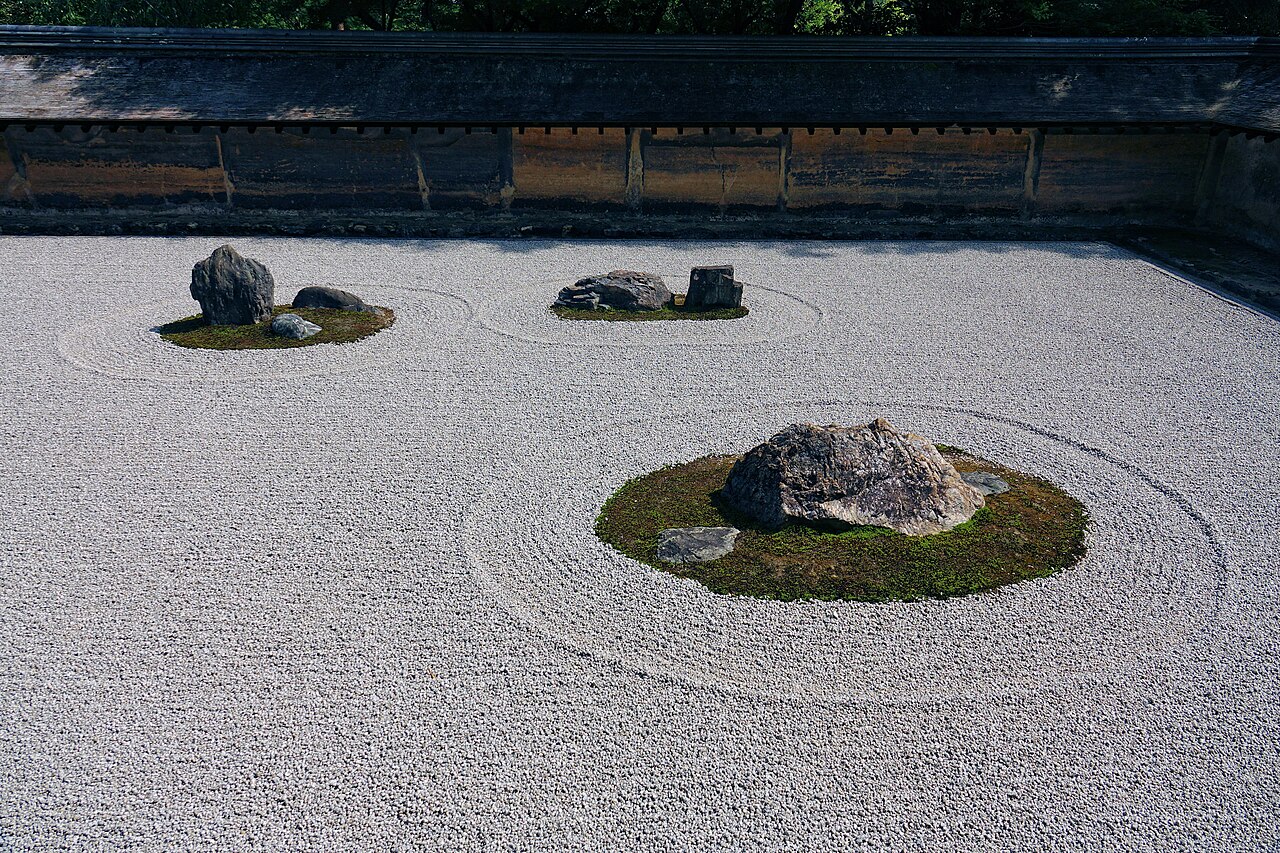
The rock garden (karesansui) at Ryōan-ji temple in Kyoto, laid out in the late 15th century, is one of the most celebrated expressions of Zen aesthetics in Japan. Photo: Bjørn Christian Tørrissen, CC BY-SA 4.0, via Wikimedia Commons.
Related Dictionary Words
dhyana (profound meditation)
zazen (seated Zen meditation, usu. in a cross-legged position)
comprehension; understanding
koan; kōan; Zen question for meditation (e.g. the sound of one hand clapping)
nothing; naught; nought; nil; zero
Zen (Buddhism)
meditation; contemplation
martial arts; military arts; Bushido
rock garden
tea ceremony; Way of Tea; sadō
wabi-sabi; aesthetic sense in Japanese art centered on the acceptance of transience and imperfection