デスノート
desu nootoDeath Note is Tsugumi Ohba and Takeshi Obata's landmark psychological thriller manga about a supernatural notebook that kills anyone whose name is written in it, and the cat-and-mouse battle of wits it sparks between a genius vigilante and the detective hunting him.
Meaning
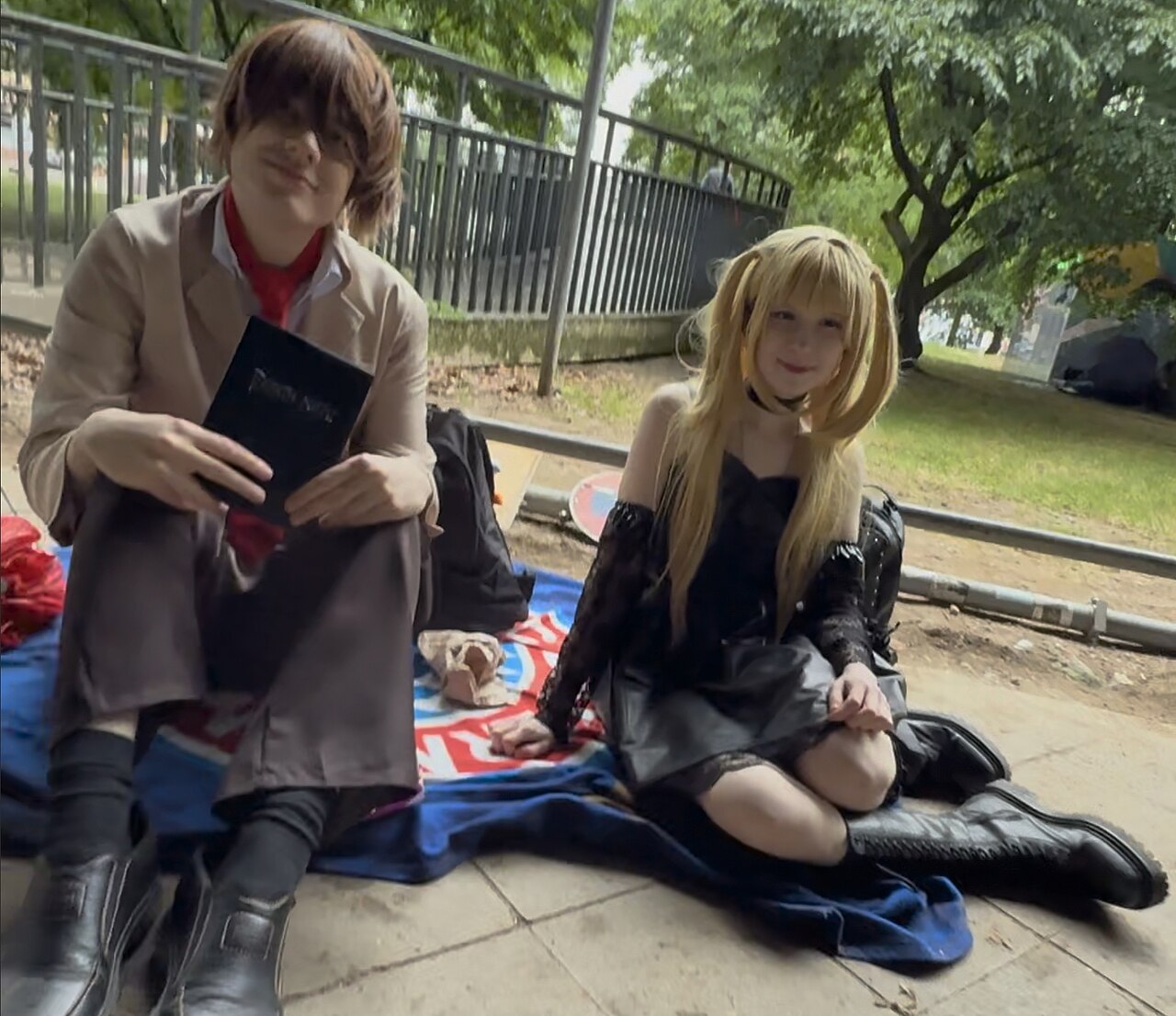
Cosplayers as Light Yagami (holding a replica of the notebook) and Misa Amane at Japantag Düsseldorf 2025. Photo: Markbenecke, CC BY-SA 4.0, via Wikimedia Commons.
Death Note (デスノート, Desu Nōto) is a Japanese manga written by Tsugumi Ohba and illustrated by Takeshi Obata, serialized in Weekly Shōnen Jump from 2003 to 2006. Its premise is simple and devastating: a 死神 (shinigami, "god of death") named Ryuk drops a black ノート into the human world. Whoever's 名前 is written in it while its user pictures their face dies, usually of a heart attack, at a time the writer can specify. The notebook falls into the hands of Light Yagami, a brilliant, bored high school 天才 who decides to use it to eliminate every criminal on Earth and remake the world as its self-appointed god of a new, crime-free order.
What follows is not a conventional action story but an extended 頭脳戦 (zunōsen, "battle of wits") between Light — operating under the alias "Kira" (from the English "killer") — and L, an eccentric, reclusive detective hired to stop him. Twelve tankōbon volumes and a 37-episode anime adaptation (2006–2007) turned that duel into one of manga's most influential thrillers, prized less for spectacle than for its meticulous, chess-match plotting.
Plot Premise
Light Yagami is an outstanding student with a growing contempt for a justice system he sees as too slow and too lenient. When he discovers the 悪魔-adjacent Death Note and its rules — write a name, picture the face, the person dies — he begins secretly executing criminals worldwide, killing thousands within weeks. The sudden, simultaneous deaths of convicted 犯罪者 draw global attention, and an anonymous figure calling himself "L" is brought in by international police to identify and stop the killer he nicknames Kira.
世界は俺のものだ。俺が正義だ。 (Sekai wa ore no mono da. Ore ga seigi da.) "The world is mine. I am justice."
The series' tension comes almost entirely from deduction rather than combat: L and Light each try to expose the other's identity while concealing their own, using narrowing circles of 正義 (justice) as their public justification. Light's supporting cast — his police-detective father, his eventual notebook-wielding accomplice Misa Amane, and a rotating set of successor detectives after L — keep raising the stakes of a story that is, structurally, an elaborate game of hidden information where a single written name can end it.
The Rules of the Notebook
Much of Death Note's appeal lies in its dense, legalistic rule system — the manga's mythology reads like a contract, and the plot repeatedly hinges on characters exploiting loopholes in it.
| Rule | Effect |
|---|---|
| Full name + face required | The writer must know both to kill; a wrong name has no effect |
| Default cause of death | Heart attack, unless another cause and circumstances are specified within set time limits |
| 40-second rule | Writing only a name (no details) kills the person of a heart attack 40 seconds later |
| Ownership transfer | A human who touches the notebook can see and speak with its shinigami owner |
| Shortened shinigami lifespan | Using the notebook to kill humans extends the human's life at the cost of the shinigami's own remaining years |
These constraints turn even a single page of the notebook into a puzzle: because Light must satisfy every rule precisely to frame 反則-proof deaths as natural or accidental, the story's biggest twists usually come from a rule the audience — and Light's opponents — didn't know existed.
Cultural Context and Themes
Death Note belongs to the Weekly Shōnen Jump tradition, but it inverts the magazine's usual friendship-effort-victory formula: its protagonist is a murderer, its central relationship is an adversarial rivalry rather than camaraderie, and its emotional core is the corrosive effect of unchecked 権力 on a genuinely brilliant, ostensibly well-intentioned mind. Light's transformation from idealistic reformer to 独裁者-in-waiting is often read as a study of vigilante justice and the seductive logic of ends-justify-means thinking — questions that resonated well beyond Japan, particularly with readers debating capital punishment, surveillance, and moral absolutism.
The manga's success also owes a great deal to artist Takeshi Obata's design work, particularly L: barefoot, hunched, sugar-addicted, and utterly unlike the typical detective archetype, he became as iconic a character as Light himself and set a visual template other manga detectives have echoed since. Ohba, who writes under a pseudonym and has largely stayed out of the public eye, later reunited with Obata on Bakuman and other projects, but Death Note remains their defining collaboration.
Adaptations and Legacy
Death Note's 原作 manga, 連載 across 108 chapters and 完結 in 2006, spun off into a wide media franchise:
- Anime (2006–2007, Madhouse) — a faithful 37-episode adaptation that remains the most widely watched version outside Japan, often cited as a gateway series for new anime fans thanks to its thriller pacing rather than typical action spectacle.
- Live-action films — a trilogy of Japanese films (2006–2008) beginning with Death Note and Death Note: The Last Name, plus a 2016 sequel and a further 2016 spin-off centered on L.
- Netflix's 2017 Death Note — an American 実写化 relocating the story to Seattle; it drew heavy criticism from fans for departing sharply from the source material, a frequently cited case study in the difficulty of adapting Japanese manga for Western audiences.
- Musical and stage adaptations — Japanese stage musicals (from 2015) and a Korean production have restaged the L–Light confrontation for theater.
- A one-shot 続編 — Death Note: Special One-Shot (2020) revisited the story's world decades later.
- Video games and light novels, including prequel novels focused on L's backstory before the main story begins.
Beyond formal adaptations, Death Note seeded lasting internet culture: the sight of someone dramatically writing in a notebook while narrating a villain monologue is a recurring meme template, "L sitting" (the crouched, feet-on-the-chair pose) is instantly recognizable cosplay and fan-art shorthand, and "this is my notebook" jokes about mundane to-do lists nod knowingly at the franchise. Decades after its original run, Death Note is still routinely ranked among the best-selling and most influential manga ever published, and is frequently a new fan's first exposure to seinen-adjacent psychological thriller storytelling within the broader shōnen space.
Related Works
Death Note is often discussed alongside other genius-detective and cat-and-mouse thrillers in manga, and it shares Weekly Shōnen Jump's stable with far more conventional action series like NARUTO and Jujutsu Kaisen, against which its slow, dialogue-driven plotting stands out. Its blend of horror atmosphere and moral ambiguity also invites comparison to the psychological horror manga of Junji Ito, even though the two work in different registers.
See Also
Related Dictionary Words
god of death; death deity; Death; Grim Reaper
notebook; copy-book; exercise book
name
genius; prodigy; natural gift
battle of the brains; battle of wits; psychological battle
justice; right; righteousness
devil; demon; fiend
criminal; culprit
foul; breaking the rules
original work
serialization; serialisation; serial story
conclusion; completion
live-action adaptation (of a manga, animated film, etc.)
continuation; sequel
(political) power; authority; influence
dictator; despot