名探偵コナン
Meitantei ConanA long-running mystery manga and anime franchise about a teenage detective shrunk into a child's body, who solves cases as "Conan Edogawa" while hunting the crime syndicate responsible.
Overview
名探偵コナン (Meitantei Conan, known in English as Detective Conan or Case Closed) is a mystery 漫画 created by Gosho Aoyama (青山剛昌), serialized in 週刊 Shōnen Sunday continuously since January 1994. Its anime adaptation has aired weekly on Nippon TV since January 1996, making it one of the longest-running detective fiction franchises anywhere in the world — over 1,100 manga chapters and more than 1,100 TV episodes and counting, with no end in sight after more than three decades.
The story follows Kudo Shinichi (工藤新一), a 高校生 探偵 already famous for helping the police solve cases. While investigating suspicious dealings at an amusement park, he is caught spying by two members of a mysterious black-suited 組織 and force-fed an experimental 毒 meant to kill without a trace. Instead of dying, Shinichi wakes up 縮んで into the body of a seven-year-old 子供. To protect himself and his loved ones, he hides his identity under the alias Edogawa Conan (江戸川コナン) — a 名前 combining mystery writers Edogawa Ranpo and Arthur Conan Doyle — and moves in with his childhood friend Ran and her father, a bumbling private detective named Mouri Kogoro. From there, Conan secretly solves Kogoro's cases for him while quietly hunting the organization that shrank him.
Premise and Structure
Each story arc typically follows a classic whodunit formula: Conan and the cast stumble onto an 事件 — usually a murder in a locked room, on a train, or at some isolated gathering — gather clues, interview witnesses, and Conan reveals the 犯人 in an elaborate deduction scene. Because a child detective wouldn't be taken seriously, Conan uses a bow tie that broadcasts Kogoro's own voice and a wristwatch that fires a tranquilizer dart, knocking the older detective unconscious so Conan can "narrate" the solution through him — a device that lets the plot keep its adult authority figure while the real reasoning comes from the shrunken protagonist.
Episodes alternate between standalone mysteries, wrapped up within one or two episodes, and the overarching plot involving the shadowy Black Organization (黒の組織) that poisoned Shinichi. Other characters — most notably the scientist Haibara Ai, who created the poison and later took it herself to escape the organization — share Conan's 謎 and slowly help him close in on the truth. This dual structure (self-contained mystery-of-the-week plus a decades-long serialized conspiracy) is a large part of why the series has sustained new viewers and lifelong fans simultaneously for over 30 years.
| Element | Detail |
|---|---|
| Creator | Gosho Aoyama (青山剛昌) |
| Manga serialization | Weekly Shōnen Sunday (Shogakukan), since January 1994 |
| Anime | Yomiuri TV / Nippon TV, weekly since January 1996 |
| Manga volumes | 100+ tankōbon, 270+ million copies in circulation worldwide |
| English titles | Detective Conan / Case Closed (US dub, due to a trademark conflict with Conan the Barbarian) |
Cultural Context: A Household Name
Detective Conan is one of the best-selling manga series of all time and, alongside franchises like ワンピース and ドラえもん, is considered a fixture of modern Japanese popular culture that crosses generational lines — many adults who grew up reading it now watch it with their own children. Its influence on the mystery genre within manga and anime is substantial: it helped popularize the "kid detective" trope and demonstrated that a long-running, case-driven procedural could sustain a mainstream weekly manga audience the same way sports and battle series do, opening the door for later detective and thriller titles.
The Annual Movie Event
Since 1997, Toho has released a new Detective Conan theatrical film every spring (typically mid-April), without a single year skipped in nearly three decades. Unlike many franchise films, these are original feature-length mysteries — often with higher stakes, larger action set-pieces, and reunions of the full supporting cast — rather than adaptations of manga arcs. The films are a major annual box-office event in Japan: several installments have ranked among the highest-grossing films of their respective years domestically, and the series as a whole is consistently one of the most reliable non-Ghibli anime franchises at the Japanese box office. The films function as a yearly cultural checkpoint the way a long-running live-action franchise might elsewhere — a springtime tradition for families and fans alike.
Merchandise and Tourism
Detective Conan merchandising spans everything from stationery and snack tie-ins to a long-running collaboration with Universal Studios Japan. Creator Gosho Aoyama's hometown of Hokuei, Tottori Prefecture, has embraced the connection directly: the town has rebranded parts of itself around the series, with a "Conan Road" of bronze character statues, a bridge locally nicknamed Conan Ohashi, a museum (the Gosho Aoyama Manga Factory), and a themed recreation of the story's fictional Beika shopping street — turning the series into a genuine pilgrimage destination (a practice known in Japan as seichi junrei, 聖地巡礼) for fans from across the country.
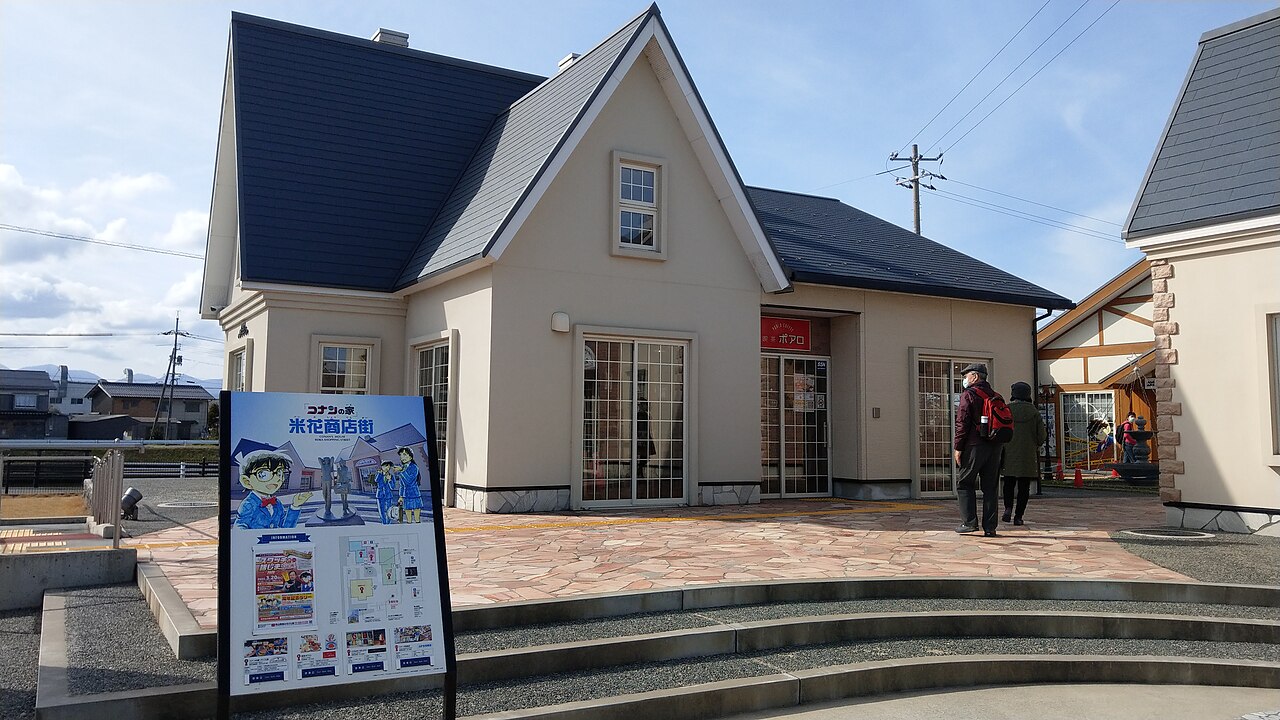
"Conan's House," a themed building on a recreated Beika shopping street in Hokuei, Tottori — part of the town's Detective Conan tourism tied to creator Gosho Aoyama's hometown. Photo: Hsu, Tzu-hsun, CC BY-SA 4.0, via Wikimedia Commons.
Legacy
Decades in, Detective Conan remains a fixture of Japanese weekly television and print culture: its Sunday-evening anime broadcast slot and its April movie release are both treated as recurring cultural events rather than niche otaku programming, comparable in mainstream visibility to franchises like ドラえもん or クレヨンしんちゃん. Along with デスノート, it stands as one of the defining detective/mystery titles in manga, and its central hook — a genius mind trapped in a child's body, forced to solve crimes from the shadows — has become one of the most recognizable premises in the medium.
Related Dictionary Words
detective; investigator; sleuth
great detective
reasoning; inference; deduction
boy
cartoon; comic; comic strip; manga
weekly publication
movie; film; motion picture
organization; organisation; formation
poison; toxicant
event; affair; incident; case; plot; trouble; scandal
riddle; puzzle; enigma; mystery
offender; criminal; culprit
to shrink; to contract; to diminish (in size)
name
child; children
senior high school student