ジョジョの奇妙な冒険
JoJo no Kimyou na BoukenHirohiko Araki's long-running manga and anime saga about the Joestar bloodline, famous for its Stand battle powers, dramatic "JoJo pose," and outsized influence on fashion and internet meme culture.
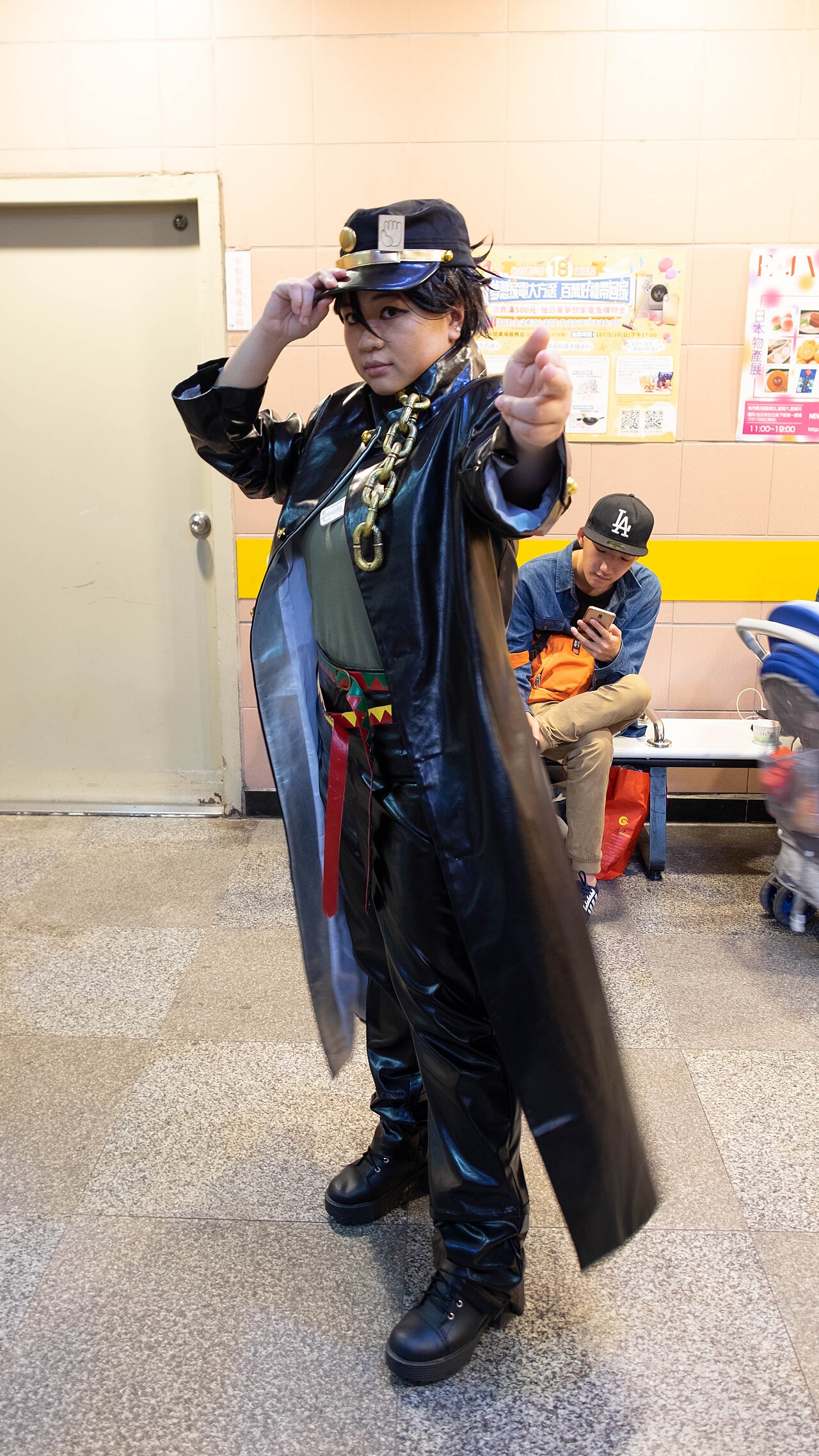
A cosplayer as Jotaro Kujo (Part 3) striking a signature stance — the trench coat, sunglasses, and dramatic pose are hallmarks of the series' visual style. Photo: 玄史生, CC0, via Wikimedia Commons.
Meaning
ジョジョの奇妙な冒険 (JoJo no Kimyou na Bouken), known internationally as JoJo's Bizarre Adventure, is a 漫画 written and illustrated by Hirohiko Araki, serialized in Weekly Shōnen Jump since 1987 and continuing today in Ultra Jump. The title translates literally as "JoJo's 奇妙 Adventure" — 奇妙 meaning "strange" or "bizarre." Fans and the franchise itself commonly shorten the name to just JoJo (ジョジョ), a nickname shared by nearly every protagonist across the story's eight (and counting) story arcs, or "Parts," each following a different descendant of the Joestar family across roughly a century of in-universe time, from Victorian England to modern-day Japan and beyond.
The series is best known for introducing Stands (スタンド, sutando), visible manifestations of a person's inner life-energy that act as fighting familiars with unique, often bizarrely specific superpowers — one Stand might stop time for a few seconds, another might turn objects into bombs at a touch, another might only work on Tuesdays. Stands are named after real-world songs, bands, and tarot cards (a habit that has caused later printings to quietly rename a few Stands after copyright disputes). Battles are less about raw strength and more like logic puzzles, as characters probe an enemy's Stand ability and improvise a countermeasure — a structure widely credited with influencing the modern "power system" battle-shōnen genre (Jujutsu Kaisen's Cursed Techniques and Hunter × Hunter's Nen are direct descendants of this idea).
Equally iconic is the series' art: anatomically exaggerated, hyper-muscular figures frozen in impossible, fashion-magazine contortions — the so-called ジョジョ立ち ("JoJo standing/pose"). Araki has cited Renaissance and Mannerist painters like Caravaggio, and haute couture runway photography, as direct influences on these poses, which is part of why the series reads as much like a fashion editorial as a fight comic.
Usage
Fans use "JoJo" as shorthand both for the franchise and, confusingly but intentionally, for whichever protagonist is currently the star — Jonathan Joestar, Joseph Joestar, Jotaro Kujo, Josuke Higashikata, Giorno Giovanna, Jolyne Cujoh, Johnny Joestar, and Josuke Higashikata (again, a different one) all share the JoJo nickname.
このスタンド、能力がマジで奇妙すぎる。 Kono sutando, nouryoku ga maji de kimyou sugoi. "This Stand's ability is seriously bizarre."
かっこいいポーズ決めて!これぞジョジョ立ちだ。 Kakkoii poozu kimete! Kore zo jojo-dachi da. "Strike a cool pose! That's the JoJo stance right there."
Online, "Is this a JoJo reference?" is itself a long-running meme — any image online of someone striking an odd, dramatic pose, or any coincidental appearance of the word "JoJo" or a Stand name in unrelated media, gets tagged with the joke, since the fandom has spent over a decade finding (and inventing) references everywhere.
Character catchphrases have become memes in their own right. Jotaro Kujo's weary やれやれだぜ ("yare yare daze," roughly "good grief" / "give me a break") and his Stand Star Platinum's rapid-fire punch cry オラオラオラ! ("ORA ORA ORA!") are recognizable even to people who have never watched the show, thanks to constant remixing in reaction images, video edits, and gaming livestream clips.
Cultural Context
Araki began JoJo in 1987 as a fairly conventional Victorian adventure/horror manga (Jonathan Joestar's rivalry with the vampiric Dio Brando), but by Part 3 (Stardust Crusaders, serialized from 1989) the introduction of Stands turned it into something structurally unlike anything else in Shōnen Jump — a battle series where the power system is closer to a logic game than a display of brute force. That structural DNA is now everywhere in modern shōnen: series like Jujutsu Kaisen, Hunter × Hunter, and Chainsaw Man all owe a visible debt to JoJo's rule-bound, puzzle-solving fight scenes.
The anime adaptation arrived comparatively late — a 1993–2002 run of OVAs covered only the first two Parts, and it wasn't until David Production's 2012 TV series that the full story began reaching a global audience through streaming. That delay, paradoxically, helped build the franchise's meme-first reputation in the West: many English-speaking fans encountered out-of-context JoJo pose screenshots and "Za Warudo" ("The World," Dio's Stand's time-stop cry) clips on forums and imageboards years before ever watching an episode, making the series a byword for over-the-top absurdity before it was a byword for great storytelling.
The series' influence extends well beyond the manga shelf. Araki's fashion-runway art style has been recognized by the fashion industry itself: in 2011–2013 he collaborated directly with Gucci on original one-shot comics, and separately was invited by the Louvre museum in 2009 for its own manga commission project (Rohan at the Louvre). JoJo poses, JoJo-branded streetwear crossovers, and the series' saturated color palette are frequently cited as reference points in Japanese and Western fashion photography.
The Joestar Family Tree
| Part | Protagonist (JoJo) | Era / Setting | Stand |
|---|---|---|---|
| 1 | Jonathan Joestar | 1880s England | (pre-Stand era) |
| 2 | Joseph Joestar | 1930s USA/Italy/Mexico | Hermit Purple |
| 3 | Jotaro Kujo | 1980s Japan/Egypt | Star Platinum |
| 4 | Josuke Higashikata | 1999 Morioh, Japan | Crazy Diamond |
| 5 | Giorno Giovanna | Italy | Gold Experience |
| 6 | Jolyne Cujoh | Florida, USA | Stone Free |
| 7 | Johnny Joestar | Alt-history American West | Tusk |
| 8 | Josuke Higashikata (JOJOLands) | Modern Morioh, Japan | Soft & Wet |
Why "Bizarre"
The 悪 (evil) vs 正義 (justice) framing recurs across every Part, but Araki keeps subverting who counts as which — villains get sympathetic backstories, heroes make morally messy choices, and the 血統 (bloodline) at the center of the story is defined as much by its enemies (the Joestar family's generations-long rivalry with Dio and, later, DIO's manipulated legacy) as by blood relation itself. That refusal to stay tidy — mixing horror, camp, high fashion, opera-scale melodrama, and genuinely inventive puzzle-fights in one story — is exactly what fans mean when they call the whole franchise "bizarre" with genuine affection.
Related Dictionary Words
stands; bleachers
adventure; venture
strange; odd; peculiar; queer; curious
cartoon; comic; comic strip; manga
animation; animated film; animated cartoon; anime
pose
ripple; ring on the water
vampire; bloodsucker
evil; wickedness
justice; right; righteousness
lineage; pedigree; family line; birth
oh!; ah!; oh dear!; good grief!; dear me!; thank God!
departure; setting off; start
Shōnen Jump (weekly magazine)
readiness; (mental) preparedness