ゲームセンター
geemu sentaaThe Japanese arcade — a multi-floor amusement building of UFO catcher crane games, rhythm-game cabinets, medal corners, and purikura booths that doubles as a social hangout and date spot.
Meaning
A ゲームセンター (geemu sentaa, "game center"), almost always shortened in speech to ゲーセン (geesen), is Japan's version of the video arcade — but the concept has evolved into something quite different from the strip-mall arcades of the West. A typical ゲームセンター is a multi-story 建物 near a train station or in a busy 繁華街 (entertainment district), with each floor dedicated to a different kind of play: one floor of crane games, one of rhythm and music cabinets, one of classic fighting and shooting games, and often a corner of coin-pusher メダルゲーム machines that pay out in tokens rather than cash. Many locations also house a プリクラ photo-sticker booth near the entrance, making the game center as much a hangout and social space as a place to actually play games.
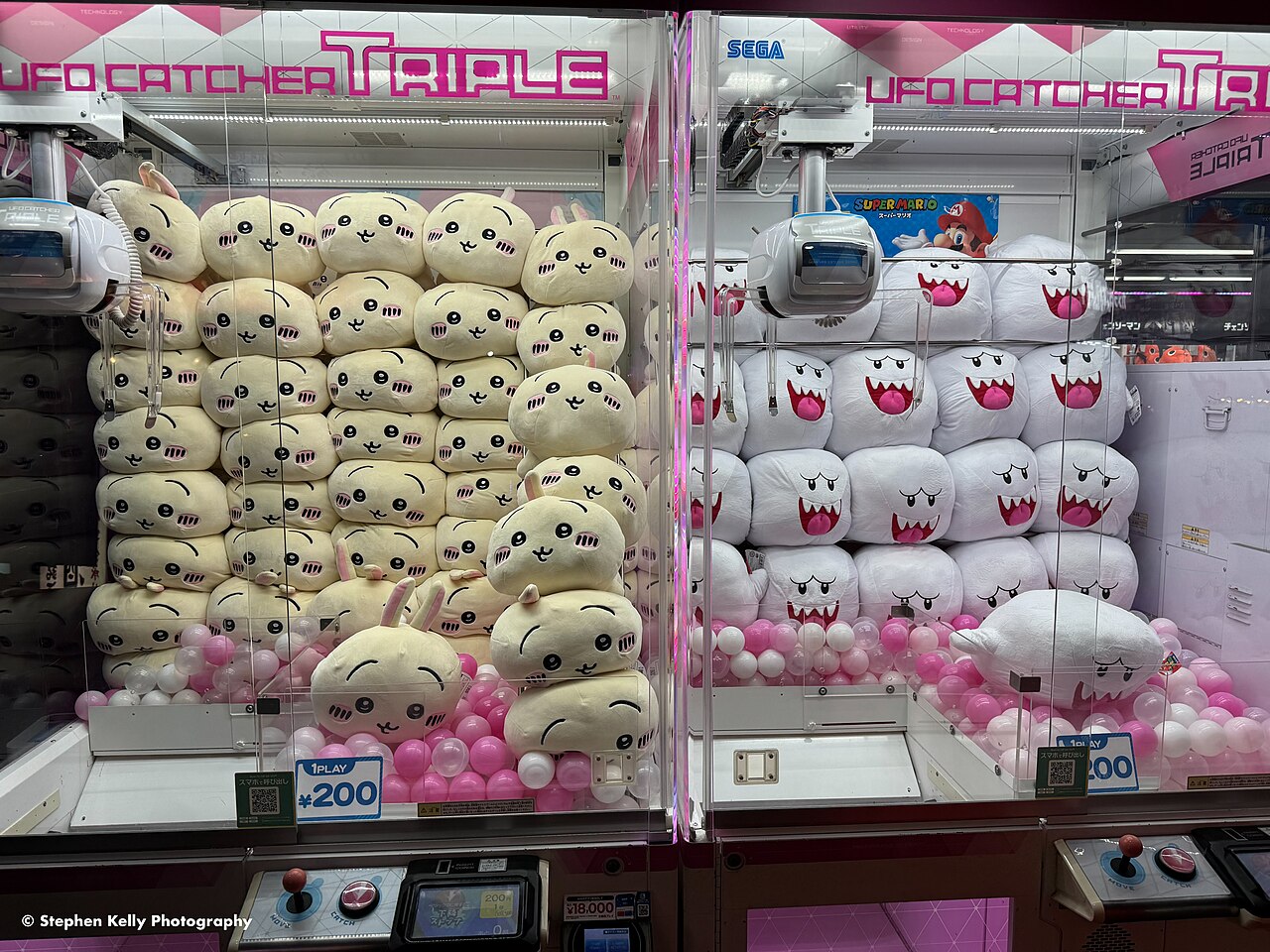
Rows of UFO catcher crane machines at an arcade in Shinjuku, Tokyo. Photo: Stephen Kelly, CC BY 2.0, via Wikimedia Commons.
Anatomy of a Game Center
Walk into a large chain location — Taito Station, GiGO, or Round1 — and you'll typically find several distinct zones stacked on top of one another:
- Crane game (UFO catcher) floors. Rows of glass-boxed クレーン machines packed with plush toys, anime figures, snacks, and licensed merchandise. These floors are often the brightest, busiest, and most photographed part of the building, especially in tourist-heavy districts like Akihabara and Shinjuku.
- Rhythm and music game corners. Dedicated 筐体 (cabinets) for franchises like maimai, Chunithm, and Taiko no Tatsujin — the 太鼓 ("drum") rhythm game whose giant barrel-shaped controllers are instantly recognizable. These games reward repeat visits, since players track their scores and rankings on linked player cards, and they've become a genre unto themselves with dedicated fan communities and tournaments.
- Medal corners. Slot-machine-style and coin-pusher 遊技場 sections where players buy a stack of house-only medals and try to grow their pile — medals have no cash value and can't be exchanged for money, which is what keeps this corner legally distinct from gambling.
- Retro and classic cabinets. Many arcades, especially GiGO's flagship Akihabara locations, preserve rows of vintage 1980s–90s cabinets for older visitors and retro-gaming enthusiasts, alongside modern fighting-game setups used for competitive play and streaming.
- Purikura and photo booths. Photo-sticker machines are frequently built into or attached to game centers, turning them into a natural first stop on a date or a group outing with friends.
The UFO Catcher and the Crane Game Debate
"UFO catcher" is the generic English-language term most people use for a claw/crane game in Japan, but it actually started life as a Sega trademark. Sega's original crane machine, released in 1985, was named the UFO Catcher after its flying-saucer-shaped claw housing; it was so dominant in the market that, like "Band-Aid" or "Kleenex," the brand name became the everyday word for the entire category of 景品 (prize)-grabbing crane games, regardless of manufacturer.
Because these machines pay out prizes based on a game of physical skill (or apparent skill), Japan regulates them under the Entertainment Business Control Law (風営法), the same law that governs pachinko parlors and other amusement businesses. Operators can't simply program a machine to be un-winnable — that risks running afoul of consumer-protection rules against 射幸心 (gambling-like impulse) exploitation — but they also aren't required to disclose a fixed win rate, and claw grip strength is often deliberately weakened for all but a set number of "winning" attempts. Regulators also cap the retail value of a single prize (a National Police Agency directive raised the ceiling from ¥800 to roughly ¥1,000 in 2022), which is why crane-game prizes tend to be plush toys and character goods rather than high-value electronics. This murky mix of skill, luck, and house-favoring odds is a constant topic of debate among players, and an entire subculture of "how to win UFO catchers" guides, YouTube tutorials, and technique-sharing communities has grown up around trying to beat the machines legitimately — collectors sometimes clip their winnings onto 痛バッグ bags alongside ガチャ capsule prizes and ガシャポン figures as visible trophies of their hobby.
History: From Postwar Parlors to the Golden Age
Coin-operated amusement machines existed in Japan going back to postwar 屋台-style stalls and pachinko-adjacent parlors, but the modern game center took shape alongside the rise of video games in the 1970s. Taito's Space Invaders (1978) was a genuine cultural phenomenon, reportedly causing a nationwide shortage of the ¥100 coins used to play it, and it helped establish dedicated arcade venues as a mainstream leisure destination rather than a niche hobby space.
The 1980s and early 1990s are widely remembered as the golden age of the Japanese game center. Sega, Namco, Taito, and Konami competed fiercely with new cabinets, and the arcades themselves became the primary place to experience cutting-edge graphics and gameplay that home consoles couldn't yet match — fighting games like Street Fighter II, and later rhythm games like Dance Dance Revolution and beatmania, turned arcades into genuine social hubs where players gathered, competed, and formed 若者 (youth) subcultures around specific games.
That advantage eroded through the 1990s and 2000s as home consoles closed the technology gap and, later, as smartphones and free-to-play mobile games captured a huge share of casual gaming time. Many neighborhood arcades closed, and the industry consolidated around a smaller number of large, well-capitalized chains that could afford expensive, hard-to-pirate cabinet technology — crane games, rhythm cabinets with proprietary hardware, and purikura booths — that couldn't simply be replicated at home.
Revival: A New Kind of Third Place
Rather than disappearing, surviving Japanese game centers have carved out a role as social "third places" — somewhere between home and work/school — built around experiences phones can't replicate: the physical presence of rhythm-game communities, the tactile thrill of crane games, and photo booths with friends. Large flagship locations in Akihabara, Shinjuku, and Osaka's Nipponbashi now draw both domestic regulars and international tourists specifically for retro cabinets and crane-game hunting, and some venues have leaned hard into that appeal — one Tokyo arcade set a Guinness World Record for the most crane games under one roof. Competitive rhythm-game and fighting-game scenes keep certain floors busy late into the night, and the shared, semi-public nature of the space keeps it functioning as a low-cost, low-commitment hangout spot in a way home gaming can't.
Major Chains Today
| Chain | Notes |
|---|---|
| GiGO | Formerly Sega's own arcades; rebranded in 2022 after Sega sold its amusement-arcade business to Genda, which now operates them as GENDA GiGO Entertainment |
| Taito Station | Taito Corporation's chain, known for large crane-game floors and its "Egg" sub-brand focused on prize games |
| Round1 | A hybrid entertainment complex chain combining an arcade floor with bowling, karaoke, batting cages, and other activities |
| Adores / Bandai Namco | Namco's arcade brand, historically strong in Tokyo and known for rhythm-game and prize-game floors |
Social Role: Dates, Hangouts, and Otaku Culture
Game centers occupy a distinctive place in Japanese youth social life. A trip to a game center is a classic casual デート (date) activity — cheap, low-pressure, and full of built-in conversation starters, from teaming up on a rhythm game to hunting for a crane-game prize together before finishing at the purikura booth. For students, arcades near train stations and 商店街 (shopping streets) function as an after-school meeting spot, filling a role similar to what a mall food court or bowling alley might in other countries.
Game centers are also closely woven into オタク and gaming subculture more broadly. Rhythm-game floors have their own competitive rankings and communities; retro sections attract collectors and preservationists; and the crane-game prize economy overlaps with the wider Japanese "prize culture" ecosystem that includes capsule-toy ガチャ machines and convention culture. (Note: the lottery-style ichiban kuji prize draws sold at convenience stores and hobby shops are a related but distinct concept — they aren't crane games, though the same collectors often chase both.)
See Also
Related Dictionary Words
game arcade; video arcade; penny arcade
gift; premium; freebie; giveaway; something additional; an extra
drum
amusement parlour game which uses tokens (parlor)
case (of a machine, computer, etc.); casing; cabinet (arcade games); housing; enclosure; chassis; frame
passion for gambling; fondness for speculation; speculative spirit
amusement center (centre); game arcade; gambling hall
business district; shopping district; bustling street; shopping centre; shopping center; downtown
date (with someone); (social) outing (for two); date night