花火
hanabiJapanese fireworks and the summer fireworks festivals (hanabi taikai) built around them, from their Edo-period river-memorial origins to their role as a symbol of fleeting beauty and a staple romantic scene in anime.
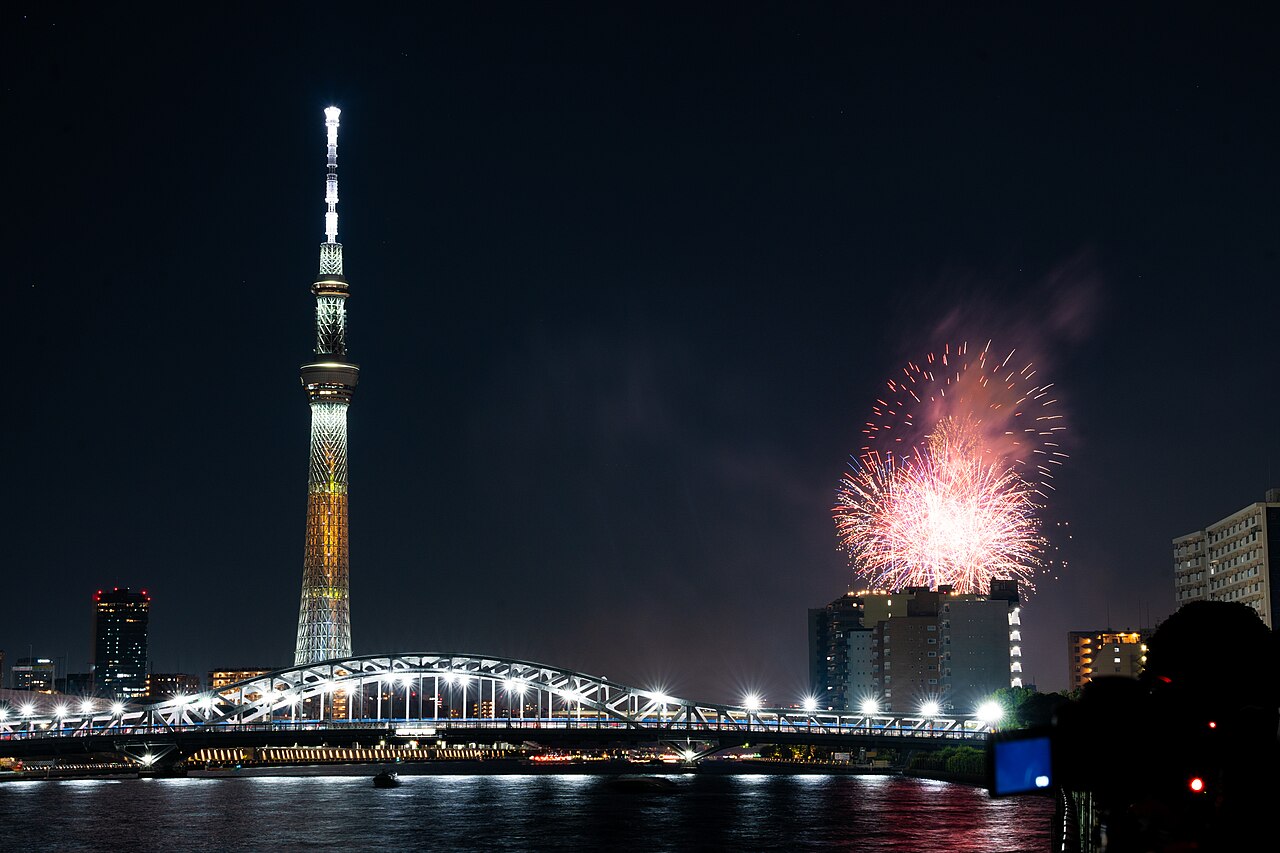
Fireworks over the Sumida River at the Sumidagawa Hanabi Taikai, Tokyo, 2023. Photo: Dick Thomas Johnson, CC BY 2.0, via Wikimedia Commons.
Meaning
花火 (hanabi, literally "fire flower") is the Japanese word for fireworks. While the word covers everything from a single sparkler to a professional pyrotechnic show, in cultural context "hanabi" most often refers to the 花火大会 (hanabi taikai) — a large-scale fireworks display or festival held over a river, lake, or harbor on a summer evening, often watched by tens or hundreds of thousands of spectators at once.
Hanabi taikai are not casual events tacked onto a wider festival; they are their own entertainment institution, comparable in scale and anticipation to a major outdoor concert. Cities, towns, and even small municipalities across Japan hold one during the summer months, and the biggest ones — like the Sumidagawa Hanabi Taikai in Tokyo — are broadcast on television and draw well over a million visitors over the course of an evening.
A useful distinction within the word itself:
| Term | Meaning |
|---|---|
| 打ち上げ花火 (uchiage hanabi) | Large aerial shells launched from mortars — the kind seen at a taikai |
| 線香花火 (senkō hanabi) | Small handheld "incense stick" sparklers, held in intimate groups |
| 手持ち花火 (temochi hanabi) | Handheld consumer fireworks in general, used at home or with friends |
| 花火師 (hanabi-shi) | A professional pyrotechnician who designs and fires the aerial shells |
History
Gunpowder pyrotechnics reached Japan in the 16th century via Portuguese and Chinese trade, and early fireworks were initially a novelty for the ruling class — Tokugawa Ieyasu is said to have watched a fireworks demonstration by a visiting Chinese merchant around 1613. Fireworks culture as a public, mass event, however, is tied to a specific and rather grim origin: the 川開き (kawabiraki, "river opening") ceremony on the Sumida River in Edo (modern Tokyo).
In 1732, the Kyōhō famine and a cholera epidemic killed enormous numbers of people in Edo. The following year, in 1733, the shogunate held a memorial ceremony on the Sumida River that included a fireworks display, intended both to console the spirits of the dead and to drive away evil and pestilence. This event is usually cited as the direct ancestor of the modern Sumidagawa Hanabi Taikai, making it, with roots stretching back nearly 300 years, one of the oldest continuously-referenced fireworks traditions in the world.
Through the Edo period, two rival fireworks houses — Kagiya (鍵屋) and its offshoot Tamaya (玉屋) — competed to outdo each other on the river, launching shells while spectators in boats and on the banks shouted their names as a form of cheering. That call survives today: at hanabi taikai across Japan, it is still traditional for the crowd to shout "Tamaya!" or "Kagiya!" in appreciation of a particularly beautiful burst, much like calling out a performer's name — a rare case of an 18th-century advertising rivalry becoming a permanent piece of festival etiquette.
Famous Hanabi Taikai
Japan holds thousands of hanabi taikai every summer, but a handful are considered the pinnacle of the art form:
- Sumidagawa Hanabi Taikai (隅田川花火大会), Tokyo — the historic descendant of the 1733 river-opening ceremony, held on the last Saturday of July, launching roughly 20,000 shells watched by around a million spectators along the riverbanks near Asakusa.
- Omagari Fireworks Festival (大曲の花火), Akita Prefecture — widely regarded as the most technically prestigious event in Japan, effectively a national competition where top pyrotechnicians are judged on craftsmanship rather than simple spectacle.
- Nagaoka Fireworks Festival (長岡まつり大花火大会), Niigata Prefecture — held every August 2–3 partly as a memorial for the Nagaoka air raids of World War II, famous for its enormous "Phoenix" (フェニックス) shells symbolizing recovery and peace.
- Tenjin Matsuri fireworks, Osaka — the fireworks component of one of Japan's three great Shinto festivals, launched over the Ōkawa river.
Omagari, Nagaoka, and a handful of other events are sometimes grouped together as Japan's "Nihon San-dai Hanabi" (日本三大花火), the "three great fireworks displays."
Cultural Practices
Attending a hanabi taikai is as much a social ritual as a visual spectacle. Typical customs include:
- Yukata: Many attendees, especially younger people and couples, wear a 浴衣 (yukata), the light cotton summer kimono, specifically for the occasion. Going to see hanabi in yukata is one of the most iconic images of Japanese summer, appearing constantly in advertising, TV, and social media.
- Uchiwa and sensu: A 団扇 (uchiwa) flat fan is a near-universal accessory, both for cooling off in the summer heat and as a fashion item that coordinates with a yukata outfit.
- Yatai food stalls: The approach to the viewing area is lined with 屋台 (yatai) food stalls selling festival staples like yakisoba, takoyaki, kakigōri (shaved ice), and ringo-ame (candy apples) — visually and functionally similar to the 夜店 and 縁日 stalls found at shrine festivals, though a hanabi taikai isn't necessarily tied to a shrine.
- Claiming a spot early: Prime riverside viewing spots are claimed hours in advance with picnic sheets (reijāshiito), a communal, first-come custom not unlike staking out space for a parade.
- Going with someone: Because hanabi taikai are an evening event traditionally attended in yukata as pairs or groups, they carry a strong romantic association in Japan. Asking someone to hanabi is a well-understood, semi-formal way of asking them on a summer date, comparable to inviting someone to a school dance in other cultures.
Aesthetic and Symbolic Meaning
Hanabi occupies a distinctive place in Japanese aesthetics precisely because it disappears the instant it appears. A shell blooms into a full sphere of light and color and is gone within a few seconds, leaving only smoke and afterimage — an experience often discussed in the same breath as cherry blossoms (sakura) as an embodiment of 儚い (hakanai, "fleeting, ephemeral") beauty and もののあわれ (mono no aware), the bittersweet awareness of impermanence.
Because of this, hanabi is a well-established 季語 (kigo) — a required seasonal reference word in haiku poetry, firmly marking summer. Classical and modern haiku alike use hanabi (and specifically the intimate, dwindling glow of senkō hanabi) as a compact image for a fading, precious moment. The contrast between the two forms captures the same idea at different scales: an uchiage hanabi is loud, public, and enormous but over in an instant; a senkō hanabi, held quietly between two people, burns down slowly through visibly named stages and then simply drops away.
Together with matsuri drums, obon lanterns, and Tanabata streamers, hanabi is one of the core 風物詩 (fūbutsushi) — seasonal touchstones — of the Japanese summer calendar.
In Anime, Manga, and Pop Culture
Hanabi is one of the most reliable visual shorthand devices in anime and manga for "summer" and, especially, for a pivotal romantic or nostalgic scene. A couple watching fireworks together — often from a rooftop, riverbank, or distant hillside rather than in the crowd — is a stock scene used to mark a turning point in a relationship or the emotional climax of a summer arc.
Notable examples include:
- 5 Centimeters per Second and other Makoto Shinkai works, which repeatedly use fireworks scenes to explore missed timing and distance between people.
- Anohana: The Flower We Saw That Day (あの日見た花の名前を僕達はまだ知らない。), whose entire plot and title revolve around a promise made during a hanabi festival.
- The recurring anime gag around 花火大会 episodes where characters debate the best angle to see a firework shell "from the side" — a joke referencing the fact that shells are designed to look spherical only from directly below, so viewing position changes the visual.
- Idol and Vocaloid music videos and countless visual novel/eroge summer routes, which use a hanabi date as a default seasonal event scene.
This trope is strong enough that "hanabi episode" functions almost as its own genre marker in seasonal anime, signaling a slower, emotionally-loaded interlude before a season's climax.
Related Terms
Related Dictionary Words
fireworks
fireworks display; display of fireworks
skyrocket (firework)
toy fireworks; sparklers
yukata; light cotton kimono worn in the summer or used as a bathrobe
uchiwa; type of traditional Japanese handheld fan
cart (esp. a food cart); stall; stand
summer
seasonal word (in haiku)
festival; feast; matsuri
night stall; night shop; night fair
temple festival; fair; fete day; day related to a particular deity and thought to bring divine blessing to those who celebrate it
pyrotechnician; pyrotechnist
festival marking the start of boating season
fleeting; transient; short-lived; momentary; ephemeral; fickle; vain
emotion; feeling
feature of the season; something characteristic of a particular season