地蔵
jizouA Buddhist bodhisattva depicted as small roadside stone statues who protects children, travelers, and the souls of miscarried or stillborn children, typically adorned with a red bib and cap.
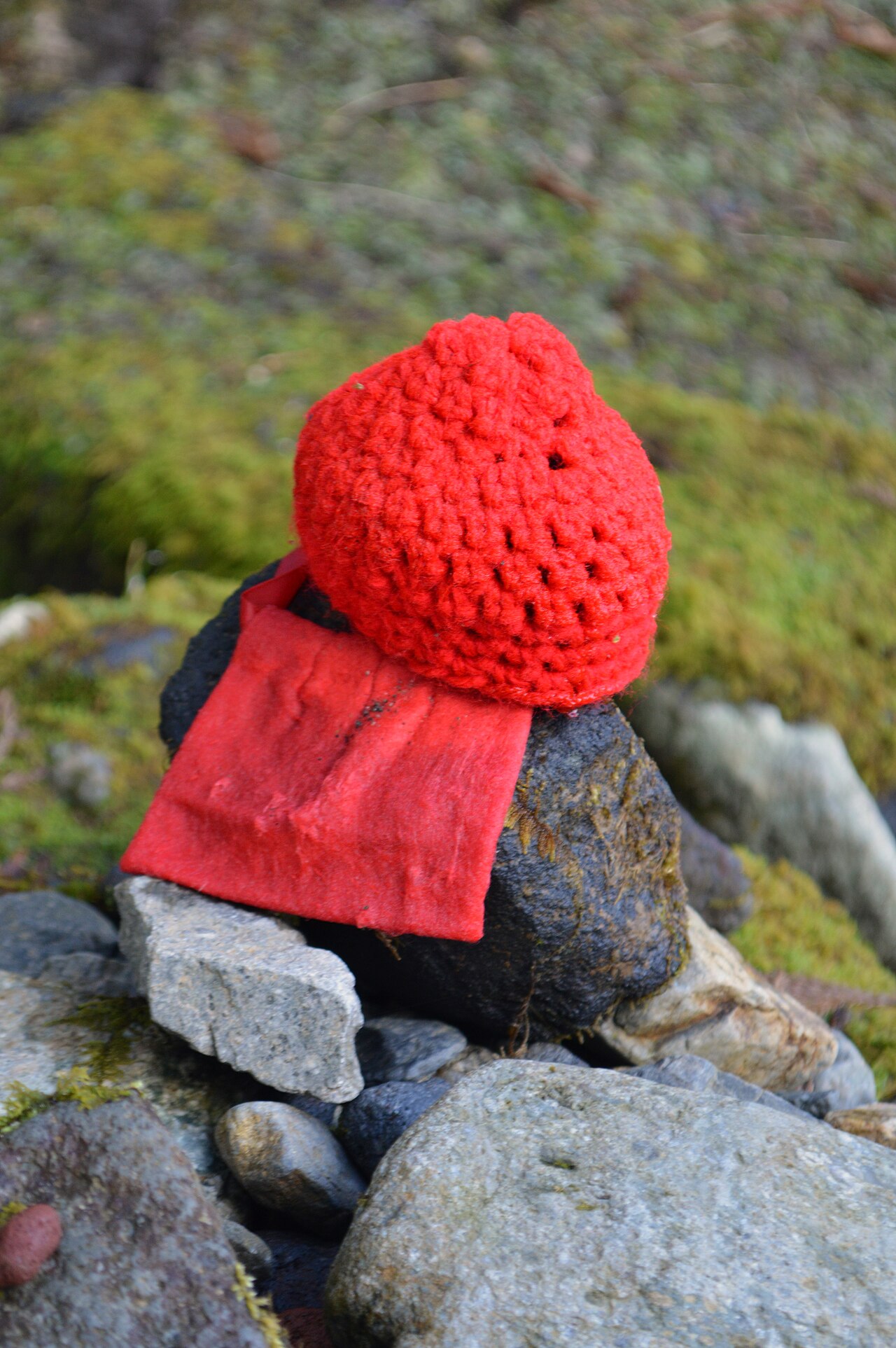
A roadside Jizō dressed in a red cap and bib at the Kanmangafuchi Abyss, Nikkō — a classic example of the offerings worshippers sew or knit by hand. Photo: DimiTalen, public domain (CC0), via Wikimedia Commons.
Meaning
地蔵 (Jizō, formally 地蔵菩薩 Jizō Bosatsu) is a 菩薩 — a being who has reached enlightenment but chooses to remain in the world to help others before entering final 仏hood. In Sanskrit Buddhism he is known as Kṣitigarbha ("Earth Treasury"). Jizō is one of the most beloved figures in Japanese Buddhism precisely because he is so unglamorous: rather than presiding from a golden altar, he is the guardian of travelers, of expectant mothers, of the dead passing through the underworld, and above all of children — living and deceased alike.
Unlike the grand halls of a 寺 or the torii-gated precincts of a 神社, Jizō statues are found in the most mundane places imaginable: at a fork in a country road, tucked into a roadside alcove, lining a cemetery path, or standing quietly at a street corner in the middle of a city. Small, roughly carved, and usually no taller than a person's waist, these 石 statues are so common that most Japanese people barely register them as religious objects at all — they are simply part of the landscape, which is itself the point.
The Red Bib and Cap
The single most recognizable feature of a Jizō statue is the small red 前掛け (bib) tied around its neck and, often, a matching red knitted 帽子 on its head. Red is traditionally believed to ward off illness and evil spirits, especially those threatening children, which is why it was historically used for baby clothing as well.
These bibs and caps are not part of the original statue — they are offerings, usually 手作り (編み物, hand-knitted, or sewn), left by grieving parents, temple visitors, or local well-wishers. A family who has lost a baby to 流産 (miscarriage), 死産 (stillbirth), or 中絶 (abortion) may sew a bib for a Jizō statue as an act of 供養 — a memorial offering and prayer for the child's soul. Others leave toys, pinwheels, coins, or food. Over time the cloth fades and frays in the weather, and a new one is tied on top — so many statues carry layers of bibs from different hands and different years, a visible record of ongoing care rather than a single ritual moment.
地蔵さんに赤い前掛けをかけてあげました。 Jizō-san ni akai maekake o kakete agemashita. "I put a red bib on the Jizō statue [as an offering]."
Mizuko Jizō and the Sai no Kawara Legend
Jizō's most emotionally significant role is as protector of 水子 — literally "water child," a term for a fetus or infant lost before, during, or shortly after birth. Statues dedicated to this purpose, called mizuko Jizō (水子地蔵), are often found in dedicated sections of temple grounds, sometimes numbering in the hundreds, each one representing a specific child mourned by a specific family.
The folk belief behind this practice comes from the legend of 賽の河原 (Sai no Kawara), the dry riverbed at the border between life and the afterlife. According to the story, children who die before their parents — through no fault of their own — cannot cross to the other side and are made to atone by 積む (stacking) small stones into towers, hoping to build a stairway to paradise. Each night, demons come and knock the towers down, and the children must begin again. Jizō, moved by their suffering, hides the children in the sleeves of his robe and protects them from the demons, guiding their souls onward.
This is why visitors to Jizō statues — not only mizuko Jizō but roadside Jizō in general — often stack small stones or pebbles at the statue's base or nearby. The act is simultaneously a prayer for a specific child's passage, general good luck for travelers, and simply a widespread devotional gesture people repeat because it is what is done at a Jizō site.
Jizō as Everyday, Folk Religion
Part of what makes Jizō distinctive is that devotion to him sits outside the more institutional structures of 民間信仰 (folk religion) rather than formal 神社 worship or scheduled temple ritual. Jizō statues are not always maintained by a temple at all — many roadside Jizō are cared for informally by whichever neighborhood or family happens to live nearby, who might sweep the area, replace flowers, or refresh the bib without any priest involved. A single Jizō might be the responsibility of one elderly resident who has looked after it for decades simply because it stands outside her house.
This is a useful contrast with 神道 (Shinto) practice, where a 鳥居 marks a formally bounded shrine precinct and specific festivals govern when and how worship happens. Jizō belongs to a much looser, everyday register of spirituality — you might bow briefly to a roadside Jizō on your morning walk the same way you'd nod to a neighbor, with no special occasion required. He also frequently appears alongside other roadside markers historically tied to safe travel, since one of his oldest roles is 道祖神-adjacent protector of 道端 (roadsides) and crossroads, watching over anyone passing by.
Regional and Seasonal Practices
Some notable Jizō-related customs found around Japan:
| Practice | Description |
|---|---|
| Jizō-bon (地蔵盆) | A festival held in late August, especially in the Kansai region, where neighborhoods clean and decorate local Jizō statues and hold gatherings for children, echoing the ancestor-focused spirit of お盆 (Obon) |
| Sugamo Jizō | The famous "Togenuki Jizō" in Tokyo's Sugamo district, a pilgrimage site especially popular with elderly worshippers seeking health and healing |
| Roku Jizō (六地蔵) | Sets of six Jizō statues placed together, representing protection across the six realms of Buddhist rebirth |
| Kanmangafuchi Abyss | A row of around 70 moss-covered Jizō statues along a gorge in Nikkō, famous for the impossibility of counting them the same way twice |
Cultural Context
Jizō worship in Japan dates back over a thousand years, spreading widely during the medieval period as Buddhism absorbed and blended with local folk beliefs about death, travel, and the protection of the vulnerable. His enduring popularity — especially as mizuko Jizō — grew significantly in the 20th century as changing social attitudes made it more acceptable to publicly grieve pregnancy loss, giving families a concrete, visible way to memorialize a child who was never formally recognized elsewhere.
Because Jizō statues require no priest, no membership, and no formal ritual to approach, they remain one of the most accessible expressions of religious feeling in Japanese daily life — a small stone figure in a red bib, standing quietly at the edge of the road, that anyone can stop for.
Related Dictionary Words
Kshitigarbha (bodhisattva who looks over children, travellers and the underworld); Ksitigarbha; Jizō
bodhisattva; one who has reached enlightenment but vows to save all beings before becoming a buddha
France
koku; traditional unit of volume, approx. 180.4 litres
red; crimson; scarlet
hat; cap
apron (waist-down); waist apron
traveller; traveler; wayfarer; tourist
child; children
aborted fetus (foetus); miscarried fetus; stillborn fetus
memorial service for the dead; holding a service
roadside; wayside
cemetery; graveyard
temple (Buddhist)
Shinto shrine
folk beliefs; folk religion
to pile up; to stack
Children's Limbo
protection; safeguard
soul; spirit; departed soul; ghost
dead person; (the) deceased; (the) dead; casualties
pregnancy; conception; gestation
abortion
miscarriage; (spontaneous) abortion; abortive birth
stillbirth
knitting; knitted material; crochet
handmade; handcrafted; homemade; homegrown