メルカリ
merukariJapan's dominant consumer-to-consumer resale app that turned smartphone photos of used goods into a nationwide, convenience-store-shipped secondhand economy.
Meaning
メルカリ (Mercari) is a smartphone flea-market app, launched in Japan in 2013, that lets ordinary people photograph something they own, list it for sale in a couple of minutes, and ship it to a stranger through the local コンビニ without ever learning the buyer's name or address. The name blends the Latin mercari ("to trade") with the English "market," but in everyday Japanese the word has become a verb-like habit: people say things like 「これメルカリで売ろう」("I'll sell this on Mercari") the way an English speaker might say "I'll eBay it" — except in Japan almost everyone, from teenagers to grandparents, actually does.
Where 中古 (chūko) describes secondhand goods and shops in general, Mercari is specifically the platform and mechanics that made 個人間 (individual-to-individual) trading effortless: fixed prices instead of auctions, one-tap listing, and an escrow system that holds the buyer's money until the item arrives safely.
How It Works
The process is short enough to do while waiting for a train:
- List — Photograph the item, let AI suggest a category and price range, write a short description, and set a price (sellers can also just accept the suggested price).
- Sell — A buyer purchases at the listed price (no bidding); Mercari holds the payment in escrow.
- Ship — The seller prints or shows a QR code and drops the package at a konbini counter, a staffed post office, or one of the automated メルカリポスト lockers that have proliferated outside train stations. Integrated services like ゆうゆうメルカリ便 (a Japan Post partnership) and らくらくメルカリ便 (with Yamato Transport) provide flat-rate shipping by parcel size, calculated automatically from the box dimensions.
- 匿名配送 (anonymous shipping) — Both parties' names and addresses stay hidden; the courier network handles delivery using only the transaction ID, which removed the biggest hesitation people had about trading with strangers online.
- Confirm & release — Once the buyer confirms the item matches the listing, Mercari releases the funds to the seller, minus a 10% 手数料 (handling fee).
Because there is no need to negotiate a meeting place, carry cash, or reveal a home address, the entire loop — 出品 (listing), 発送 (shipping), and payment — can be completed by an average user in minutes, which is the innovation that separates Mercari from older PC-based auction sites like Yahoo! Auctions.
Cultural Context
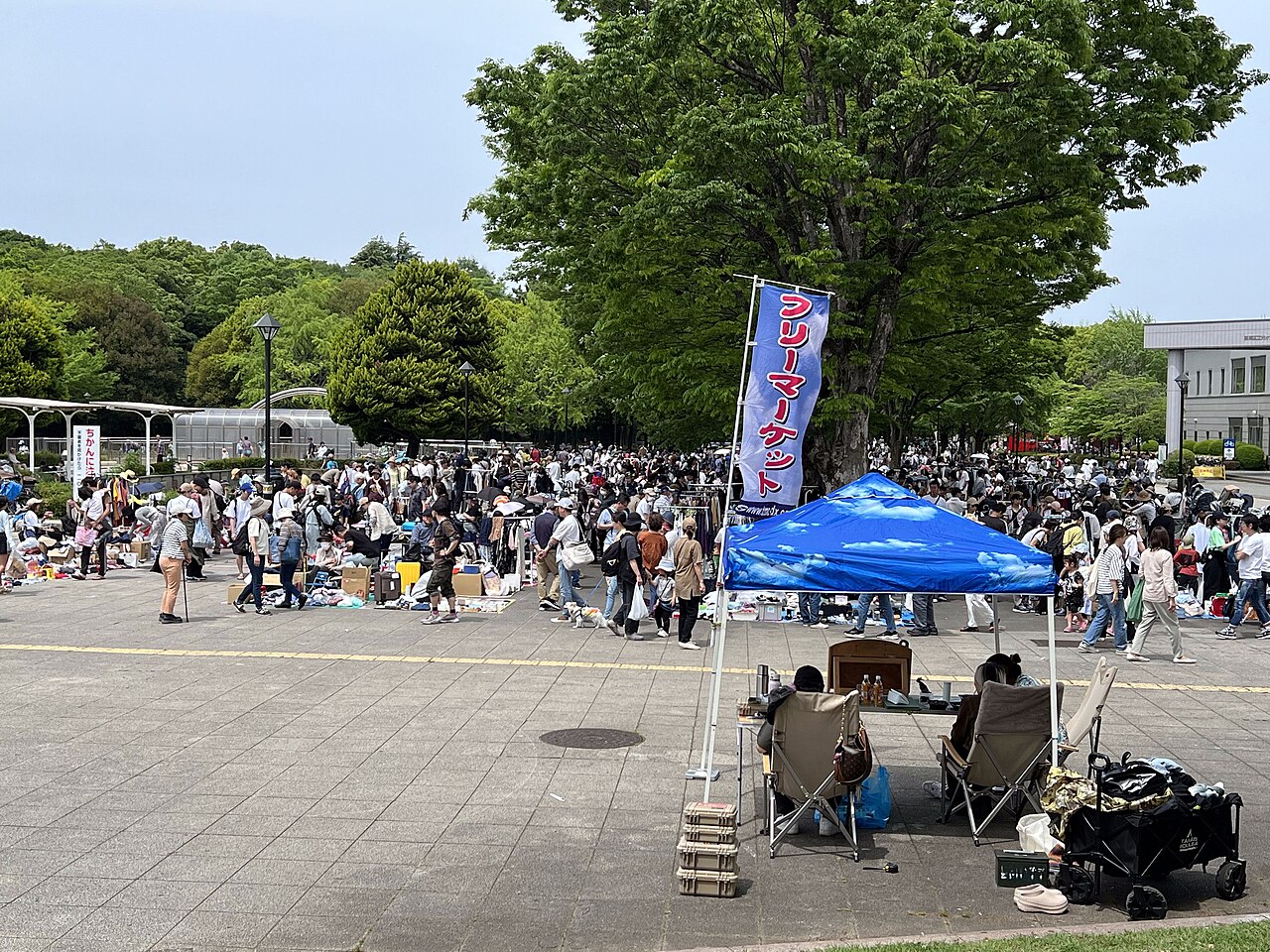
A physical flea market in Hikarigaoka Park, Tokyo — the kind of in-person reuse culture Mercari moved onto smartphones. Photo: Asanagi, public domain (CC0), via Wikimedia Commons.
Mercari's runaway success is often explained less as a tech story and more as a cultural one. Japan already had strong social norms around もったいない (mottainai, "what a waste") — a deep discomfort with discarding something still usable — and around 断捨離 (danshari), the practice of decluttering by discarding, cutting off, and separating from excess possessions, popularized by Hideko Yamashita's 2009 book. Mercari gave those instincts a frictionless outlet: instead of an item sitting in a closet out of guilt, it could become cash within a day.
The app is also deeply woven into practical rhythms of Japanese life:
- Moving season (春の引っ越しシーズン) — Every March–April, when leases turn over, apartments empty out and Mercari listings spike as people sell furniture, appliances, and textbooks before relocating rather than paying disposal fees (many Japanese municipalities charge for large-item garbage collection, giving Mercari a real cost advantage over throwing things away).
- Students — University and high-school students buy and sell used textbooks, uniforms, and club equipment each semester, and Mercari has become the default alternative to campus bulletin boards.
- Parents — Baby clothes and toys, quickly outgrown, cycle through Mercari constantly; it's common for an item to be resold two or three times before it's worn out.
- All ages, not a niche — Unlike Depop or Poshmark in the West, which skew toward younger, fashion-focused resellers, Mercari's user base spans generations; surveys have repeatedly found tens of millions of monthly active users in Japan, making it closer to a basic utility than a subculture.
Because listing something is so easy, Mercari also functions as an informal check on impulse buying — before purchasing something new, many Japanese shoppers first calculate what they could resell an old item for, folding resale value into everyday spending decisions in a way that has no close equivalent in most other retail markets.
Why It's Distinctly Japanese
Secondhand marketplace apps exist worldwide (eBay, Poshmark, Vinted, Depop, Carousell), but a few features make Mercari's dominance particularly Japanese:
| Feature | Mercari (Japan) | Typical Western resale app |
|---|---|---|
| Shipping | Built-in flat-rate courier pickup via konbini/lockers, address never shared | Often seller arranges their own carrier and shares address |
| User base | All ages, mainstream household habit | Skews younger, fashion/streetwear-heavy |
| Trust infrastructure | Leverages Japan's dense konbini network and near-universal courier reliability | Varies by carrier and region |
| Cultural framing | Extension of mottainai / danshari values | Framed more around sustainability or side-income |
Mercari IPO'd on the Tokyo Stock Exchange in 2018 — one of Japan's largest tech listings in years — and has since expanded to the U.S. market and begun a cross-border push into other parts of Asia. But inside Japan, its identity remains closely tied to a simple, everyday sentence: 「いらないものはメルカリで売る」— "if you don't need it, sell it on Mercari" — a habit that has reshaped how an entire country thinks about clutter, waste, and the life of an object after its first owner is done with it.
Related Dictionary Words
used; second-hand; old
exhibiting; showing; putting on display; putting up for sale; entering (a work into a competition); submitting
sending; forwarding; shipping
anonymous shipping
decluttering; clearing out past accumulation; minimalism
moving (dwelling, office, etc.); changing residence
flea market
(handling) fee; charge (e.g. for a cancellation); commission; brokerage
interpersonal; between individuals