僕のヒーローアカデミア
Boku no Hīrō AkademiaMy Hero Academia, Kōhei Horikoshi's manga and anime about a superpowered "Quirk" society and the students training to become professional heroes at U.A. High, became one of the defining shōnen franchises of the 2010s and 2020s before its manga concluded in 2024.
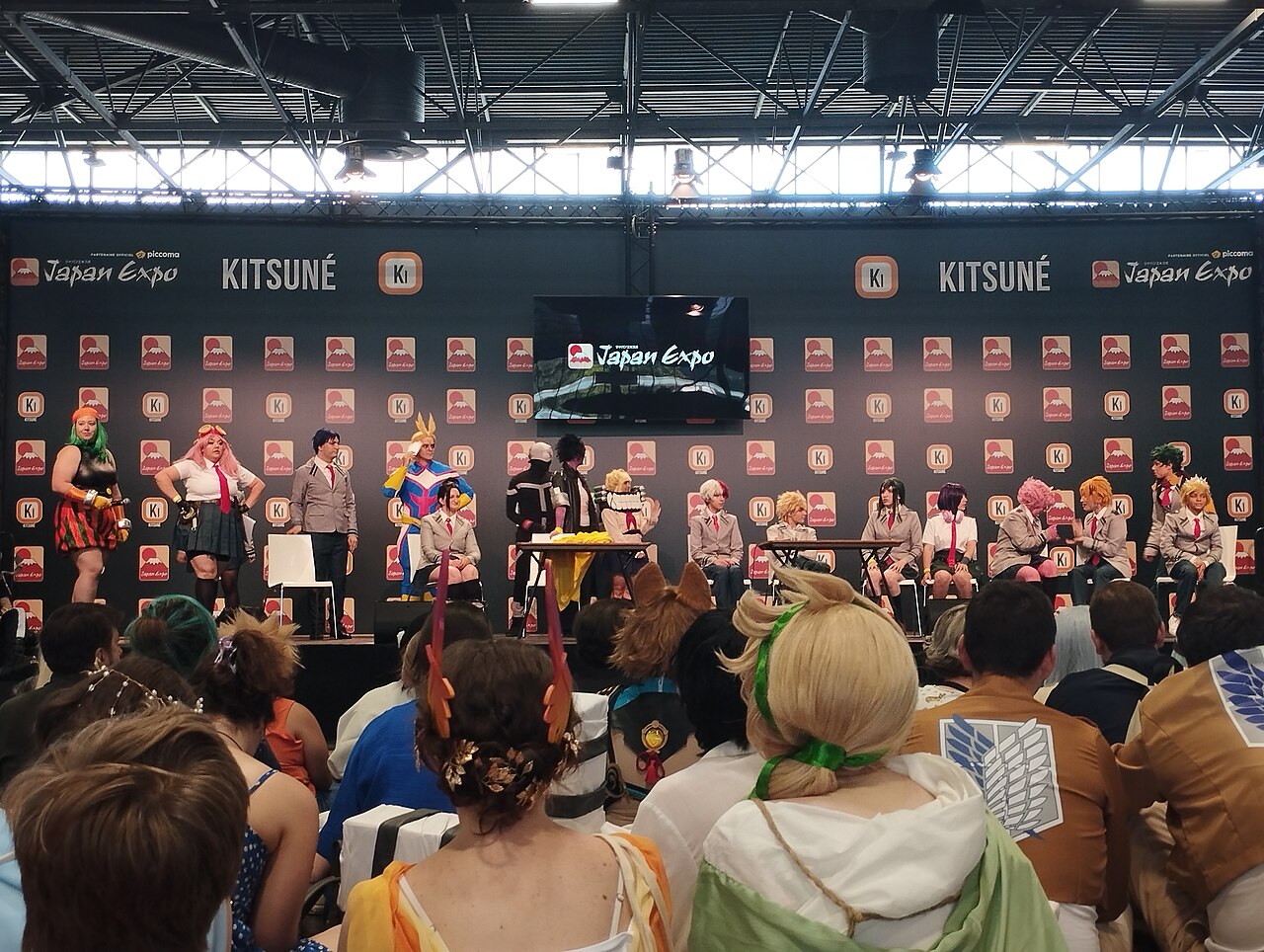
Cosplayers as My Hero Academia characters at Japan Expo, Paris, 2023. Photo: ManoSolo13241324, CC BY-SA 4.0, via Wikimedia Commons — a representative fan photo, not official franchise artwork.
Meaning
僕のヒーローアカデミア (Boku no Hīrō Akademia, "My Hero Academia") is a Japanese 漫画 series written and illustrated by Kōhei Horikoshi, serialized in 集英社's Weekly 少年ジャンプ from July 2014 to August 2024. The story is set in a world where roughly eighty percent of humanity is born with a superpower called a 個性 (kosei) — usually translated as "Quirk" — ranging from minor physical quirks to reality-altering abilities. In this world, being a licensed professional hero is a mainstream, almost celebrity-level career, complete with hero rankings, merchandise, and TV coverage.
The protagonist, Izuku Midoriya (nicknamed Deku), is one of the rare people born 個性-less in a society that treats Quirklessness as a disability. His idolization of the 英雄 (hero) All Might — the setting's greatest hero, whose catchphrase is "Plus Ultra" — leads All Might to secretly pass down his own Quirk, One For All, to Izuku. The manga follows Izuku's enrollment at U.A. High School, an elite institution for training future heroes, alongside classmates like the hot-tempered rival Katsuki Bakugo and the fire-and-ice user Shoto Todoroki, as they train under pressure from a growing villain threat led by the shadowy All For One and his protégé Tomura Shigaraki.
The Quirk System
The series' central conceit — that superpowers are simply a biological trait like eye color, present in the overwhelming majority of the population — is what separates it from Western superhero comics, where powered individuals are typically rare exceptions. My Hero Academia treats Quirks as a normal, regulated part of society:
| Term | Reading | Meaning in-story |
|---|---|---|
| 個性 (kosei) | こせい | "Quirk" — an individual's innate superpower, inherited genetically and usually manifesting around age four |
| 能力 (nōryoku) | のうりょく | General term for "ability" or "power," often used interchangeably with Quirk in casual speech |
| ヒーロー (hīrō) | ヒーロー | "Hero" — a state-licensed professional who uses their Quirk to fight crime and rescue civilians, ranked in public popularity charts |
| 悪役 (akuyaku) | あくやく | "Villain" — an unlicensed Quirk user who commits crimes; the series' antagonist faction calls itself the League of Villains |
| プラス・ウルトラ (Plus Ultra) | プラスウルトラ | All Might's catchphrase, meaning "go beyond" — the unofficial motto of U.A. High and its students |
| 覚悟 (kakugo) | かくご | "Resolve" or "resolve to face hardship" — a recurring theme word for the mental readiness heroism demands |
Because almost everyone has a Quirk, the series can explore heroism as a licensed, bureaucratic profession rather than a lone vigilante's calling — hero agencies, internships, and public approval ratings all factor into the plot much like a corporate career track, which is part of what critics point to as the story's satirical edge on Japan's own conformist, credential-driven 学校 and workplace culture.
Usage
Fans almost universally shorten the title to ヒロアカ (Hiroaka), a contraction of Hīrō Akademia the same way Japanese speakers abbreviate other long compound titles. In English-language fan spaces, "MHA" serves the same purpose.
ヒロアカの最新話、もう読んだ?デクとバクゴーの関係がついに変わったね。 Hiroaka no saishin-wa, mō yonda? Deku to Bakugō no kankei ga tsuini kawatta ne. "Have you read the latest My Hero Academia chapter? Deku and Bakugo's relationship finally changed, huh."
あなたの個性は何ですか? Anata no kosei wa nan desu ka? "What's your Quirk?" — a stock line borrowed as a joke greeting among fans, imitating the show's most repeated question.
Why It Became a Phenomenon
My Hero Academia's rise through the 2010s tracks closely with the broader global anime boom that streaming services helped fuel:
- A superhero framework instantly legible worldwide: by grafting Western-style superheroics — capes, secret identities, rival factions — onto 少年 manga structure (training arcs, tournament arcs, friendship-powered comebacks), the series gave international audiences an easy entry point into anime conventions they might not otherwise recognize.
- All Might and "Plus Ultra": All Might's rise-and-fall arc, and his catchphrase "Plus Ultra," became one of the most quoted and merchandised elements of 2010s shōnen, printed on everything from hoodies to convention banners.
- A deep, popular villain roster: characters like Shigaraki, Dabi, and the League of Villains gave the series morally complex antagonists that drove some of its most-discussed story arcs, particularly the Paranormal Liberation War arc.
- Anime adaptation by Studio Bones: the anime, which began airing in 2016 and ran for seven seasons plus multiple feature films (Two Heroes, Heroes: Rising, World Heroes' Mission, and the finale You're Next), kept the franchise visible in theaters and on streaming well beyond its weekly manga chapters.
- A merchandising and collaboration machine: figure lines, mobile games, theme-park events, and fashion collaborations turned My Hero Academia into a fixture of 秋葉原 storefronts and anime conventions worldwide, with characters like Deku, Bakugo, and All Might among the most cosplayed in modern anime.
Cultural Context: The "New Big Three"
The original "Big Three" of Weekly Shōnen Jump — NARUTO, ワンピース, and Bleach — defined the magazine's global reach through the 2000s. As those series wound down through the 2010s, fans and critics began describing My Hero Academia, together with 鬼滅の刃 (Demon Slayer) and 呪術廻戦 (Jujutsu Kaisen), as a "new Big Three" — three franchises that similarly dominated manga sales charts, anime seasons, and convention floors at once. My Hero Academia is arguably the bridge title of that generation: it began its serialization years before Demon Slayer or Jujutsu Kaisen and helped prove there was still a global audience hungry for a new weekly 少年 mega-hit after Naruto and Bleach ended.
The series has also been read as commentary on Japanese social pressure to conform and to find one's designated place in a hierarchy — Izuku's journey from being told he can never be a hero because he lacks a Quirk speaks to broader anxieties about ability, worth, and belonging that resonate well beyond its comic-book premise. That combination of an accessible superhero hook and a very Japanese anxiety about proving your place in a rigid system is part of why the series found such a wide audience both domestically and abroad.
Conclusion and Continued Relevance
The manga concluded its main story on August 5, 2024 with Chapter 430 (followed by a bonus epilogue chapter in December 2024), after ten years of serialization collected into 42 tankōbon volumes and over 100 million copies in circulation worldwide. Rather than ending the franchise, the conclusion functioned as a handoff: the anime continued adapting the manga's final arcs in subsequent seasons, the finale film My Hero Academia: You're Next released in Japanese theaters in August 2024, and spinoff manga such as Vigilantes and Team-Up Missions kept the setting active. Horikoshi has also teased future projects set in the same universe, following the pattern set by other concluded mega-franchises like Naruto (which continued via Boruto) and Demon Slayer (which continues via films and spinoffs) of a manga's ending marking a transition rather than a full stop for the brand.
My Hero Academia's legacy is now less about ongoing weekly chapters and more about the scale of fandom it built during its run: cosplay of its cast remains a convention staple, its openings and soundtrack (including Kenshi Yonezu's "Peace Sign") are karaoke and アニソン mainstays, and it remains one of the most commonly cited "gateway" anime for viewers who got into the medium during the 2010s streaming boom.
Related Dictionary Words
individuality; personality; quirk; idiosyncrasy; character; individual characteristic
hero; heroine; great person
school
cartoon; comic; comic strip; manga
protagonist; main character; hero; heroine
ability; faculty
villain; baddie; the villain's part
readiness; (mental) preparedness
boy