鬼滅の刃
kimetsu no yaibaDemon Slayer, the record-shattering manga and anime about a boy who becomes a swordsman to cure his demon-turned sister, became the biggest pop-culture phenomenon in modern Japan and a global anime breakout.
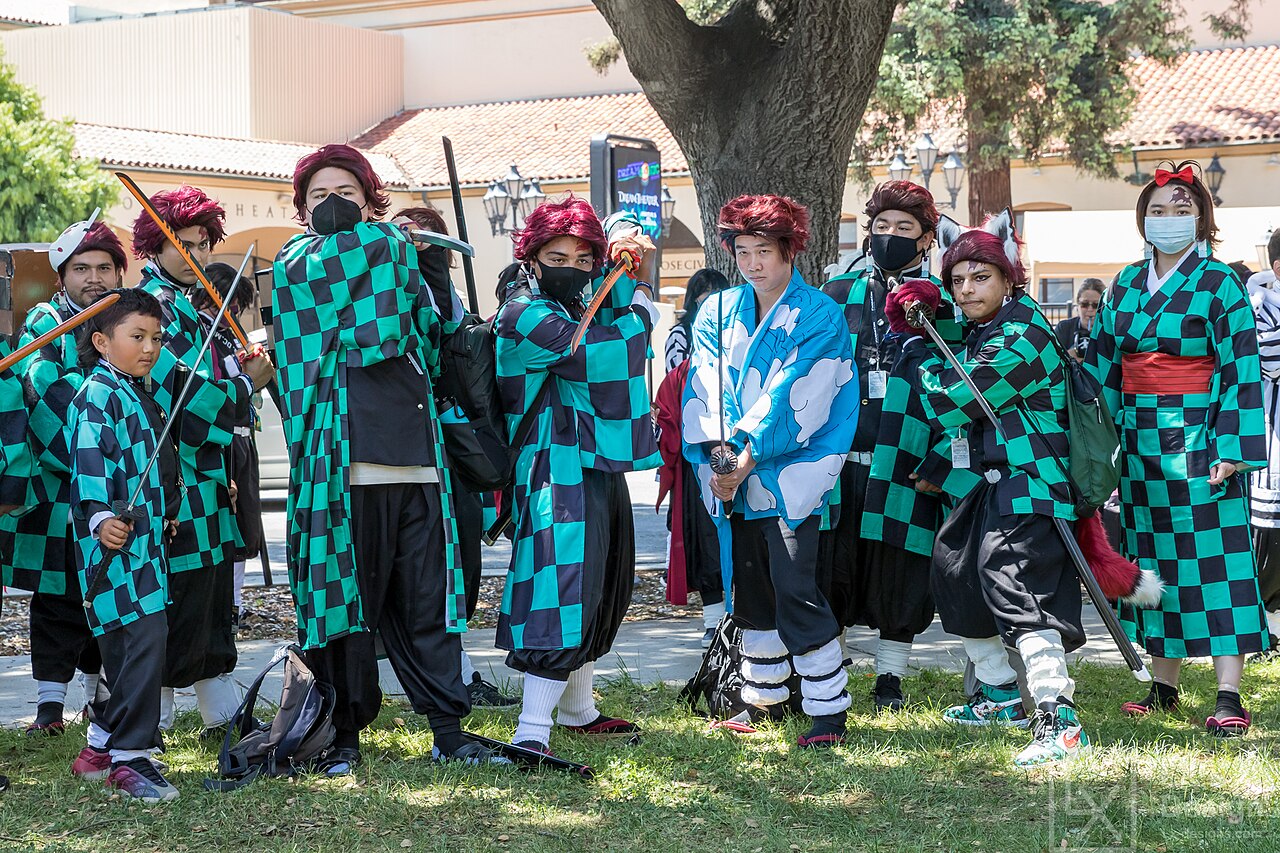
Fans cosplaying as Tanjiro Kamado, instantly recognizable by his green-and-black checkered (市松模様) haori, at FanimeCon 2023. Photo: LX-Designs from SF Bay Area, CA, CC BY-SA 2.0, via Wikimedia Commons — a representative fan photo, not official franchise artwork.
Meaning
鬼滅の刃 (Kimetsu no Yaiba, "Demon Slayer"; literally "blade of demon destruction") is a Japanese 漫画 series written and illustrated by Koyoharu Gotouge, serialized in 集英社's 少年ジャンプ from 2016 to 2020. Its アニメ adaptation by the studio ufotable, and the record-breaking films that followed, turned it into arguably the single biggest Japanese pop-culture phenomenon of the last decade — a story that dominated bookstores, box offices, toy aisles, and コスプレ meet-ups simultaneously, in Japan and far beyond.
The story follows 剣士 Tanjiro Kamado, a gentle charcoal seller whose family is slaughtered by a 鬼 (oni, "demon") — except his younger 妹 Nezuko, who survives but is transformed into a demon herself. Determined to find a cure and avenge his family, Tanjiro joins the Demon Slayer Corps (鬼殺隊, Kisatsutai), a secret organization of swordsmen who hunt demons using 呼吸法 (kokyū-hō, "breathing techniques") and blades forged from sun-infused ore, the only weapon that can kill a demon.
Usage
In everyday Japanese conversation, 鬼滅の刃 is usually shortened to 鬼滅 (Kimetsu), the way English speakers say "Demon Slayer" instead of the full title. During its 2019–2020 peak, the phrase 鬼滅フィーバー ("Kimetsu fever") was used in news coverage to describe the near-total saturation of the franchise across media, retail, and conversation.
今、鬼滅の刃にハマってるんだ。 Ima, Kimetsu no Yaiba ni hamatteru n da. "I'm really into Demon Slayer right now."
鬼滅の映画、もう見た?興行収入がすごいことになってるらしいよ。 Kimetsu no eiga, mō mita? Kōgyō shūnyū ga sugoi koto ni natteru rashii yo. "Have you seen the Demon Slayer movie yet? I heard the box office numbers are insane."
Why It Became a Phenomenon
Demon Slayer didn't start as an obvious hit — early manga volumes sold modestly compared to Shōnen Jump stablemates like One Piece or My Hero Academia. What changed everything was the 2019 anime adaptation. Studio ufotable applied an unusually lavish, film-quality blend of hand-drawn and 3D-assisted animation to weekly television episodes, particularly in fight sequences, at a level of polish rarely seen outside theatrical releases. Word of mouth around the animation quality — especially the Episode 19 fight against the demon Rui — sent manga sales soaring retroactively; volumes that had been sitting on shelves for years sold out nationwide.
That momentum culminated in Demon Slayer: Mugen Train (2020), a theatrical continuation of the story. Released in October 2020, in the middle of the COVID-19 pandemic when Japanese cinemas were desperate for a hit, the film became the highest-grossing movie in Japanese box-office history, and — for a time — the highest-grossing anime film ever released worldwide, surpassing Hayao Miyazaki's Spirited Away, a record that had stood for nearly two decades. The manga itself became one of the best-selling manga series ever, with well over 150 million copies in circulation once the anime-driven sales spike is counted.
Several factors compounded to produce this scale of success:
- Animation as an event: ufotable's approach proved that a weekly TV anime could look and feel like a movie, resetting audience expectations for the medium.
- An emotionally direct story: beneath the swordplay, the core hook — a devoted brother fighting to save his transformed sister, with demons themselves often portrayed sympathetically as former humans — resonated broadly, including with viewers who don't normally follow 少年 manga.
- A hit theme song: the anime's opening theme, "Gurenge" (紅蓮花) performed by LiSA, became a genuine chart phenomenon in its own right, a well-known example of the アニソン tradition of anime songs crossing over into mainstream J-pop charts.
- Pandemic timing: with much of the entertainment industry paused in 2020, Demon Slayer had unusually little competition for public attention at the exact moment its film released.
Stylistic Hallmarks
Breathing Styles (呼吸の型)
Since ordinary humans cannot match a demon's regenerative strength and speed, Demon Slayer Corps members train in 呼吸法 — specialized breathing techniques, most famously 全集中の呼吸 ("Total Concentration Breathing"), that flood the body with oxygen to grant superhuman strength, speed, and reflexes. Each swordsman specializes in a breathing "style" tied to a natural element — Water, Flame, Thunder, Stone, Wind, Insect, and more — a distinctly Japanese fantasy-martial-arts framework that lets every character have a visually and thematically distinct fighting style. The strongest of these swordsmen hold the rank of 柱 (Hashira, "Pillar"), the organization's elite guard.
Character-Defining Patterns
The series is instantly recognizable by the traditional Japanese textile patterns assigned to its cast — a deliberate design choice that ties each character to real Edo-period kimono motifs. Tanjiro's 羽織 (haori jacket) uses the green-and-black checkerboard 市松模様 (ichimatsu moyou), a pattern named after the Edo-period kabuki actor Sanogawa Ichimatsu, who is said to have popularized it centuries earlier. Nezuko wears a pink-and-white 麻の葉 (asanoha, "hemp leaf") pattern kimono; Zenitsu's haori carries a yellow triangular "thunder" motif; Inosuke's uses a blue-and-white fish-scale pattern. These choices sparked a genuine boom in interest around traditional Japanese patterns among younger fans, who began seeking out ichimatsu-patterned goods — from face masks to phone cases to actual kimono fabric — well beyond the anime-merchandise aisle.
Cultural Context
Demon Slayer's demon-hunting premise draws on a much older well of Japanese folklore: 鬼 (oni) have been villains of myth and folktale for over a thousand years, cousins of the broader supernatural tradition covered in this wiki's 妖怪 article, though oni are usually depicted as more overtly monstrous and malevolent than the wider yōkai category. Framing the story as a boy protecting his demon sister — rather than simply exterminating monsters — gave a very old folkloric antagonist unusually sympathetic, human-scaled stakes, which is part of why the series resonated with audiences who don't normally engage with 少年 action manga at all.
The series also sits squarely inside the broader fan ecosystems already documented on this site. Its explosive popularity supercharged 同人 (fan-made) output at コミケット events, made its 声優 — including Natsuki Hanae (Tanjiro) and Akari Kitō (Nezuko) — into major public figures, and pushed its theme songs deep into アニソン culture. Unlike the 異世界 genre that dominates much of current Shōnen fantasy, or the special-effects tradition of 特撮, Demon Slayer is a more classical shōnen adventure — sword-fighting siblings, a rigid dōjō-style training arc, and a clear villain hierarchy — executed with a level of production polish that reset audience expectations across the whole industry.
Its reach extended well beyond otaku circles into everyday Japanese life: convenience-store tie-in snacks, department-store pop-ups, a themed attraction at Universal Studios Japan, and even a JR Kyushu commemorative steam-locomotive livery all carried Demon Slayer branding during the peak of "Kimetsu fever." Internationally, the anime and Mugen Train film introduced a huge new audience to modern Japanese animation, cited by many Western fans alongside Attack on Titan and My Hero Academia as their entry point into anime fandom in the early 2020s.
Legacy
The main manga concluded in 2020 after 23 collected volumes, but the anime and film franchise continued well past that, adapting later story arcs (Entertainment District, Swordsmith Village, Hashira Training) as subsequent television and film seasons through the mid-2020s, keeping the franchise a fixture of anime conventions, merchandise shelves, and streaming charts years after its original manga run ended. It remains a standard reference point whenever the industry discusses what a modern anime hit can look like commercially.
Related Dictionary Words
Demon Slayer: Kimetsu no Yaiba (manga, anime)
ogre; demon; oni
edge (of a knife or sword); blade
breathing; respiration
breathing techniques; breath control
pillar; post
haori (Japanese formal coat)
checked pattern; chequered pattern; checks; checkers; chequers
cartoon; comic; comic strip; manga
animation; animated film; animated cartoon; anime
movie; film; motion picture
box-office takings; box-office revenue
chasing out ogres; exterminating ogres
swordsman; swordswoman; fencer
younger sister
Shueisha (publisher)
Shōnen Jump (weekly magazine)
standalone book (i.e. not part of an anthology, series, etc.); (book published as a) single volume
serialization; serialisation; serial story
circulation (of a newspaper, magazine, etc.); number of copies sold