ニトリ
nitoriNitori (ニトリ) is Japan's largest home furnishings chain, famous for cheap, well-designed furniture and household goods sold under the slogan "Oh, more than the price" — often called the IKEA of Japan.
Meaning
ニトリ (Nitori) is the trading name of Nitori Holdings Co., Ltd. (株式会社ニトリホールディングス), Japan's largest 家具 (furniture) and home goods retailer. The name comes directly from its founder, Akio Nitori (似鳥昭雄), whose surname 似鳥 is written with different kanji but pronounced the same way; the company itself is written only in katakana, ニトリ, giving it a clean, brand-like look on storefronts and packaging.
Stores are almost always full-size warehouse-format outlets — typically two floors, with furniture showrooms upstairs and smaller housewares, 布団 (futon/bedding), カーテン (curtains), kitchenware, and seasonal goods downstairs — plus a large parking lot, since most Japanese customers drive out to a suburban Nitori to buy anything bulky. The company also runs smaller, インテリア (interior)-focused urban formats called Nitori Deco Home for shoppers without a car.
Usage
In everyday conversation, Nitori functions as a normal shopping destination noun, much like Muji or Uniqlo:
週末、ニトリで家具を見てくる。 Shuumatsu, Nitori de kagu o mite kuru. "I'm going to check out furniture at Nitori this weekend."
一人暮らしを始めるから、ニトリで収納グッズを買い揃えた。 Hitorigurashi o hajimeru kara, Nitori de shuunou guzzu o kaisoroeta. "Since I'm starting to live alone, I stocked up on storage items at Nitori."
The brand is closely tied to a few big life moments in Japan: moving into a first apartment, furnishing a new house, preparing a dorm room for university, or doing an autumn/spring 節約 (budget-conscious) household refresh. "Let's just get it at Nitori" is a common, slightly self-deprecating way of saying something is functional and affordable rather than a splurge.
Cultural Context
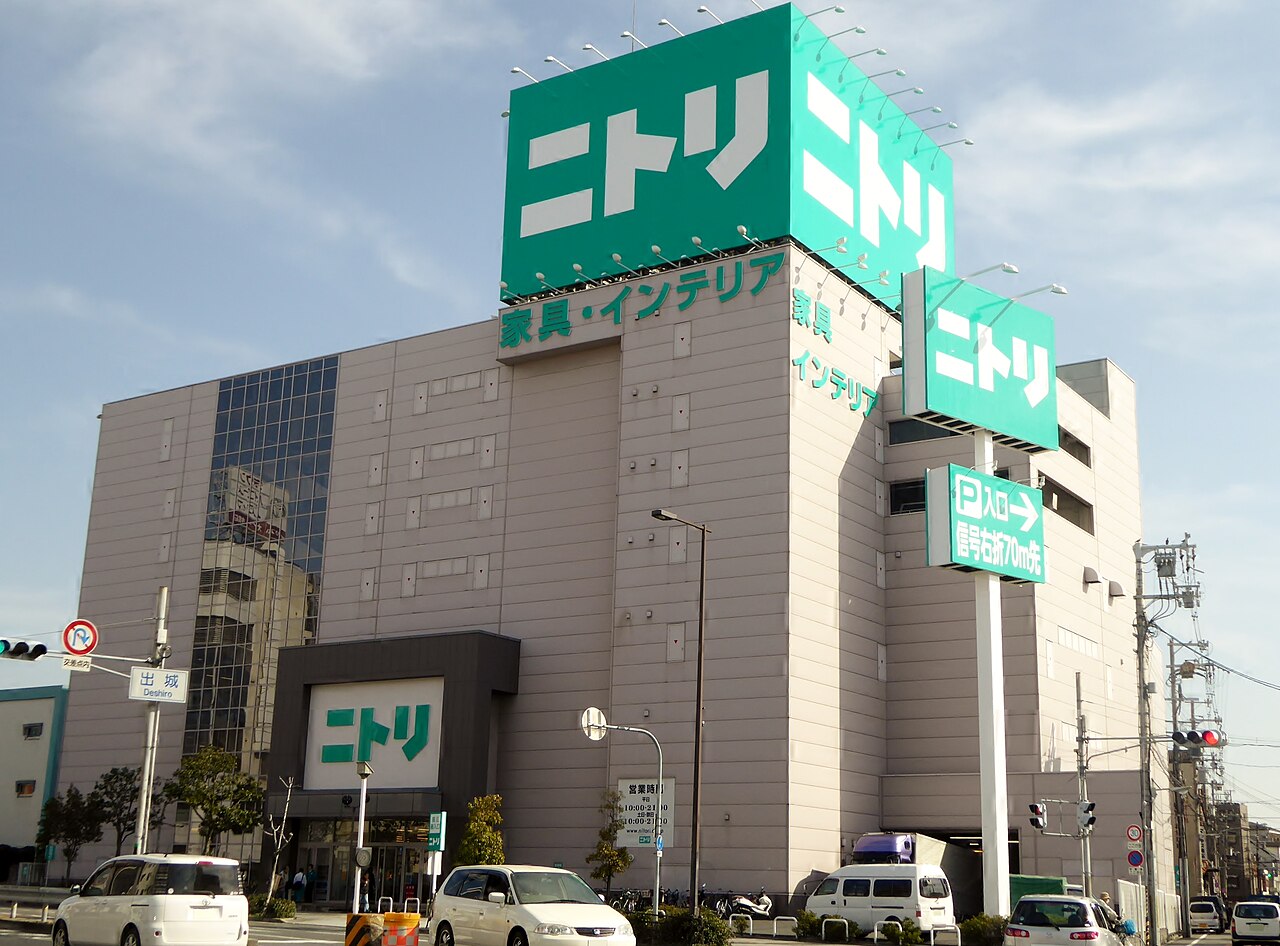
A Nitori store in Nishinari-ku, Osaka — the company's warehouse-format layout, with a large attached parking lot, is typical of its roughly 800 domestic locations. Photo: Tokumeigakarinoaoshima, public domain (CC0), via Wikimedia Commons.
From a two-person shop to a national chain
Nitori traces back to 1967, when Akio Nitori opened a small furniture shop, Nitori Kagu Ten (似鳥家具店), in Sapporo, Hokkaido, with his mother as the only other employee. Early sales were poor — by his own account the business nearly failed multiple times — until a 1972 trip to the United States exposed him to American-style big-box retail and supply-chain efficiency. He returned determined to build a Japanese furniture chain that could sell good design at prices ordinary households could actually afford, rather than furniture as an occasional, expensive purchase. The company incorporated as Nitori Co., Ltd. in 1972, went public in 1989, and steadily expanded from a regional Hokkaido chain into a nationwide one through the 1990s and 2000s, eventually overtaking older department-store furniture floors as most Japanese consumers' default source for home goods.
Vertical integration is the whole strategy
Unlike most furniture retailers, which buy from wholesalers, Nitori controls nearly its entire supply chain in-house: it designs its own products, manufactures many of them in its own factories (heavily concentrated in Vietnam, Indonesia, and China), ships them through its own logistics network, and sells them exclusively in its own stores — a model the company calls its "Manufacturing SPA" (製造物流IT小売業, roughly "manufacturing-logistics-IT retail"). Cutting out wholesalers and importers at every stage is how Nitori keeps prices low without sourcing from other companies' factories, and it is the direct reason the chain could deliver same-store 価格 cuts for over 30 consecutive years even as raw material and shipping costs rose.
"Oh, more than the price."
Nitori's advertising slogan, お、ねだん以上。ニトリ ("O, nedan ijou. Nitori" — "Oh, more than the price. Nitori"), has run in television commercials since 2000 and is one of the most recognized retail jingles in Japan. The phrase promises that the 品質 (quality) or design of the product exceeds what its low 値段 (price) would suggest — reassurance aimed directly at shoppers wary that "cheap" furniture also means "cheap-looking" or "flimsy." The jingle is catchy enough that Japanese people who have never set foot in a Nitori store can usually still sing the tag line.
The "IKEA of Japan" — and the actual rival to IKEA
Nitori is routinely described in English-language coverage as "the IKEA of Japan," and the comparison is apt in spirit — both chains built empires on affordable, mass-manufactured furniture for young households — but the two companies compete directly rather than occupying separate markets. IKEA entered Japan in 2006, and Nitori has treated it as a benchmark competitor ever since, positioning itself as offering comparable or better prices without requiring home assembly for most items, and without IKEA's Scandinavian-only aesthetic. Nitori's product range is also considerably broader day-to-day, extending well past furniture into bedding, kitchenware, curtains, home appliances, and even groceries at some larger stores, making it closer to a one-stop 大型店 (big-box store) for 生活 (daily life) needs than a furniture specialist.
Part of Japan's suburban retail landscape
Nitori belongs to the same generation of large-format Japanese retail chains as Tokyu Hands and Loft for home goods, or Don Quijote for variety retail — but where those chains lean into curated selection or bargain-bin chaos, Nitori is defined by predictable, orderly aisles and consistent low pricing across roughly 800 stores in Japan, plus locations across Asia and a growing footprint in North America. Alongside Muji's minimalist, unbranded aesthetic and Uniqlo's fast fashion, Nitori completes a trio of Japanese retail giants built on the same underlying idea: mass-produce a broad, well-designed catalog in-house, strip out middlemen, and sell it at a price nobody needs to think twice about.
Related Terms
| Term | Reading | Meaning |
|---|---|---|
| 家具 | かぐ | furniture |
| 収納 | しゅうのう | storage |
| 値段 | ねだん | price |
| 品質 | ひんしつ | quality |
| 大型店 | おおがたてん | large-format store, big-box store |
| お、ねだん以上。 | お、ねだんいじょう。 | "Oh, more than the price" (Nitori's slogan) |
Related Dictionary Words
furniture
storage; putting away
price; cost
quality (of a product or a service)
large store; large-scale store
futon; Japanese bedding consisting of a mattress and a duvet
curtain; curtains
interior (of building, room, vehicle, etc.)
price; value; cost
life; living
economising; saving