ユニクロ
yunikuroJapan's globally dominant casual clothing chain, owned by Fast Retailing, known for affordable basics, technical fabrics like HeatTech, and its "LifeWear" philosophy of simple, functional design for everyone.
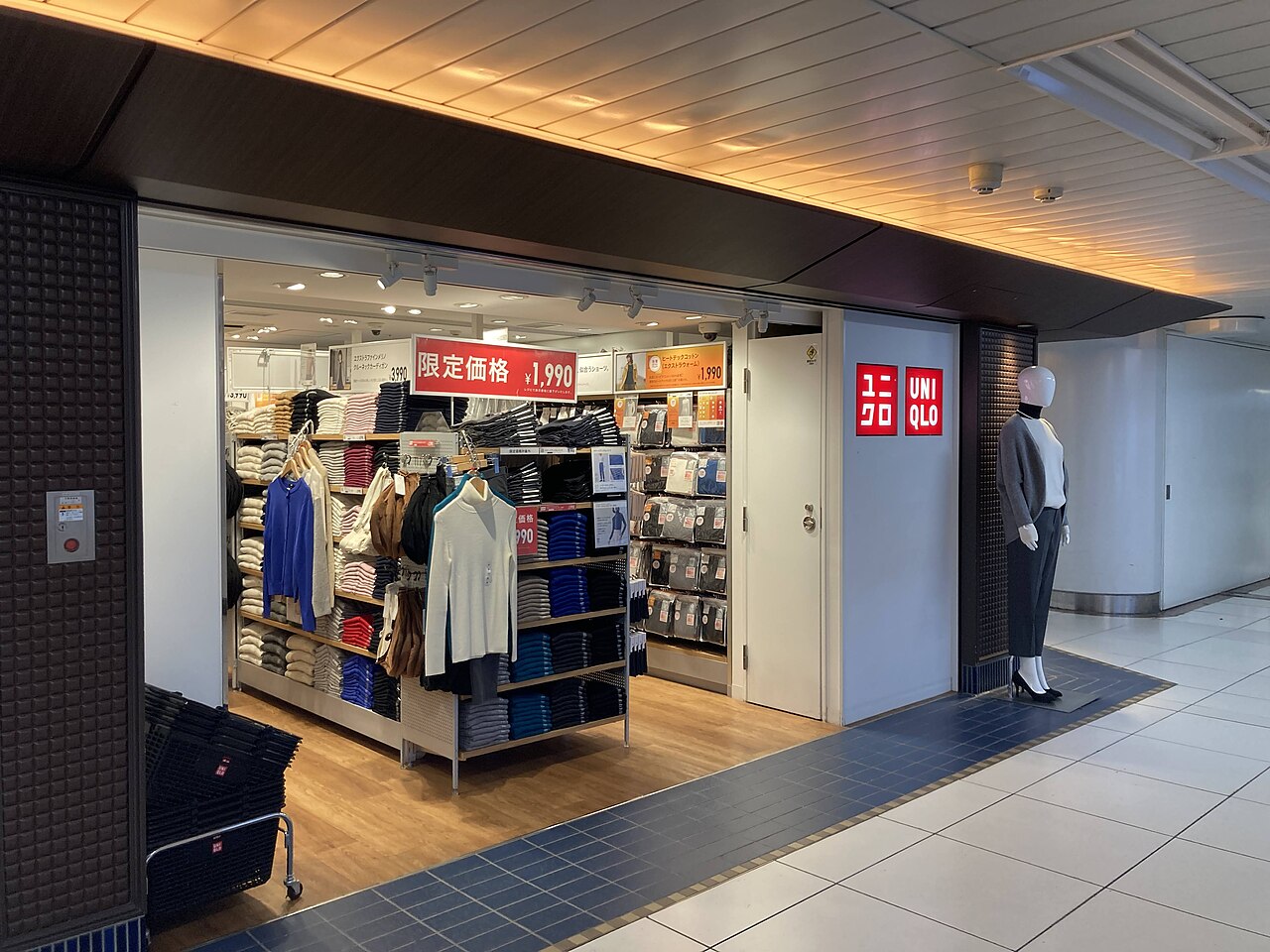
A Uniqlo storefront inside Tokyo Station. Photo: Nick-D, CC BY-SA 4.0, via Wikimedia Commons.
Meaning
ユニクロ (Uniqlo) is Japan's largest casual clothing retailer and one of the largest apparel companies in the world. It is the flagship brand of Fast Retailing Co., Ltd., the company founded and still led by chairman and CEO Tadashi Yanai (柳井正, Yanai Tadashi). Rather than chasing seasonal trends, Uniqlo sells simple, high-quality 服 (fuku, "clothes") — T-shirts, jeans, sweaters, outerwear, and innerwear — designed to be worn as everyday building blocks rather than fashion statements in themselves.
The name is a shortened, Japanized rendering of "Unique Clothing Warehouse," the English name under which the first stores opened. An early trademark filing famously misspelled "Unique" as "Uniqlo" with a C instead of a Q, and the company kept the accidental spelling because it looked cleaner as a logo.
Usage
In everyday conversation, ユニクロ functions like any brand name — as a place to shop, a style of dressing, or shorthand for reliable basics.
今日の服、全部ユニクロなんだ。 Kyou no fuku, zenbu Yunikuro nan da. "My whole outfit today is Uniqlo."
ヒートテック着てるから、そんなに寒くないよ。 Hiitotekku kiteru kara, sonna ni samukunai yo. "I'm wearing HeatTech, so I'm not that cold."
Because Uniqlo clothing is inexpensive, well-made, and nearly ubiquitous, Japanese speakers sometimes use ユニクロ almost as an adjective for something plain, practical, and inoffensive — the sartorial equivalent of a default setting. It can be said with genuine appreciation (reliable 品質, quality, at a fair price) or with light self-deprecation ("I didn't try very hard today, I'm just in Uniqlo").
Cultural Context
From a single Ube storefront to a global chain
Tadashi Yanai took over his father's small men's tailor shop in Ube, Yamaguchi Prefecture, in 1972, and opened the first Unique Clothing Warehouse store in Hiroshima in 1984 — a self-service, warehouse-style shop selling casual clothing at low prices, a novel concept in Japan at the time. The company (renamed Fast Retailing in 1991) expanded nationwide through the 1990s, and a nationwide fleece boom in 1998–99 — cheap, colorful fleece jackets that became a genuine social phenomenon, selling tens of millions of units — turned Uniqlo from a regional discount chain into a household name across Japan.
From there Uniqlo expanded overseas: London (2001), China (2002), the United States (2005, with a flagship in New York's SoHo), and steadily into Europe, Southeast Asia, and beyond. Fast Retailing is now consistently ranked among the largest clothing retailers on Earth by revenue, competing directly with Zara (Inditex) and H&M, and Yanai has for years been one of Japan's wealthiest people.
The "LifeWear" philosophy
Uniqlo's guiding concept, articulated explicitly since the 2010s, is LifeWear: clothing designed to be simple, high-機能性 (kinousei, "functionality"), and universal, rather than tied to any particular season, trend, gender, or subculture. The idea echoes Japanese design sensibilities like wabi-sabi that favor understated utility over ornamentation — clothes that quietly improve daily life rather than clothes meant to be noticed. Uniqlo describes this as clothing that is "not fashion," a deliberate contrast to trend-driven fast fashion competitors.
This philosophy shapes the product line directly: rather than dozens of micro-trend collections per year, Uniqlo focuses on refining a relatively stable core catalog — perfecting the 綿 (wata, "cotton") T-shirt, the down jacket, 下着 (shitagi, "underwear") — season after season, investing heavily in fabric research through 提携 (teikei, "partnerships") with material science companies.
Signature product lines
| Line | What it is |
|---|---|
| HeatTech (ヒートテック) | Thin, moisture-wicking 発熱 (hatsunetsu, "heat-generating") innerwear developed with Toray Industries, launched 2003; a winter wardrobe staple across Japan |
| AIRism (エアリズム) | Breathable, quick-drying innerwear designed for hot, humid summers |
| UNIQLO U | A higher-design ready-to-wear line developed with French designer Christophe Lemaire and his studio, blending Uniqlo's basics philosophy with runway-level tailoring |
| Ultra Light Down | Compressible, lightweight down jackets that helped normalize down outerwear as an everyday item rather than technical mountain gear |
| +J | A revived collaboration line with Jil Sander, first running 2009–2011 and returning in 2020, pairing minimalist high fashion with Uniqlo's mass-market pricing |
Designer and artist collaborations
Alongside in-house lines, Uniqlo has built a long track record of collaborations that briefly turn its basics into collectibles: fashion partnerships with Jil Sander (+J) and Christophe Lemaire (UNIQLO U), and the long-running UT graphic T-shirt line, which has featured art, anime, and pop-culture partners from Studio Ghibli and Pokémon to Keith Haring, KAWS, Andy Warhol, and various musicians. UT drops periodically generate queues and resale markets not unlike sneaker culture, one of the few places Uniqlo leans into hype and limited-time exclusivity rather than its usual everyday-basics model.
Economic and social significance
In Japan, Uniqlo is often discussed as a case study in successful 経営 (keiei, "management"): a company that scaled a discount, self-service retail model into a global fashion and technology-driven manufacturer without abandoning its low-price promise. It sources manufacturing heavily from partner factories in China, Vietnam, Bangladesh, and Indonesia, and has faced periodic scrutiny over labor conditions in its supply chain, alongside praise for pairing large-scale 大量生産 (tairyou seisan, "mass production") with genuine fabric R&D that smaller competitors can't match.
Domestically, Uniqlo 店舗 (tenpo, "stores") are near-universal — in nearly every train station shopping complex, suburban roadside mall, and city center — occupying a retail niche alongside コンビニ convenience stores and 百円ショップ hundred-yen shops as one of the default, unremarkable-but-essential parts of Japanese daily commerce, in contrast to discount-and-novelty chains like ドン・キホーテ. Where Donki sells surprise and excess, Uniqlo sells reliability and restraint — two very different but equally central pillars of how ordinary Japanese people shop.
Related Concepts
- ファストファッション (fast fashion) — the broader industry category Uniqlo is often placed in alongside Zara and H&M, though Uniqlo's LifeWear messaging explicitly pushes back against being lumped in with trend-cycle fast fashion
- GU (ジーユー) — Fast Retailing's separate, even-cheaper, more trend-forward sister brand, aimed at a younger and more fashion-experimental customer than Uniqlo itself
- アメカジ — a different, Americana-inspired strand of Japanese casual style, useful for contrast with Uniqlo's minimalist basics
Related Dictionary Words
clothes (esp. Western clothes); clothing; dress; costume; suit; outfit
clothes; clothing; garments
design
company; corporation; firm
shop; store; establishment; restaurant
quality (of a product or a service)
functionality
cotton
underwear; undergarment; underclothes; lingerie
generation of heat
cooperation; tie-up; joint business; partnership; alliance; sponsorship
management; administration; operation; running (a business); conducting
mass production