チームラボ
chiimu raboA Tokyo-based interdisciplinary art collective of programmers, engineers, and artists that creates immersive, technology-driven digital art installations like teamLab Borderless and teamLab Planets, blending computer science with traditional Japanese aesthetics.
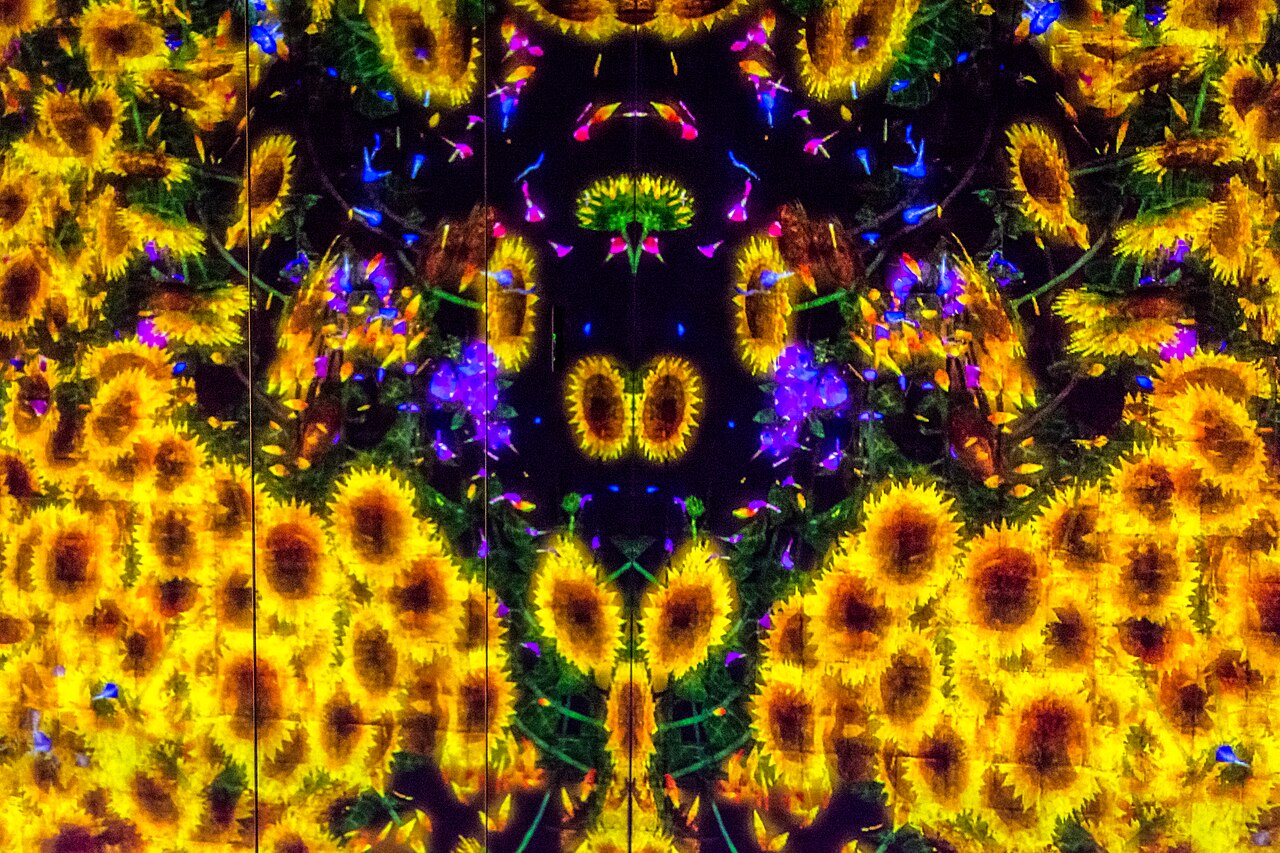
teamLab Borderless, Odaiba, Tokyo. Photo: Domenico Convertini, CC BY-SA 2.0, via Wikimedia Commons.
Meaning
teamLab (チームラボ, chiimu rabo) is a Tokyo-based 集団 (shuudan, "collective" or "group") of several hundred artists, programmers, engineers, CG animators, mathematicians, and architects who work together as a single, unsigned creative entity. Rather than one artist claiming authorship, every teamLab work is credited to the collective as a whole — a deliberate rejection of the Western idea of the solitary genius-artist.
teamLab calls itself an "ultratechnologist group," and its output blurs the line between 芸術 (geijutsu, "art"), science, technology, and design. Its best-known works are large-scale, 没入 (botsunyuu, "immersive") digital installations: darkened rooms filled with projected 光 (hikari, "light"), animated flowers, flocks of digital birds, and rolling waves of color that respond in real time to visitors' movement. Walking through a teamLab exhibit means becoming part of the 作品 (sakuhin, "artwork") itself — the crowd is not merely observing the piece but continuously reshaping it.
Usage
In everyday Japanese and English conversation, "teamLab" functions almost like a brand name for a category of experience as much as a specific company:
チームラボボーダレスに行ってきたよ。花の部屋がすごく綺麗だった。 Chiimu rabo Boodaresu ni itte kita yo. Hana no heya ga sugoku kirei datta. "I went to teamLab Borderless. The flower room was so beautiful."
週末は友達とチームラボプラネッツで水の中を歩いた。 Shuumatsu wa tomodachi to Chiimu rabo Puranettsu de mizu no naka o aruita. "On the weekend I walked through the water at teamLab Planets with a friend."
Travel guides and social media posts routinely shorten a visit to just "teamLab" (e.g., "we're doing teamLab tomorrow"), treating the name as shorthand for a whole category of interactive light-and-water art museums, even though teamLab itself runs several distinctly named venues.
Cultural Context
Origins as a student project
teamLab began in 1998 when Toshiyuki Inoko and fellow students at the University of Tokyo's Faculty of Engineering started building interactive digital projects together; the group was formally incorporated as a company in Tokyo in 2001. From the start it deliberately mixed disciplines that are usually kept separate in Japan's education and labor systems — coders sat alongside painters, mathematicians alongside architects — under the belief that the boundaries between art, science, and technology are artificial and that digital tools could dissolve them. This philosophy gave the group its signature English name for its flagship museum, teamLab Borderless.
An aesthetic rooted in Japanese tradition
While the tools are cutting-edge (real-time rendering, motion sensors, custom software), the visual language teamLab draws on is deeply Japanese. Its recurring motifs — cherry blossoms, crows, waterfalls, calligraphy-like brushstrokes of light — echo ukiyo-e woodblock prints and the flat, borderless picture-plane of traditional Japanese painting (where a scene continues beyond the edge of the frame rather than being fixed inside a Western-style vanishing-point perspective). teamLab has explicitly discussed how concepts like ma (間, the meaningful use of empty space) and the flower-arranging discipline of 生け花 (ikebana) inform how its digital gardens are composed. The result is often described as connecting a very old idea in Japanese art — that nature, art, and the viewer's own body are not separate things — with 21st-century computing.
Notable venues and works
| Work / Venue | Location | Notes |
|---|---|---|
| teamLab Borderless | Odaiba, Tokyo (2018–2022); reopened at Azabudai Hills (2024–) | Flagship "museum without a map": rooms have no fixed boundaries and artworks move between spaces and interact with each other |
| teamLab Planets | Toyosu, Tokyo (2018–) | Visitors walk barefoot through ankle-deep water and a garden of orchids projected with light |
| teamLab SuperNature / Continuous | Abu Dhabi, Jeddah, and other international sites | Permanent large-format venues outside Japan |
| Digitized Nature projects | Various locations in Japan (e.g., forests, hot springs) | Site-specific installations that layer digital light onto real natural landscapes rather than indoor galleries |
teamLab Borderless in Odaiba was certified by Guinness World Records in 2021 as the world's most-visited museum dedicated to a single art group, drawing over 2.3 million visitors in a single year before it closed and relocated to the Azabudai Hills complex in central Tokyo in February 2024. teamLab Planets subsequently set its own Guinness record. Together, teamLab's two Tokyo museums now draw several million visitors annually, a large majority of them international tourists — making the collective one of the most visited single art phenomena in the world and a fixture on "must-see Tokyo" lists alongside historic temples and shrines.
Cultural and tourism significance
teamLab's rise coincided with the smartphone-and-social-media era, and its saturated, photogenic rooms were built almost perfectly for Instagram — a factor widely credited with accelerating its popularity abroad even faster than in Japan itself. This has made teamLab a case study in how デジタル art can function simultaneously as fine art, popular entertainment, and tourism infrastructure. Domestically, it is often discussed alongside contemporary artists like Yayoi Kusama and Takashi Murakami as part of Japan's broader late-20th/21st-century export of art that is both conceptually serious and immediately accessible to a mass, non-specialist audience — though unlike those artists, teamLab insists it has no single creative "star" and credits every work to the group alone.
Related Terms
- チームラボボーダレス (Chiimu rabo Boodaresu) — teamLab Borderless, the flagship immersive museum
- チームラボプラネッツ (Chiimu rabo Puranettsu) — teamLab Planets, the water-and-garden museum in Toyosu
- ウルトラテクノロジスト集団 (urutora tekunorojisuto shuudan) — "ultratechnologist group," teamLab's own self-description
- デジタルアート (dejitaru aato) — digital art, the broader category teamLab is credited with popularizing on a mass scale in Japan