アニメイト
animeitoJapan's largest anime, manga, and otaku goods retail chain, and a pilgrimage destination for fans centered on its flagship Ikebukuro store.
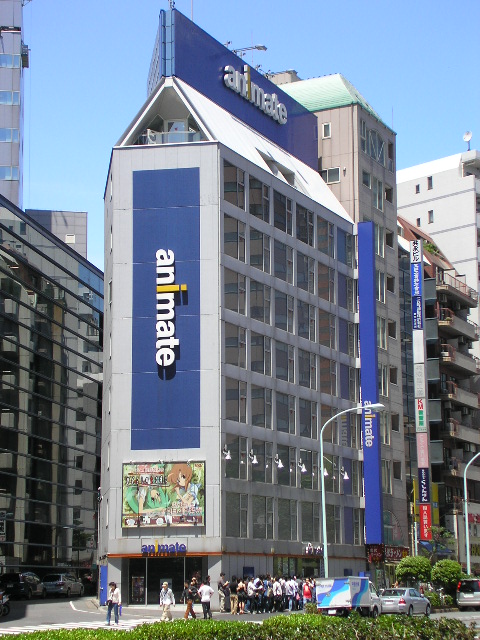
Animate's Ikebukuro main store. Photo: Itasan, CC BY-SA 3.0, via Wikimedia Commons.
Meaning
Animate (アニメイト, Animeito) is Japan's largest retail chain dedicated to anime, manga, games, and related merchandise. With roughly 140 店舗 across Japan and outposts overseas, it functions less like an ordinary shop and more like an infrastructure layer for otaku culture — the place fans go to buy the newest manga volume, pre-order a limited edition Blu-ray, pick up a フィギュア, enter a lottery for 声優 event tickets, and browse 同人誌 from independent creators, all under one roof.
The name is a portmanteau of "anime" and a suffix implying "state" or "-mate," coined to suggest a place fans could feel at home. Since opening its first shop in Ikebukuro in 1983, Animate has grown from a single manga-and-anime-goods store into a nationwide chain owned by parent company AiL Co., Ltd. (a subsidiary of Kadokawa-linked media group), and it is now widely regarded as a bellwether for what's popular in Japanese pop culture: a series getting significant shelf space and a themed pop-up at Animate is a signal that it has "made it" commercially.
History
Animate opened its doors on April 21, 1983, in Ikebukuro, Tokyo, at a time when dedicated retail space for anime and manga グッズ barely existed — fans typically had to hunt across scattered specialty shops or general bookstores. The store's 発祥 concept was simple but novel: gather manga, anime video, music, and character goods together in one specialty retailer built specifically around fandom, rather than treating anime merchandise as a side category of a general bookstore or toy shop.
Growth accelerated through the 1990s and 2000s as the anime industry itself expanded and diversified. Animate opened branches in every major Japanese city, and its 本店 in Ikebukuro grew into a nine-story flagship that anchors the surrounding neighborhood known as Otome Road (乙女ロード), a cluster of shops catering especially to female fans of anime, manga, and otome/BL (boys' love) content — itself a counterpart to Akihabara's more male-skewing otaku shopping scene. Animate later opened a large 支店 in Akihabara as well, cementing its presence in both of Tokyo's major otaku districts.
Today Animate operates roughly 140 stores nationwide plus international locations including Shanghai, Los Angeles, and formerly Paris, alongside its e-commerce platform Animate Online Shop and a broader group of affiliated brands (such as the AJ live-event venue chain and Animate Cafe).
What You'll Find Inside
A typical Animate store is organized across several floors, each devoted to a different category:
| Floor type | Typical contents |
|---|---|
| Manga & light novels | New releases, back catalog, 限定 editions with bonus items |
| Anime/game software & Blu-ray | New releases, box sets, pre-order campaigns |
| Character goods | Acrylic stands (アクスタ), keychains, plush toys, badges |
| Music | CDs, anisong and voice-actor releases, 同人 music |
| Doujin corner | Independently published fan works, some stores have dedicated self-publishing sections |
| Event space | In-store 握手会 (handshake events), サイン会 (autograph sessions), listening parties, pop-up shops |
Much of Animate's commercial power comes from exclusive tie-in merchandise: publishers and production committees frequently release Animate-limited variant covers, bonus postcards, or standee sets available only through the chain, driving fans to visit (or order online) specifically for that 店舗 exclusivity. Popular pre-order campaigns and lottery (抽選) draws for tickets or rare goods can produce long lines outside flagship stores on release days.
A membership program, Animate Wonder Ticket / A-Cune, lets 会員 collect points redeemable for goods and early access to some campaigns, reinforcing loyal, repeat shopping behavior that has become central to how the modern anime industry monetizes fandom beyond the anime broadcast itself.
Cultural Significance
Animate occupies a distinctive place in Japanese pop culture as both a commercial barometer and a community space. Because shelf space, floor displays, and collaboration campaigns are competitive and expensive, a franchise receiving a large Animate campaign is read by fans and industry alike as a marker of mainstream popularity. Studios and publishers routinely coordinate exclusive Animate-only merchandise as part of a series' marketing rollout, timed to overlap with anime broadcasts, movie releases, or 声優 events.
Beyond retail, Animate stores function as informal gathering points. Fans queue together for midnight releases, exchange recommendations while browsing, and treat trips to the Ikebukuro or Akihabara flagships as a social outing in their own right — not unlike how record store culture once operated for music fans elsewhere. The in-store event spaces (small stages for talk shows, mini-lives, and signing sessions) turn shopping trips into fan-community experiences, and many Animate locations run themed cafes or pop-up collaborations tied to currently airing series.
A Pilgrimage Destination for International Otaku
For overseas anime fans, visiting an Animate store — especially the Ikebukuro flagship — has become a form of 聖地巡礼 (seichi junrei, "sacred site pilgrimage"), the term normally used for visiting real-world locations that inspired anime settings, here applied more loosely to visiting the physical heart of the fandom itself. International tourists often plan Tokyo itineraries around Ikebukuro's Otome Road and Akihabara's Animate branch specifically to find 限定 goods unavailable through overseas distribution, browse a far larger selection than any store back home, and experience the density of otaku retail culture concentrated in one building.
Because many of Animate's biggest exclusives never get international release, resale communities and travel vloggers have amplified the chain's reputation abroad; "go to Animate" is now standard advice on English-language anime tourism guides, alongside Mandarake and Book-Off for used goods. Animate itself has responded to this international interest by expanding tax-free shopping services and, at points, operating overseas branches directly, most notably its long-running Animate International shop in Los Angeles and a former Paris location serving the European market.
Animate vs. Other Otaku Retailers
| Store | Focus | Note |
|---|---|---|
| Animate | New anime/manga goods, official merchandise | Largest chain, publisher-backed exclusives |
| Mandarake | Used manga, retro toys, cel art | Secondhand and collector-grade rarities |
| K-Books | Doujin goods, character merch (new & used) | Strong in Otome Road / Ikebukuro |
| Kotobukiya / Good Smile | Figures specifically | Manufacturer-run, not general retail |
Animate's role is best understood as the mainstream, publisher-aligned front door to otaku shopping — new, official, and heavily tied to current media franchises — distinct from the secondhand and collector markets that surround it in districts like Ikebukuro and Akihabara.
Related Dictionary Words
dōjinshi; magazine published by like-minded people; fanzine; zine
otaku; geek; nerd; enthusiast
cartoon; comic; comic strip; manga
goods; merchandise; commercial items
pilgrimage to sacred places
being a fan of; being a supporter of; pushing for
figure; form; shape
privilege; special favor; special favour; benefit; prerogative; perk; amenity
shop; store; establishment; restaurant
voice actor or actress (radio, animation, etc.)
same person
limit; restriction