BLEACH
burīchiBLEACH is Tite Kubo's supernatural shōnen manga and anime about Ichigo Kurosaki, a substitute Soul Reaper who battles evil spirits called Hollows — one of the "Big Three" alongside Naruto and One Piece, now back in the spotlight thanks to its Thousand-Year Blood War anime finale.
Meaning
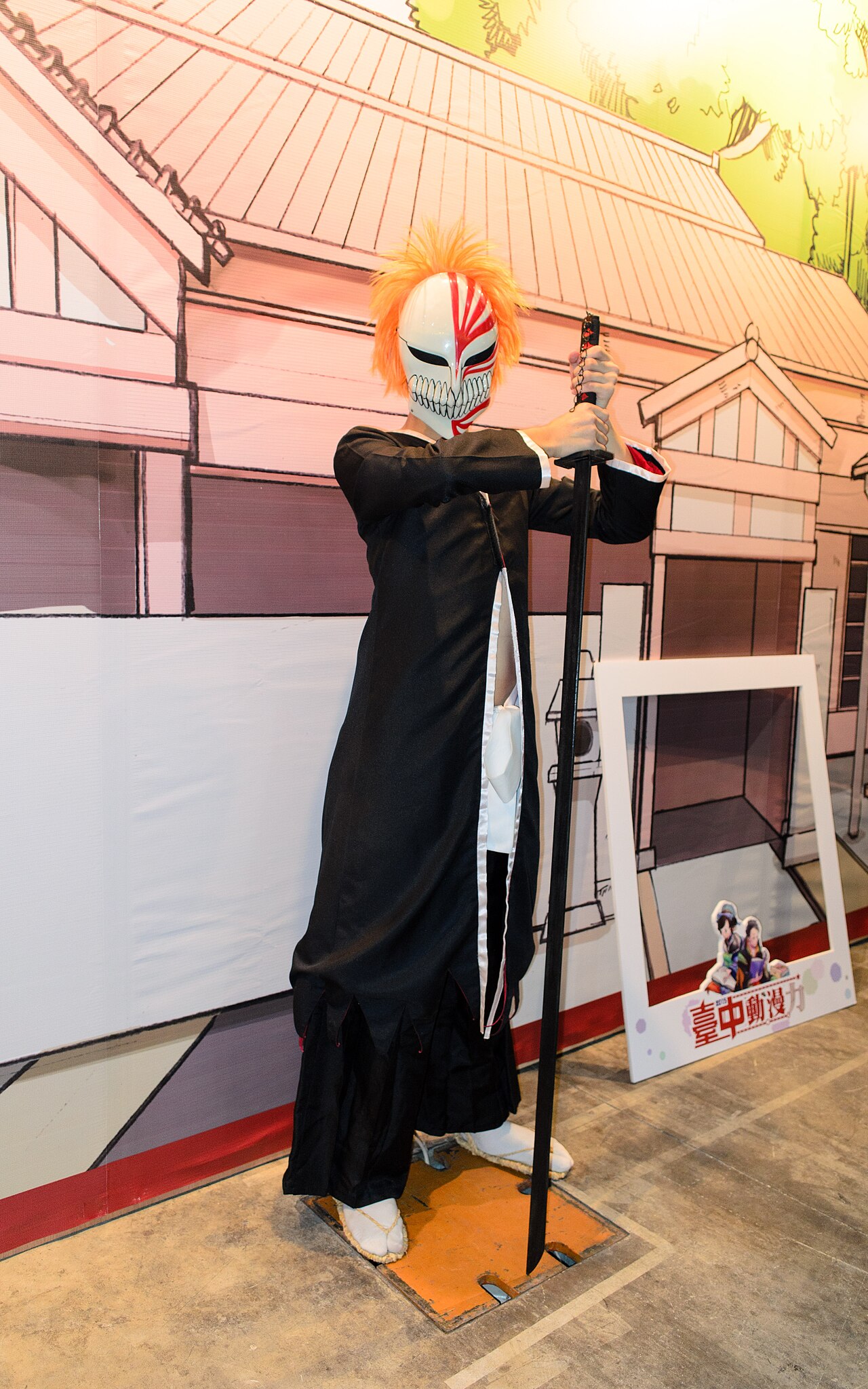
A cosplayer as Ichigo Kurosaki in his Soul Reaper robes and Hollow mask. Public domain, via Wikimedia Commons.
BLEACH (ブリーチ, Burīchi) is a Japanese 少年漫画 (shōnen manga) written and illustrated by Tite Kubo (久保帯人, Kubo Taito), serialized in Weekly Shōnen Jump from 2001 to 2016. It follows Ichigo Kurosaki (黒崎一護), an ordinary teenager who can see 幽霊 (ghosts), after he accidentally inherits the powers of a 死神 (shinigami, "Soul Reaper" or "Death God") named Rukia Kuchiki. As a substitute Soul Reaper, Ichigo takes on the job of guiding lost souls to the afterlife and fighting Hollows — corrupted spirits that devour human 魂 (tamashii, "souls") — while getting pulled deeper into the politics of Soul Society, the realm Soul Reapers govern.
The manga ran for 74 volumes and 686 chapters, selling well over 130 million copies worldwide. Alongside Naruto and One Piece, it forms anime's so-called "Big Three" (ビッグ3) — the trio of Weekly Shōnen Jump series that defined mainstream shōnen anime internationally through the 2000s. Its anime adaptation ran 366 episodes from 2004 to 2012, then went dormant for a decade before returning in 2022 to finally animate the manga's final arc.
The World of Souls and Hollows
BLEACH builds an elaborate afterlife cosmology out of Buddhist- and Shinto-flavored ideas about death and the soul. When a person dies, their soul becomes a Plus (プラス); a Soul Reaper performs Konsō (魂葬, "soul burial") to send it on to Soul Society (尸魂界, Soul Society, also called Seireitei 瀞霊廷 at its center), a parallel world resembling feudal-era Japan. If a Plus lingers too long in the human world (現世, gense) without being sent on, it can transform into a Hollow (ホロウ) — a mask-wearing monster driven by the endless hunger left behind by its regrets.
| Term | Reading | Meaning |
|---|---|---|
| 死神 | しにがみ | Soul Reaper; guides souls and destroys Hollows |
| ホロウ (Hollow) | ほろう | A corrupted lost soul that preys on the living and on other souls |
| 尸魂界 (Soul Society) | ソウルソサエティ | The afterlife realm Soul Reapers inhabit and protect |
| 護廷十三隊 (Gotei 13) | ごていじゅうさんたい | The thirteen military divisions that police Soul Society |
| 斬魄刀 (zanpakutō) | ざんぱくとう | A Soul Reaper's living sword, the source of their fighting power |
| 卍解 (bankai) | ばんかい | A zanpakutō's final, most powerful released form |
Every Soul Reaper wields a zanpakutō (斬魄刀, literally "soul-cutting sword"), a sentient weapon with its own name and spirit. In battle, a Soul Reaper can unlock two levels of released power: Shikai (始解, "initial release") and, for the most elite fighters, Bankai (卍解, "final release") — a dramatically more powerful transformation that becomes one of the series' signature spectacle moments. Ichigo's own 覚醒 (kakusei, "awakening") of these powers, layered with a second, monstrous Hollow side born from his mixed human-Soul Reaper-Hollow heritage, drives much of his internal 精神 (seishin, "spirit/mind") struggle across the story.
己で斬り拓け、その道を。 (Onore de kirihirake, sono michi o.) "Cut your own path open, with your own hands."
This line, spoken to Ichigo by his zanpakutō spirit, captures BLEACH's recurring theme: 力 (chikara, "power") only means something when a character chooses, deliberately, what to protect with it.
Structure and the Thousand-Year Blood War
The manga's 連載 (rensai, "serialization") unfolds across several major arcs — the Soul Society arc, the Arrancar/Hueco Mundo arc, the Fullbringer arc — before culminating in its final saga, Thousand-Year Blood War (千年血戦篇, Sennen Kessen-hen), which pits Soul Society against the Wandenreich, an army of god-like Quincy warriors bent on wiping out Soul Reapers entirely. The manga completed this arc in 2016, but the 2004–2012 anime had stopped one arc short, leaving the ending unanimated for a decade — a famously painful gap for fans who wanted to see it on screen.
Studio Pierrot's anime finally adapted Thousand-Year Blood War starting in October 2022, splitting it into four seasonal cours released through 2023, 2024, and into 2025, each treated as a major streaming event on Disney+/Hulu (English-language territories) and other platforms. This slow-burn, multi-year rollout of the finale is the direct reason BLEACH — a series whose manga ended in 2016 — is back in active cultural conversation nearly a decade later, introducing the 仲間 (nakama, "comrades") of Ichigo's story to viewers who never got the original conclusion.
Cultural Impact
BLEACH's footprint, in Japan and internationally, includes:
- A defining Toonami-era import: Along with Naruto, BLEACH aired on Cartoon Network's Toonami programming block in the 2000s, becoming a formative gateway anime for a generation of Western fans alongside Dragon Ball Z before it.
- Fashion and design influence: Kubo's high-contrast art style — sharp linework, streetwear-inflected costume design, and Ichigo's spiky orange hair — is frequently cited by other manga artists and fashion designers as an influence distinct from the more traditional shōnen look of its Big Three peers.
- Convention culture: Ichigo's black shihakushō robes, Hollow mask, and oversized zanpakutō remain one of the most consistently popular cosplay choices at anime conventions worldwide, decades after the character's debut.
- Catchphrases and moves: Attack names like Getsuga Tenshō (月牙天衝, Ichigo's signature sword technique) are recognizable shorthand even among casual fans, echoed in memes and fan art referencing the anime's return.
- Games and merchandise: The Bleach: Brave Souls mobile game and various fighting-game adaptations kept the franchise commercially active through its decade-long anime hiatus, priming an existing audience for Thousand-Year Blood War's arrival.
Related Works
BLEACH belongs to the same Weekly Shōnen Jump generation as Naruto and One Piece, together forming the "Big Three" that shaped international shōnen fandom in the 2000s. Its focus on a young protagonist's 成長 (seichō, "growth") through escalating 対決 (taiketsu, "showdowns") and found-family bonds is a template later carried forward by series like Jujutsu Kaisen and Kimetsu no Yaiba, both of which draw on similar spirit-versus-human cosmologies.
See Also
- Naruto, fellow "Big Three" series and Weekly Shōnen Jump stablemate
- One Piece, fellow "Big Three" series and Weekly Shōnen Jump stablemate
- Jujutsu Kaisen, a later series with a similar spirit-battling premise
- Otaku culture and fandom that has kept BLEACH's cosplay and convention presence alive for two decades
Related Dictionary Words
god of death; death deity; Death; Grim Reaper
soul; spirit; mind
ghost; specter; spectre; apparition; phantom
shōnen manga; boys' comics; manga aimed a younger male audience
this world; this life
waking up; awakening; arousal; revival
growth; development; growing up; becoming an adult
confrontation; showdown
serialization; serialisation; serial story
force; strength; might; vigour; vigor; energy
mind; spirit; soul; heart; ethos
companion; fellow; friend; mate; comrade; partner; colleague; coworker; associate