ダイソー
daisoJapan's largest 100-yen shop chain, famous worldwide for its enormous variety of cheap, surprisingly well-designed goods and its rapid overseas expansion.
Meaning
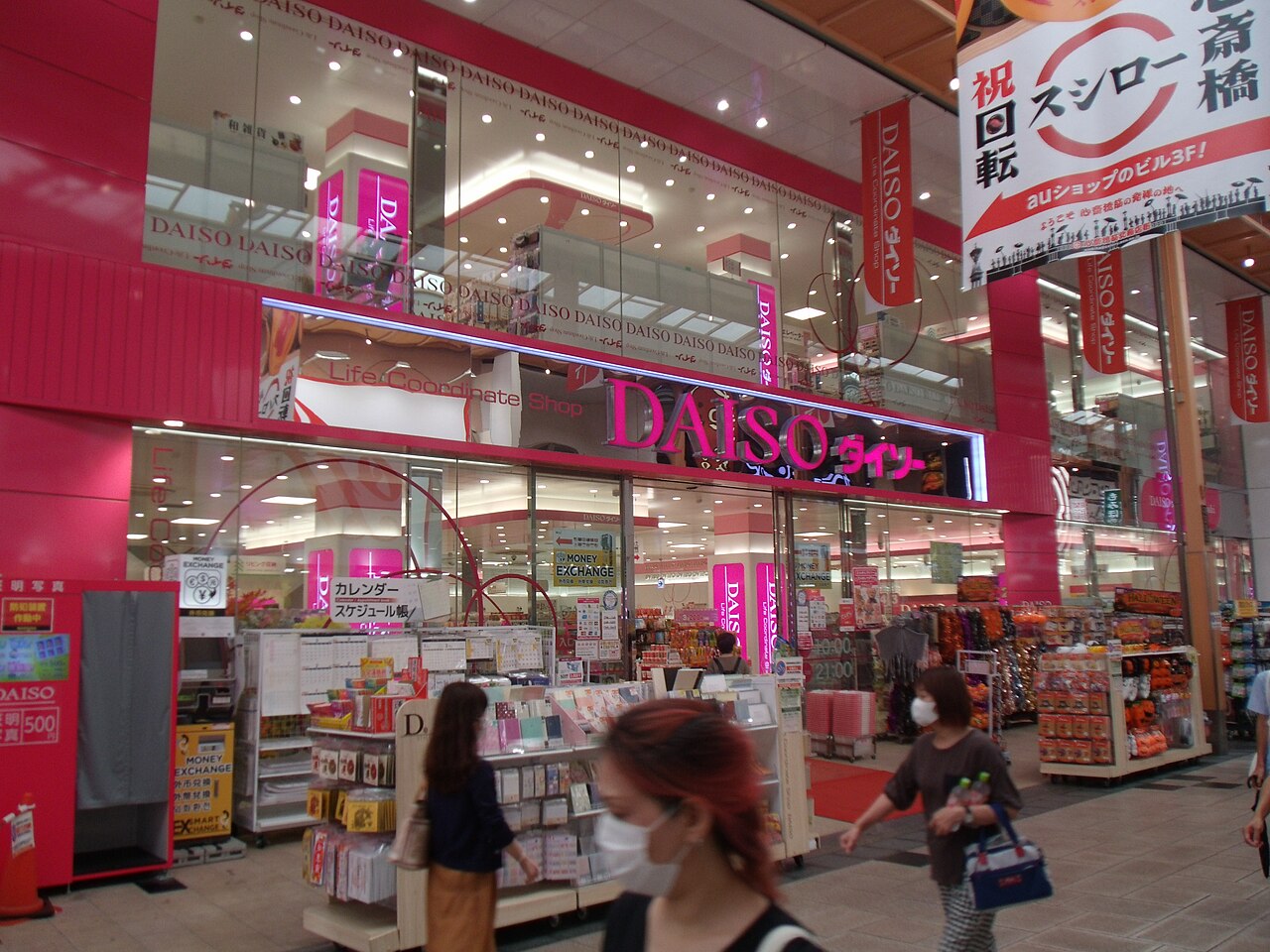
A Daiso storefront in Shinsaibashi, Osaka. Photo: Mr.ちゅらさん, CC BY-SA 4.0, via Wikimedia Commons.
ダイソー (Daisō), formally operated by 大創産業 (Ōsho Sangyō, "Daiso Industries"), is the largest chain of 百円ショップ (hyakuen shoppu, "100-yen shops") in Japan, with roughly 4,000 domestic stores and thousands more abroad. The name is a shortening of the founding slogan "daizei ni kansha suru sōgyōsha" (roughly "a founder who is grateful to the many"), though it is popularly explained simply as combining 大 ("big/great") with a play on the English word "store."
While 百円ショップ is the general Japanese concept of a fixed-price discount shop (comparable to a dollar store), Daiso is the specific brand that most people, in Japan and abroad, picture when they hear the term. It is often used almost generically, the way "Kleenex" stands in for tissues — someone might say they are "going to Daiso" even when they mean a 100-yen shop in general.
Usage
Daiso is typically used as a proper noun referring to the store itself, or to describe an item bought there.
ダイソーで買った収納ボックス、めちゃくちゃ使いやすい。 Daisō de katta shūnō bokkusu, mechakucha tsukaiyasui. "The storage box I bought at Daiso is incredibly easy to use."
今日はダイソーで文房具と雑貨を大量買いした。 Kyō wa Daisō de bunbōgu to zakka o tairyōgai shita. "I bought a ton of stationery and miscellaneous goods at Daiso today."
Internationally, English-speaking shoppers and crafters frequently use "Daiso" as shorthand for an entire genre of aesthetic — minimal, cute, practical Japanese design at a rock-bottom price — as in "this looks like something from Daiso."
Cultural Context
History
Daiso traces back to 1972, when founder Yano Hirotake began selling goods from the back of a truck at temporary markets and supermarket parking lots around 広島 (Hiroshima) Prefecture, pricing everything at 100 yen so he wouldn't have to carry a cash register or price-tag each item individually. The flat 100-yen model — since expanded to include 200, 300, and 500-yen product lines as raw material and shipping costs rose — became the company's defining trait. Daiso Industries was formally founded in 1977, and the first fixed-location Daiso store opened in the 1990s as the concept exploded across the country during Japan's post-bubble economy, when consumers newly prized frugality without sacrificing quality or design.
What sets Daiso apart
What distinguishes Daiso from smaller 100-yen rivals (Seria, Can Do, Watts) is sheer scale and range: a large Daiso branch can stock over 100,000 different SKUs across kitchenware, cosmetics, stationery, seasonal decorations, party supplies, gardening tools, and — increasingly — craft and hobby supplies (yarn, resin, beads, washi tape, planner stickers). This breadth, combined with an in-house product design and sourcing operation, lets Daiso turn around trend-responsive 商品 (products) fast while keeping unit 品質 (quality) surprisingly high for the price point — a reputation that has made "it's just from Daiso" a small badge of honor rather than an embarrassment among Japanese shoppers.
Global expansion
Daiso began 海外 (overseas) 進出 (expansion) in the late 1990s and now operates over 2,000 stores outside Japan across roughly 25 countries and regions — including large footprints in Taiwan, South Korea, China, Southeast Asia, Australia, the Middle East, and a fast-growing chain of stores across the United States (often through licensing/franchise partners rather than direct ownership). Because currency conversion and import costs make an exact 100-yen price impossible abroad, most international branches sell items at a flat local price instead (for example $1.50 in many U.S. stores), but keep the core identity: a vast single-aisle-per-category 店舗 (store) layout stuffed with small, affordable, nicely designed goods.
The devoted following
Daiso has an outsized fanbase among two overlapping groups: crafters and international travelers/expats. Crafting and scrapbooking communities on YouTube, TikTok, and Pinterest regularly produce "Daiso haul" videos, prizing the store for cheap 手芸 (handicraft) supplies that would cost far more at specialty craft retailers. Meanwhile, tourists visiting Japan often list a Daiso flagship — such as the multi-floor branch in Shibuya or Harajuku — as a must-visit stop, treating it almost like a souvenir superstore where an entire suitcase can be filled with kitchen gadgets, stationery, and snacks for a few thousand yen total. This reputation for "impossibly good value" is central to why Daiso, more than any other 100-yen chain, has become internationally recognized as shorthand for Japanese budget design culture.
Daiso vs. Other Retail Brands
| Brand | Category | Price positioning |
|---|---|---|
| Daiso | General 100-yen goods | Fixed ultra-low price (100–500 yen) |
| 無印良品 (Muji) | Minimalist lifestyle goods | Mid-range, no-brand aesthetic |
| ニトリ (Nitori) | Furniture & home goods | Budget-to-mid furniture retailer |
| ドン・キホーテ (Don Quijote) | Discount variety store | Mixed pricing, maximalist chaos |
| 東急ハンズ (Tokyu Hands) | Specialty hobby/DIY | Higher-end, curated selection |
Related Dictionary Words
miscellaneous goods; general goods; sundries
handicrafts
storage; putting away
stationery
quality (of a product or a service)
Hiroshima (city, prefecture)
foreign; abroad; overseas
advance (into a new market, industry, etc.); expansion (into); launch (into); entering; making inroads (into)
the world; society; the universe
shop; store; establishment; restaurant
commodity; article of commerce; goods; stock; merchandise