こけし
kokeshiSimple limbless wooden dolls from Japan's Tōhoku region, traditionally lathe-turned by onsen-town craftsmen as hot-spring souvenirs and now beloved in kawaii pop culture.
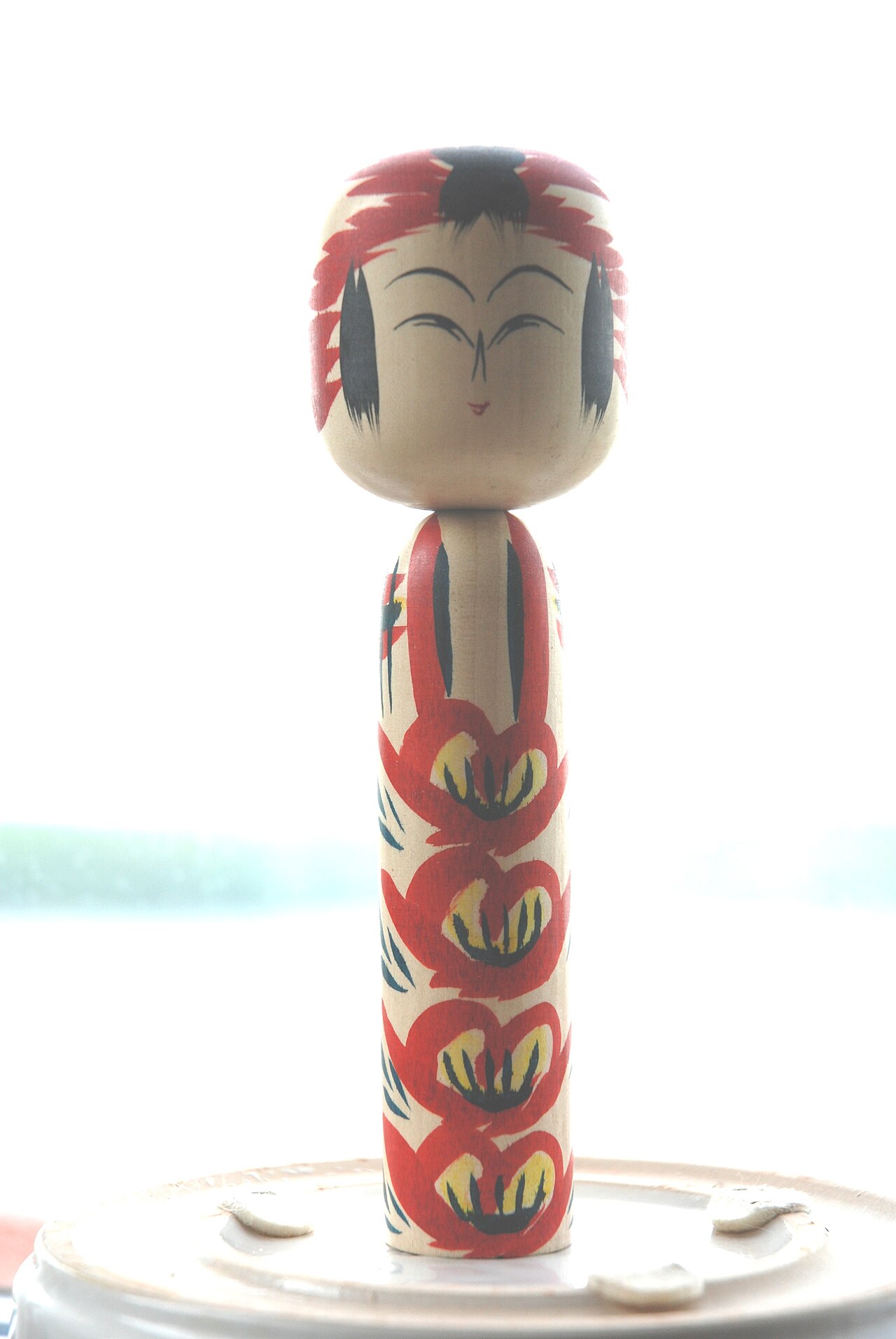
A traditional kokeshi, lathe-turned and hand-painted in the classic cylindrical style. Photo: Boberger, CC BY-SA 3.0, via Wikimedia Commons.
Meaning
こけし (kokeshi) are handmade wooden dolls with a round head and a simple cylindrical body — no arms, no legs, just a turned trunk of wood topped with a painted face. They come from the 温泉 (onsen, hot-spring) villages scattered across the 東北 (Tōhoku) region in northern Honshu, and for close to two centuries they have been one of Japan's most recognizable pieces of 郷土玩具 — regional folk toys tied to a specific place.
Unlike a carved figure, a kokeshi's form comes almost entirely from a lathe: the 木地師 (kijishi), woodturners originally trained to make bowls, trays, and other turned tableware, spin a block of wood on a rotating shaft and shape it with hand tools as it turns. The head and body are turned separately, joined, and then finished with painted patterns in black, red, and sometimes green or yellow ink, often sealed under a thin coat of wax. The result is deceptively simple — a doll with no limbs and only a suggestion of a face — yet the eleven recognized traditional lineages are each instantly identifiable to a trained eye by their proportions and motifs alone.
Traditional Regional Styles
Kokeshi are not a single uniform craft; they are a family of regional schools (kei, 系), each rooted in a particular onsen town and passed down within workshops for generations. Every lineage has its own conventions for head shape, body taper, and painted decoration, so a kokeshi can usually be traced to its home town on sight.
| Style (系) | Home area | Distinguishing features |
|---|---|---|
| Naruko (鳴子系) | Naruko Onsen, Miyagi | Head rotates with a squeak on the neck joint; chrysanthemum body patterns |
| Tsuchiyu (土湯系) | Tsuchiyu Onsen, Fukushima | Small head with a pinwheel-like mark on top; slender body |
| Yajirō (弥治郎系) | Yajirō, Miyagi | Beret-like striped cap pattern painted on the head |
| Tōgatta (遠刈田系) | Tōgatta Onsen, Miyagi | Large head, bold chrysanthemum or peony robes |
| Zaō/Takayu (蔵王系) | Zaō/Takayu, Yamagata | Considered the origin point of the craft; simple, sturdy forms |
| Sakunami (作並系) | Sakunami, Miyagi | Cross-shaped or "wa" patterns; smaller, delicate bodies |
| Kijiyama (木地山系) | Kijiyama, Akita | Diamond and plum-blossom patterns; wide-set eyes |
| Nanbu (南部系) | Nanbu, Iwate | Undecorated natural wood body; head sometimes rattles loosely |
| Tsugaru (津軽系) | Tsugaru, Aomori | Daruma-eyed faces; grape-vine or plum motifs |
| Yamagata (山形系) and Hijiori (肘折系) | Yamagata Prefecture | Chrysanthemum and camellia patterns with brighter color washes |
Because each school developed in near-isolation around its home onsen, collectors and researchers treat the eleven lineages as a kind of living taxonomy — a doll's face and pattern function almost like a regional dialect made visible.
Craft Technique: From Log to Doll
The material is usually 木製 — most often mizuki (dogwood), itaya-kaede (maple), or cherry — cut and dried for months before it can be worked. The kijishi mounts a rough-cut cylinder on a rokuro (lathe), traditionally foot- or water-powered and now usually electric, and shapes the head and body while the wood spins, using a series of specialized blades held steady against the turning wood. Once the two pieces are turned and joined, the doll is 手作り painted by hand — traditionally with the same brushes and mineral or aniline pigments used for generations within a workshop — before a final coat of wax is applied to protect and gloss the surface.
Because each stroke of the face and body pattern is freehand, no two kokeshi are perfectly identical, even from the same craftsperson. Many workshops sign and date each doll on the base, a practice that became common in the postwar decades as kokeshi shifted from anonymous folk craft toward named artisanship.
Onsen Souvenirs and Origin
Kokeshi-making is generally traced to the 江戸時代 (Edo period), when kijishi who had traditionally turned bowls and other everyday woodware for a living began also making small dolls to sell to travelers visiting the region's hot springs for tōji — extended therapeutic bathing stays. A simple, inexpensive wooden doll was an ideal souvenir: light for travelers to carry, distinctly local to the spring town where it was bought, and cheap enough for ordinary visitors rather than only the wealthy.
That original purpose — a memento of a specific onsen town — still shapes how kokeshi are sold today. Gift shops and craft co-operatives in Tōhoku hot-spring resorts continue to stock dolls in the local style alongside other regional 土産, and the annual All Japan Kokeshi Competition, held in Naruko Onsen since the 1940s, remains a major event for judging new work from across the traditional lineages.
Sōsaku Kokeshi: The Creative Movement
Starting in the early 20th century and accelerating after World War II, a second, distinct branch of the craft emerged: sōsaku kokeshi (創作こけし, "creative kokeshi"). Where traditional kokeshi follow the fixed conventions of a regional school, sōsaku kokeshi are one-off artistic works — the maker is free to depart from any established head shape, body proportion, or pattern.
This split mirrors a broader tension in Japanese folk craft between dentō (伝統, tradition-bound) production and individual artistic expression. Sōsaku kokeshi are typically signed, often more sculptural or abstract than their regional counterparts, and are collected and exhibited more as studio art objects than as tourist souvenirs — while traditional kokeshi remain tied to their home onsen and lineage.
Modern Kawaii Revival
After decades as a somewhat old-fashioned tourist curio, kokeshi found unexpected new life in the 2010s as a kawaii aesthetic motif. Their round heads, minimal faces, and pastel-friendly color schemes translate easily into stationery, phone cases, plush toys, and home décor, and craft hobbyists have taken up hand-painting blank wooden kokeshi bodies (sold as unpainted kits) as a beginner-friendly woodcraft activity. Character-goods makers have also produced kokeshi-shaped mascots and collaboration figures, and the dolls appear regularly in "cute Japan" gift shops in Tokyo and other major cities, well outside their original Tōhoku home.
This revival runs alongside — rather than replacing — the traditional craft. Regional workshops in Naruko, Tsuchiyu, and the other historic towns continue making kokeshi by hand in the old styles, even as simplified, mass-appeal versions of the same silhouette circulate as kawaii merchandise. The doll's stripped-down form, originally a byproduct of lathe technique and modest materials, turns out to translate remarkably well into contemporary minimalist and "cute" design.
Cultural Context
Kokeshi sit at an intersection of several threads in Japanese craft culture: they are a product of the 民芸 (mingei) folk-craft tradition that valorizes everyday, functional handmade objects; they are inseparable from onsen travel culture, since the doll's whole original purpose was to mark a visit to a specific spring town; and they now also function as a piece of nostalgic, retro-cute visual design. Their continued relevance — as regional craft, as competitive art form via sōsaku kokeshi, and as a kawaii icon — makes them a useful lens on how a single humble folk object can be read very differently depending on the era and audience encountering it.
Related Dictionary Words
woodturner
north-east
hot spring
local specialty or souvenir bought as a gift while travelling
folk toy; traditional toy
folk craft; folk art
handmade; handcrafted; homemade; homegrown
Edo period (1603-1868)
miscellaneous goods; general goods; sundries
ornament; decorative object
counter for large animals (e.g. head of cattle); counter for insects in a collection; counter for helmets, masks, etc.
trunk; torso; body; abdomen; waist
toy
woman; female
child; children
the whole country
hot spring district (within a town)
paper doll modeled after a kimono-clad woman