神輿
mikoshiA portable Shinto shrine carried through the streets on the shoulders of bearers during a matsuri, believed to transport a deity out of its home shrine so it can bless the neighborhood.
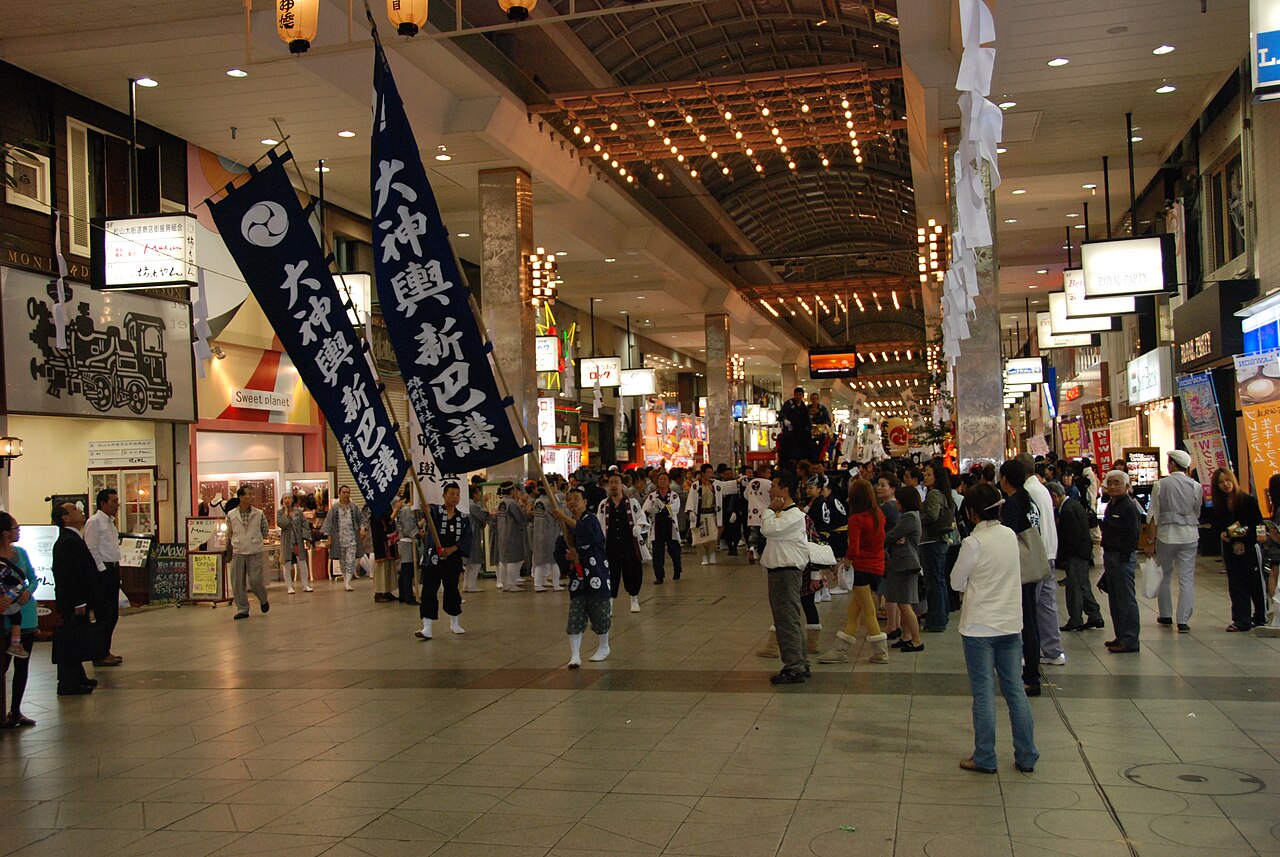
A mikoshi team shoulders the shrine's poles during an autumn matsuri. Photo: Maarten Heerlien, CC BY 2.0, via Wikimedia Commons.
Meaning
A 神輿 (mikoshi) — also read o-mikoshi (お神輿) with the honorific o- prefix — is a portable Shinto shrine, essentially a small, ornately decorated palanquin used to transport a deity (神, kami). Most mikoshi are built like miniature shrine buildings: a black-lacquered box or platform topped with a gilded roof, often crowned with a phoenix (鳳凰, hōō) ornament, and mounted on one or two long horizontal carrying poles.
The core belief behind the mikoshi is that during a festival, the resident kami of a 神社 (shrine) temporarily leaves its permanent home — the honden (本殿) — and takes up residence inside the mikoshi's central chamber, which houses a goshintai (御神体, a sacred object embodying the deity). Carried through the streets, the kami is thought to bring blessings, purification, and good fortune directly to the neighborhood and its residents, rather than requiring people to travel to the shrine.
Usage
Mikoshi are the centerpiece of countless matsuri (祭り) across Japan, especially in summer. A team of 担ぐ (katsugu, "to shoulder/carry") bearers — sometimes dozens of people per shrine — hoists the mikoshi onto their shoulders using the carrying poles and parades it through the local streets, often rocking, spinning, or bouncing it rhythmically as they go. This vigorous shaking is intentional: it's believed to energize the kami inside and amplify its power.
Bearers typically wear a matching 法被 (happi, a short festival coat) printed with the name of their neighborhood or shrine, and move to a chanted rhythm — most famously the call-and-response わっしょい (wasshoi), though regional variants like soiya or seiya are also common. This chanted 掛け声 (kakegoe) keeps the group's steps synchronized under the heavy load, since a large mikoshi can weigh well over a ton.
今年の祭りでは町内会が神輿を担いで練り歩いた。 Kotoshi no matsuri de wa chōnaikai ga mikoshi o katsuide neriaruita. "At this year's festival, the neighborhood association carried the mikoshi in a procession through the streets."
The procession usually starts and ends at the shrine, but many festivals include a stop at a 御旅所 (otabisho, literally "resting place for travel") — a temporary shrine partway along the route where the mikoshi and its kami pause before continuing on or heading home.
Cultural Context
The custom of carrying a kami's temporary vessel through town dates back over a thousand years, with early precedents recorded in the Nara and Heian periods, but the mikoshi parade format most familiar today took shape and flourished during the Edo period, when neighborhood associations (氏子, ujiko, meaning parishioners of a local shrine) organized elaborate processions as both religious observance and community celebration.
Participating in mikoshi-carrying is considered a form of communal 御霊 (goryō, spirit) veneration, but socially it functions as much more: it's a display of neighborhood pride, a rite of passage for young residents, and one of the few occasions when an entire community — merchants, families, and often visitors — physically works together toward a shared, literally weighty goal. Some of Japan's largest festivals, such as Tokyo's Sanja Matsuri at Asakusa and the Gion Matsuri in Kyoto, feature dozens of mikoshi from different neighborhoods converging in a single event, drawing enormous crowds.
Mikoshi differ from the larger, wheeled festival floats called dashi (山車) or danjiri (だんじり), which are pulled rather than carried. A mikoshi is meant to be borne on human shoulders precisely because the physical effort and shared discomfort are part of the offering — the exertion of the bearers is itself considered an act of devotion to the kami being transported.
Design and Construction
Mikoshi range enormously in size and craftsmanship, from small shrines carried by children's teams to massive, museum-quality structures requiring 40 or more bearers. Common features include:
| Element | Description |
|---|---|
| Hōō (鳳凰) | A gilded phoenix ornament atop the roof, symbolizing the auspicious arrival of the kami |
| Karahafu (唐破風) | Curved gable roofline echoing shrine architecture |
| Carrying poles | One main pole (shukan) or a rectangular frame of four poles, resting directly on bearers' shoulders |
| Lacquer and gold leaf | Black lacquer body with gold fittings, mirroring the finish of shrine buildings |
| Bells and mirrors | Small bells (suzu) and a mirror inside represent purity and the presence of the kami |
Building a mikoshi is a specialized craft passed down by shrine carpenters and metalworkers, and older or more famous mikoshi can be genuine cultural properties, restored and maintained by their neighborhood associations across generations.
Related Dictionary Words
mikoshi; portable Shinto shrine carried through the streets during festivals
festival; feast; matsuri
Shinto shrine
to shoulder; to carry on one's shoulder
god; deity; divinity; spirit; kami
spirit of a deceased person
shrine parishioner
shout (of encouragement, etc.); yell (used to time or encourage activity, e.g. "Heave ho!")
heave-ho!; heave!
happi coat; happy coat; workman's livery coat; traditional Japanese straight-sleeved coat
place where the sacred palanquin is lodged during a festival