巫女
mikoThe shrine maiden of Japanese Shinto tradition, recognizable by her white kosode and red hakama, who assists priests, performs sacred kagura dance, and staffs shrines selling omamori and omikuji.
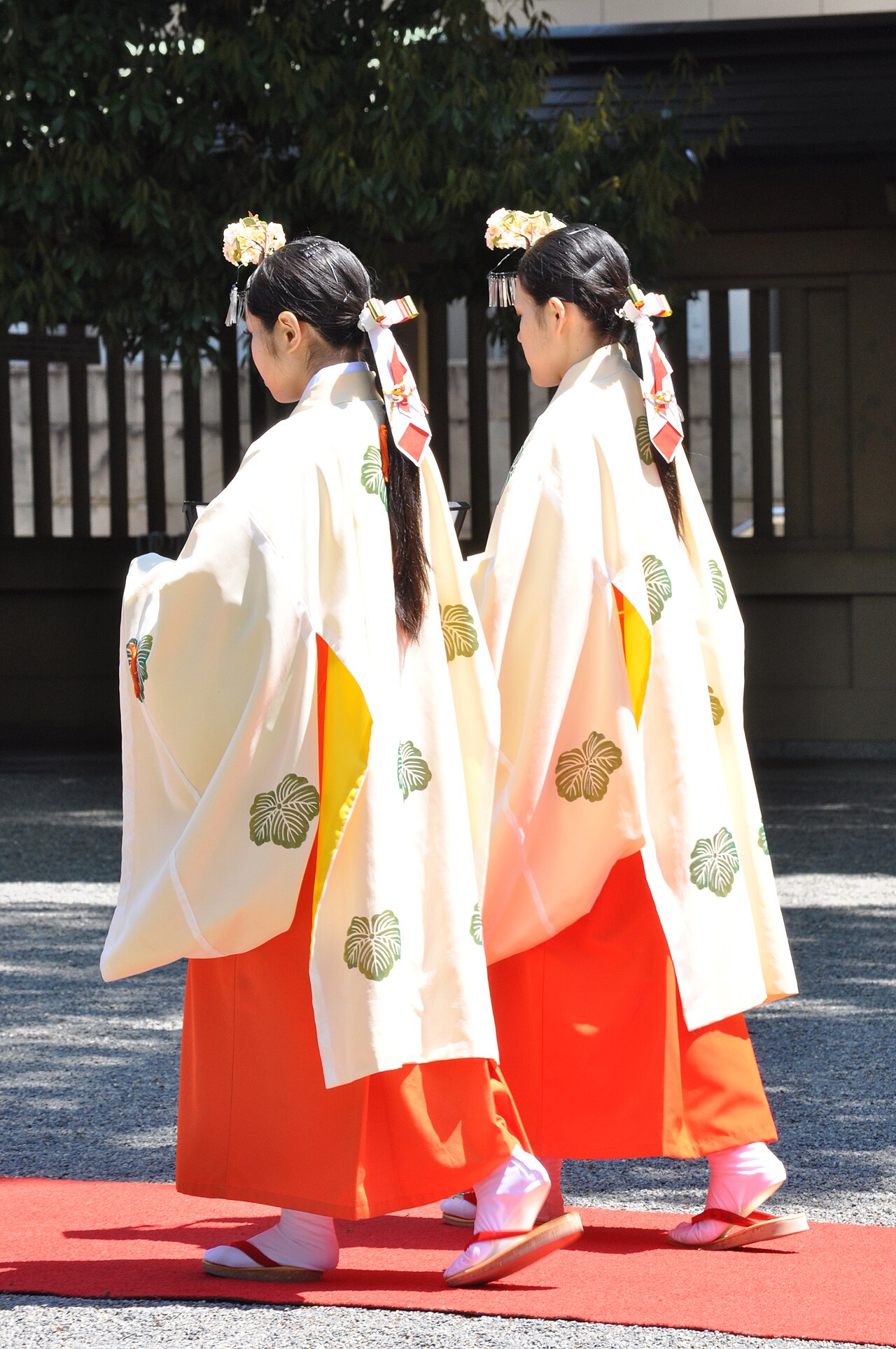
A miko in kagura dance attire. Photo: Ocdp, CC BY-SA 3.0, via Wikimedia Commons.
Meaning
巫女 (miko) is a young woman who serves at a 神社 (jinja, Shinto shrine), assisting the 神職 (shrine priests) with rituals, ceremonies, and the daily running of the shrine. The word combines 巫 ("shaman, medium") and 女 ("woman"), reflecting the role's ancient origins as a spiritual intermediary between the human and divine worlds.
Today's miko duties are broad and mostly ceremonial or administrative rather than mystical:
- Assisting priests during rites such as weddings, purification ceremonies, and festival services
- Performing 神楽 (kagura), a slow, ritualized sacred dance accompanied by bells, fans, or sacred branches, offered to the resident kami (deity)
- Purification duties, such as preparing offerings, tending the shrine grounds, and assisting worshippers with 参拝 (visits to pray)
- Staffing the shrine office, selling お守り (omamori, protective amulets), 御神籤 (omikuji, paper fortunes), and 破魔矢 (hamaya, decorative arrows for warding off evil), and inscribing goshuin (shrine stamps) in visitors' stamp books
Traditional Attire
The miko's dress is one of the most recognizable silhouettes in Japanese culture: a 白 (white) kosode — a simple, straight-sleeved robe worn as the top layer — paired with a bright 赤 (red) 袴 (hakama), the wide, pleated, skirt-like garment traditionally worn over kimono. Hair is usually tied back, often with a white or red ribbon, and for kagura performances a miko may add ornaments such as a paper wand (heisoku), hand bells (suzu), or a folding fan.
The color pairing carries meaning, not just decoration: white symbolizes purity and the sacred, while red is associated with life force and the warding off of evil — the same red seen in torii gates and the vermilion trim of many shrine buildings. This white-and-red 装束 (shōzoku, ceremonial dress) has barely changed in centuries and is standardized across nearly all shrines in Japan, though individual shrines sometimes add small regional or seasonal touches, such as floral hair ornaments in spring.
Historical Origins
The miko's role stretches back to Japan's prehistoric and early historic periods, well before organized 神道 (Shinto) existed in its current form. In ancient times, miko were shamanic figures — spirit mediums believed capable of communicating directly with kami or with the spirits of the dead through trance and possession, a practice known as kamigakari. The Kojiki and Nihon Shoki, Japan's oldest chronicles, describe legendary female shamans and even empresses who performed this mediumistic role, most famously the mythical dance of Ame-no-Uzume, sometimes considered the archetype of the miko.
Regional traditions of shamanic miko survived into the modern era in diminished form. The best known are the itako of the Tōhoku region — often blind women trained to channel the voices of the deceased for grieving families — a practice still associated with Mount Osore (Osorezan), though today only a handful of practitioners remain, mostly elderly.
During the medieval and Edo periods, some miko also worked as itinerant performers and diviners outside shrine grounds, but the Meiji government's official State Shinto reforms in the late 19th century reorganized and standardized the miko's duties, shifting the role firmly toward shrine-based ritual assistance rather than independent spiritual practice — largely the model that survives today.
A Modern, Largely Part-Time Role
Contemporary miko are, in most cases, not shamans or clergy at all. Becoming a priest (神主, kannushi) requires formal religious training and certification, but shrines have long hired young women — historically the unmarried daughters of priests, and today often local high school or university students — as miko-san for part-time or seasonal work. No spiritual calling or lineage is required; shrines simply need extra hands.
Demand spikes enormously around 初詣 (hatsumode), the New Year's shrine visit that draws tens of millions of worshippers in the first days of January. Major shrines such as Meiji Jingu or Fushimi Inari Taisha hire large numbers of temporary miko purely to handle the crowds — selling amulets, writing goshuin, and guiding lines of visitors — for a few weeks around the holiday. Some shrines also keep a small number of miko on staff year-round for weddings, festivals, and daily operations, while others hire additional seasonal miko for major festivals (matsuri) or for Shichi-Go-San in November.
Miko in Pop Culture
Few Shinto figures have crossed over into anime, manga, and games as thoroughly as the miko. The white-and-red outfit is instantly recognizable even to audiences with no knowledge of Shinto, which has made "miko" a durable character archetype: a shrine-keeper heroine who is calm, dutiful, and often secretly possesses spiritual or supernatural powers tied to her shrine role. Well-known examples span decades, from Kikyō and Kagome in Inuyasha and Sailor Mars (Rei Hino) in Sailor Moon, to Reimu Hakurei, the miko protagonist of the Touhou Project game series. Beyond named characters, generic "miko girl" designs are a staple of costume shops, cosplay, and seasonal video-game events set around New Year's or festival arcs.
This pop-culture visibility has, in turn, shaped how many people outside Japan first encounter the miko — often before ever learning about the role's religious or historical background — much as torii gates and omikuji become familiar shrine imagery through fiction before they're understood as living religious practice.
Related Shrine Culture
The miko's daily work connects directly to several other shrine customs: she typically hands out omamori and draws or sells omikuji, writes wishes on ema plaques or sells them to visitors, and is a fixture of the crowds during hatsumode. All of these customs sit within the broader framework of Shinto, Japan's indigenous religious tradition centered on kami and ritual purity.
Related Dictionary Words
miko; shrine maiden; young girl or woman (trad. an unmarried virgin) who assists priests at shrines
Shinto shrine
Shinto; Shintoism
Shinto priest; Shinto priesthood
kagura; traditional Shinto music and dancing
god; deity; divinity; spirit; kami
hakama; pleated skirt or loose-legged trousers worn over a kimono mainly on ceremonial occasions
charm; amulet; talisman
fortune slip (usu. bought at a shrine); omikuji
first shrine visit of the New Year
going and worshipping (at a shrine or temple); visit (to a shrine or temple to worship)
Shinto priest
costume; dress; attire